
Jean Perrin facts for kids
Quick facts for kids
Jean Perrin
|
|
|---|---|

Perrin in 1926
|
|
| Born |
Jean Baptiste Perrin
30 September 1870 |
| Died | 17 April 1942 (aged 71) New York City, US
|
| Resting place | Panthéon, Paris, France |
| Alma mater |
|
| Known for | Work on sedimentation equilibrium |
| Spouse(s) |
Henriette Duportal
(m. 1897; died 1938) |
| Partner(s) | Nine Choucroun (1938–42) |
| Children | Francis Perrin |
| Awards |
|
| Scientific career | |
| Fields | Atomic physics |
| Institutions | University of Paris (1897–1940) |
| Thesis | Rayons cathodiques et rayons de Röntgen. Études expérimentales (1897) |
| Doctoral advisors |
|
| Notable students | |
| Signature | |
 |
|
Jean Baptiste Perrin (born September 30, 1870 – died April 17, 1942) was a brilliant French scientist. He was an atomic physicist who helped us understand the tiny particles that make up everything around us. Perrin studied how very small particles move in liquids, a phenomenon called Brownian motion. His experiments proved Albert Einstein's ideas about this movement, confirming that atoms and molecules are real. For this important work, he received the Nobel Prize in Physics in 1926.
Contents
Discovering Jean Perrin: A Nobel Scientist
Early Life and Education
Jean Perrin was born on September 30, 1870, in Lille, France. He was a very bright student and attended a famous school in Paris called the École normale supérieure. After finishing his studies, he earned his doctorate from the Sorbonne in 1897. His research focused on cathode rays and X-rays, which were exciting new discoveries at the time. Soon after, he became a lecturer and then a professor at the Sorbonne, teaching physical chemistry.
Unlocking the Secrets of Atoms
Perrin's scientific journey was full of amazing discoveries that changed how we understand matter.
Proving Atoms Exist
In 1895, Perrin showed that cathode rays are made of tiny particles with a negative electric charge. This was a big step in understanding electricity. He also found ways to calculate the Avogadro constant, a number that tells us how many particles are in a certain amount of a substance.
One of his most famous achievements was proving the existence of atoms. For a long time, scientists debated whether atoms were real or just a useful idea. In 1905, Albert Einstein published a theory explaining Brownian motion – the jiggling movement of tiny particles in a liquid – as proof of atoms bumping into them. Perrin, working with his colleague Joseph Ulysses Chaudesaigues, performed careful experiments that matched Einstein's predictions perfectly. This work finally convinced the scientific world that atoms and molecules are real, ending a long debate. This groundbreaking research earned him the Nobel Prize in Physics in 1926.
Energy from the Stars
Perrin also thought about how stars get their energy. In 1919, he suggested that nuclear reactions inside stars could power them for billions of years. He realized that if four hydrogen atoms combine to form one helium atom, a small amount of mass is lost. According to Einstein's famous equation, E=mc², this lost mass is converted into a huge amount of energy. This idea, called nuclear fusion, explained how stars like our Sun shine so brightly for such a long time.
Building Science for the Future
Perrin was not just a researcher; he was also a visionary who wanted to make science accessible and well-supported. In 1927, he helped create the Institut de Biologie Physico-Chimique, a research institute focused on the intersection of biology and chemistry.
Later, in 1937, he established the Palais de la Découverte, a popular science museum in Paris. This museum allowed people of all ages to explore scientific concepts through interactive exhibits.
Perrin is also considered a founder of the Centre National de la Recherche Scientifique (CNRS), which is France's largest government research organization. He strongly believed that scientific research needed better organization and funding. His efforts led to the creation of this important institution, which continues to support scientific discoveries in France today.
A Life Dedicated to Science
Jean Perrin was a dedicated scientist and a thoughtful person. He held personal beliefs as an atheist and a socialist. He served as an officer in the Engineer Corps during World War I, helping to coordinate scientific efforts for national defense.
He married Henriette Duportal in 1897, and they had a son named Francis, who also became a physicist. After Henriette's passing in 1938, Nine Choucroun became Perrin's partner.
During World War II, when the Germans invaded France in June 1940, Perrin and Nine had to leave their home for safety. They traveled across the ocean to New York City, arriving in December 1941.
Perrin passed away on April 17, 1942, in New York City at the age of 71.
After the war, in 1948, his remains were brought back to France. He was laid to rest in the Panthéon in Paris, a special place where many of France's most honored citizens are buried.
Works
Jean Perrin wrote many important books and papers during his career. Some of his notable works include "The Atoms" (Les Atomes) and "Matter and Light" (Matière et lumière). These publications helped explain complex scientific ideas to a wider audience.
Images for kids
-
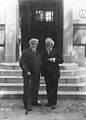
Ioan Cantacuzino (left) with Perrin in 1931
-
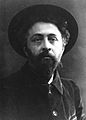
Jean Perrin in 1908
-
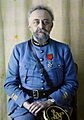
Autochrome portrait by Auguste Léon, 1918
-
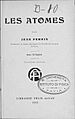
Atomes, 1913
.jpg)


