
Kalevala (corvette) facts for kids
The Kalevala was a special ship, a propeller-powered corvette (a type of warship) that belonged to the Finnish navy. It was built in 1858 at the Turku Old Shipyard in Finland. From 1860 to 1865, the Kalevala served in the Russian Pacific Fleet. At that time, Finland was an autonomous grand duchy (meaning it had its own government but was part of the Russian Empire).
Contents
Building and Launching the Kalevala
The Kalevala was designed by a ship designer named Jörgensen. He worked under the guidance of Finnish Vice Admiral Johan Eberhard von Schantz. The money for building the ship came from the Senate of Finland. The ship cost 342,804 Russian silver rubles. (The Finnish Markka became Finland's money starting in 1860).
The Kalevala had 15 cannons and weighed 1500 tons. It was launched into the water on July 2, 1858. In December 1858, the Finnish Military hired people to work on the ship, like machinists and boiler-men. In early summer 1859, the ship's steam engines were tested in the Baltic Sea near Kronstadt.
Finnish Baron Otto Carpelan was the ship's first captain. Paul Karl Toppelius, another Finn, became the head of the officers.
Kalevala in the Russian Pacific Fleet
Kalevala's Journey to the Russian Far East
In 1858 and 1860, Russia gained more land in the Far East through peace treaties. Because of this, the Kalevala was sent to serve in the Russian Pacific Fleet. Its new home port was Nikolayevsk-on-Amur on Russia's Pacific coast.
Captain Otto Carpelan remained the captain for the long journey from Kronstadt in the Baltic Sea to the Pacific Ocean. The trip began on October 18, 1860. The Kalevala sailed with two other corvettes, the Bogatyr and Rynda, and two fast ships called clippers. One clipper, the Abrek, was built in Pori, Finland. The other, Gaidamak, came from England.
Rear Admiral Andrei Alexandrovitš Popov led this group of ships. Other captains who later commanded the Kalevala included Vladimir Davydov and Fedor Želtuhin.
In June 1861, the crew of the Kalevala helped build the first church in Vladivostok. This was a year after the first Russian military camp was set up there. In 1863, the Kalevala's crew mapped the islands around Vladivostok. A bay in the area was even named after the Kalevala.
Finnish Sailors in Russian America
Russian America was the name for Russia's lands in North America from 1733 to 1867. This area is now Alaska and some settlements in California and Hawaii. The Russian-American Company (RAC) managed these lands.
Many Finns worked as sailors for Russia. They sailed Russian naval ships and deep-sea vessels. From the early 1800s, many of these ships were crewed by Finnish sailors. From 1840 onwards, ships sailing around the world for the Russian-American Company were entirely manned by Finnish captains and crews. Finnish sailors knew the coasts of North and South America very well. They also knew the Asian coast.
Some Finnish sailors became very successful. For example, Gustaf Nybom (later Niebaum) founded Inglenook wineries, and Otto Wilhelm Lindholm became very wealthy in Vladivostok.
Finnish leaders also managed Russian America. Arvid Adolf Etholén was a manager from 1840-1845, and Johan Hampus Furuhjelm from 1859-1864. Both were high-ranking naval officers.
In 1817-1818, Arvid Adolf Etholén captained the Russian frigate Kamchatka from Kronstadt to Sitka, which was the capital of Russian America. As a captain, Etholén sailed to California and the Hawaiian Islands. He also explored and mapped parts of Alaska between 1821 and 1823.
In 1839, the Sitka Lutheran Church was founded in Sitka, Alaska. This was the first Protestant church on the Pacific coast. Finns and other Lutherans working for the Russian-American Company started it. Three Finnish pastors served this church from 1840 to 1865.
In 1841, while Arvid Adolf Etholén was governor, the Russian-American area of Fort Ross in Bodega Bay, California, was sold. Later, in 1848, gold was discovered on this land, leading to the famous California Gold Rush. News of the gold spread partly because of the sailors working for the Russian-American Company.
Johan Hampus Furuhjelm became the Chief Manager of Russian America in 1858. He stopped conflicts with the native people in Alaska. He also ended a difficult "Ice Treaty" where Russian America had to sell ice to San Francisco. The ice often melted on the way, making it a bad deal. Furuhjelm arranged a better contract to sell ice.
Finnish leaders like Etholén and Furuhjelm helped prepare the way for the United States to buy Alaska. Finnish Sea Captain Gustave Niebaum, who was Russia's Consul in San Francisco, played a key role in the final deal that made Alaska part of the United States in 1867. Today, you can still find places named after Etholén, like Etolin Island.
Kalevala in San Francisco in 1861
During and after the California Gold Rush, many Finns settled in San Francisco. So, when the Finnish corvette Kalevala arrived in San Francisco on November 14, 1861, it received a very warm welcome.
The Kalevala stayed in San Francisco over the Christmas holidays. On Christmas Day, the city of San Francisco gave the officers of the Kalevala a Flag of the United States as a gift. A big dinner party was held for the officers on December 27, 1861, at Platt's Hall. This party showed how much the people of San Francisco appreciated the friendly spirit of the Russian Emperor towards the U.S. government during the American Civil War.
Kalevala in San Francisco in 1863-1864

In 1863, a group of six Russian Imperial Navy ships, including the Finnish-built corvette Kalevala, sailed to the West Coast of the United States. They came to help protect the waters there from possible attacks by the United Kingdom or France during the American Civil War (1861-1865).
This group of ships included the Kalevala, three other corvettes (Bogatyr, Rynda, and Novik), and two Finnish-built clippers (Abrek and Vsadnik). Both clippers were built in Pori, Finland. Finnish officers like Theodor Kristian Avellan, who later became a very important naval minister, were part of this group.
Rear Admiral Andrei Alexandrovich Popov commanded these six ships. They arrived in San Francisco starting on October 12, 1863. While the Russian fleet was visiting, a large fire broke out in downtown San Francisco. It destroyed a whole block of buildings and caused about $300,000 in damage.
400 sailors from the Russian fleet helped the local firefighters battle the blaze. Sadly, six Russian sailors lost their lives. The San Francisco Fire Department had no casualties. The people of San Francisco gave gold medals to the wounded sailors and special thanks to Lieutenant Etholén (not the former governor).
On October 17, 1863, a dinner was held for the 35 officers of the Russian fleet. Even though the tickets cost $100 (which was very expensive then), many San Francisco residents attended. The local newspaper, The San Francisco Chronicle, still talked about how wonderful the reception was 50 years later.
The Russian ships left San Francisco in August 1864 and returned to Kronstadt in 1865. The Kalevala was removed from active service in 1872.
Russian Baltic Fleet on the U.S. East Coast in 1863-1864
Another group of six Russian ships, from the Russian Baltic Fleet, arrived on the U.S. East Coast just days before the Pacific Fleet reached the West Coast. This Baltic Fleet arrived in New York City starting on September 24, 1863. Rear Admiral Stepan Lesovski commanded them.
Their arrival gave a much-needed boost to the Union Army, which had just suffered a big defeat in the Battle of Chickamauga. The Russian Baltic Fleet stayed in American waters for seven months, visiting cities like Boston, Minneapolis, and Washington D.C..
These two Russian navy expeditions to North America during the U.S. Civil War were the only direct foreign military support that President Abraham Lincoln and the Union Army received during the entire war. The Union navy was mostly in the Atlantic, so the help from the Russian Imperial Navy was very important. It helped protect the U.S. West Coast when there was a fear of Confederate ships attacking San Francisco.
Images for kids
-
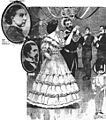
A festive dinner party arranged in honor of Admiral Popoff and the naval officers of the Russian Pacific Fleet visiting San Francisco in 1863.
