
Monastir offensive facts for kids
Quick facts for kids Monastir offensive |
|||||||
|---|---|---|---|---|---|---|---|
| Part of the Macedonian front of World War I | |||||||
 The Macedonian Front in 1916 |
|||||||
|
|||||||
| Belligerents | |||||||
| Commanders and leaders | |||||||
|
|
||||||
| Strength | |||||||
|
|
||||||
| Casualties and losses | |||||||
|
|
||||||


The Monastir offensive was a big military operation during World War I. It happened between September and December 1916. The Allied Powers fought against the Central Powers on the Macedonian front. The main goal was to break the tough fighting situation. They also wanted to make Bulgaria give up and help Romania.
This offensive was a huge battle that lasted for three months. It ended when the Allies captured the town of Monastir. The Bulgarian First Army (later the German Eleventh Army) fought hard. They had to retreat five times out of six major battles. The fighting moved the front line about 50 kilometers.
Contents
Why the Battle Happened
In August 1916, Romania joined the war on the Allied side. Romania planned to attack Transylvania and left its 3rd army to guard the border with Bulgaria. The Allies wanted to launch a big attack on the Macedonian front. This would help Romania and keep Bulgarian forces busy.
The Bulgarian leaders thought an attack was coming. Fighting near Doiran in August confirmed their suspicions. Bulgaria had wanted to attack in Macedonia for a while. They planned to strike both Allied sides with their First Army and Second Army. Germany also agreed to this plan.
Early Attacks and Changes
On August 17, the Bulgarians launched their own attacks. These were called the Chegan and Struma offensives. On the left side, the Bulgarian Second Army moved easily. They took Greek land up to the Struma river. On the right, the Bulgarian First Army captured Lerin. They kept moving despite strong Allied resistance.
But their advance soon stopped. The attack was called off on August 27. Bulgarian forces were told to dig in and defend. This early Bulgarian attack changed the plans of Allied General Sarrail. He had to delay his own offensive.
The need for an Allied attack became even more urgent in early September 1916. This was because the Bulgarian Third Army won big victories. They defeated Romanian and Russian forces in battles like Tutrakan and Dobrich.
Who Fought in the Battle
By September 1916, the Allies had a very large army. They had 6 Serbian, 5 British, 4 French, 1 Italian, and 1 Russian infantry division. This army had between 369,000 and 400,000 soldiers. They also had many weapons, including 1,025 artillery guns and 1,300 machine guns.
The Central Powers first faced these forces with the Bulgarian First Army, German Eleventh Army, and Bulgarian Second Army. They had 172 infantry battalions and about 900 artillery guns. There were also other Bulgarian forces guarding the Aegean coast.
General Sarrail planned to attack the right side of the Bulgarian First Army. He would use his Serbian, French, Russian, and Italian forces. The British would make smaller attacks to keep Bulgarian and German troops busy.
The Battle Begins
First Attacks and Key Positions
On September 12, the Allies started their attack. They fired artillery for two days. Then, the Serbian Third Army and the French Army of the Orient attacked. They fought against the Bulgarian 8th Tundzha Infantry Division. The Bulgarians soon had to retreat towards Lerin on September 14. They left some of their artillery behind. The Serbians took Gornichevo.
On September 12, the Serbians also began attacking the Kaimakchalan ridge. This ridge was very high, about 2,300 meters. The British also started fighting on the Struma front. They tried to expand their positions there.
The Bulgarian First Army's western side managed to hold the Allies. They held the line between Lerin and Kajmakcalan. But the Allies kept attacking. On September 23, after heavy fighting, the French entered Lerin. The Bulgarians still held Kajmakcalan. Serbian troops, with strong French artillery, attacked them. The fighting was very costly for both sides. The rocky ridge offered little cover from machine gun fire or artillery.
Changes in Command
The Bulgarian losses made their leaders and the German leaders pay more attention. Important changes were made in the command. On September 27, General Kliment Boyadzhiev was replaced. General Dimitar Geshov became the new commander of the First Army. The army also swapped its headquarters with the Eleventh Army. This army was led by General Arnold von Winkler.
Later, General Otto von Below arrived at the front. On October 16, he set up Army Group Below. This group included both the Eleventh and First Armies.
On September 30, after 18 days of hard fighting, the Serbian Drina Division finally captured Kajmakcalan. They took it from the tired Bulgarian 1st infantry brigade. This created a hole in the Bulgarian defenses. The German and Bulgarian leaders thought this loss was permanent. General Winkler ordered his troops to pull back to a new defensive line.
Fighting on Other Fronts
Around this time, the Allies were moving troops to attack Monastir. The commander of the Bulgarian Second Army, General Todorov, wanted to attack across the Struma river. This would help the Bulgarians and Germans fighting further west. However, the Bulgarian high command did not allow the attack.
This delay allowed the British to strengthen their positions. On September 30, they secured the left bank of the Struma near Karacaköy. On October 3, the 10th (Irish) Division attacked Bulgarian positions. They fought in the village of Yenikoy. The battle lasted all day. The Bulgarians fought fiercely and retook the village twice. Finally, the Irish division took it after a third attack that night. Both sides had many casualties from artillery and machine gun fire. After this, no major operations happened on the Struma front.
Getting Ready for the Final Push

A big problem for the Bulgarians was that their army was spread out. They had troops from Dobruja to Macedonia and Albania. The Bulgarian leaders asked their German allies for help. Germany had few extra soldiers because of other big battles. So, they asked the Ottoman Empire for help.
The Ottoman Empire sent two divisions to Macedonia. These were the 50th Division (about 12,000 men) and the 46th Division (about 12,600 men). They arrived in October and November. These forces helped free up some Bulgarian troops. These Bulgarian troops could then reinforce the Eleventh Army.
On September 30, General Joffre told General Sarrail about a new Romanian and Russian attack. This attack would be against the Bulgarian Third Army in Dobrudja. General Sarrail planned to coordinate his attack with this new push. He wanted to hit the Eleventh Army's Kenali line and try to knock Bulgaria out of the war.
On October 4, the Allies attacked. The French and Russians moved towards Monastir – Kenali. The Serbian First and Third Armies attacked along the Kenali – Cherna Loop line. The Serbian Second Army attacked towards Dobro Pole. The Allies had more soldiers and artillery in this area than the Central Powers.
The Fall of Monastir

The Battle of the River Cherna began with the Serbians trying to cross the river. Their progress was slow. Further west, the first French and Russian attacks were pushed back. Over the next few weeks, the battle became a series of attacks and counter-attacks. The Allies slowly gained ground because they had more artillery.
The Bulgarian and German leaders tried to stabilize the situation. They sent more troops to the Eleventh Army. These troops came from the First and even the Second Army. Many Bulgarian and German infantry regiments fought hard in the Cherna Loop battle. The French and Russians broke through near Kenali by the end of October. But the Bulgarians and Germans soon stopped them. The Italian division also joined the attacks around Monastir.
_-_Monastir_(anciennement)_;_Bitola_(actuellement)_-_M%C3%A9diath%C3%A8que_de_l%27architecture_et_du_patrimoine_-_APOR077002.jpg)
By this time, General Below decided to give up Monastir. On November 18, General Winckler ordered the Eleventh Army to retreat. They moved to new positions north of Monastir. The Bulgarian commander, General Nikola Zhekov, did not agree with this decision. But he could not stop it.
On November 19, French and Russian soldiers entered the town. The Bulgarians set up a new strong defense line. This line was attacked right away. But this time, the new position held firm. The Allies were tired and had trouble getting supplies. All French and Serbian attempts to break through failed. As winter began, the front line became stable. On December 11, General Joffre called off the offensive.
What Happened After the Battle
During the offensive, the Allies had about 50,000 soldiers wounded or killed. Most of these were Serbians. Also, about 80,000 Allied troops died or had to leave due to sickness. This means the total Allied losses were as high as 130,000 men. This was about a third of all Allied forces in the area. The front line moved only about 50 kilometers. The offensive did not stop Romania's defeat or make Bulgaria leave the war.
The Bulgarians and Germans had about 61,000 casualties. Even though Monastir was lost, the new positions north of the town were excellent for defense. Bulgarian artillery could easily control the town from there. This line stayed strong until the end of the war in Macedonia. The forces there only retreated when the Allies broke through at Dobro Pole.
However, the offensive did bring some good news for the Serbians. Their troops managed to return to their country's border. The Bulgarians and Germans were also proud of how well they fought against the larger Allied forces. General Nikola Zhekov even called the Battle of the River Cherna "legendary." He said the Bulgarian defense was very strong, even with many losses.
Images for kids
-
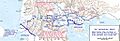
The Macedonian Front in 1916
-
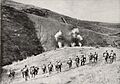
Bulgarian infantry attack in the Monastir area.
-
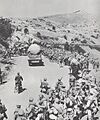
General Dieterichs' Russian brigade on the march in Macedonia
-
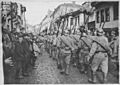
French troops in Monastir, 22 November.
