
Piano2 facts for kids
|
A grand piano
An upright piano
|
|
| Keyboard instrument | |
|---|---|
| Hornbostel–Sachs classification | 314.122-4-8 (Simple chordophone with keyboard sounded by hammers) |
| Inventor(s) | Bartolomeo Cristofori |
| Developed | Early 18th century |
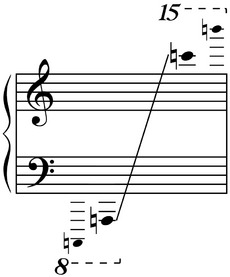
| Playing range | |
 |
|
A piano is a popular keyboard instrument that makes sound when someone presses its keys. Pressing a key triggers a small padded hammer to strike tightly stretched strings inside. Most modern pianos have 88 black and white keys. A musician who plays the piano is called a pianist.
Pianos come in two main styles: the horizontal grand piano and the compact upright piano. Grand pianos provide a richer sound and are common on concert stages. Upright pianos take up much less floor space, making them ideal for homes and classrooms.
Musicians play the piano in almost every musical style, including classical music, jazz, pop music, and rock music. It is also one of the most useful tools for composing new songs and teaching music theory.
Contents
History of the Piano
How Was the Piano Invented?

Before the piano, keyboard players mainly used the pipe organ, the clavichord, and the harpsichord. The harpsichord plucked its strings, so players could not change how loudly or softly a note sounded by pressing harder or softer.
Around the year 1700 in Italy, an instrument maker named Bartolomeo Cristofori invented the first piano. He created a clever mechanical system where hammers hit the strings and immediately bounced away. This design allowed strings to vibrate freely and let players control volume through finger pressure. Cristofori called his creation pianoforte, which means "soft and loud" in Italian.
Early Developments and Improvements

German builder Gottfried Silbermann improved Cristofori's design by creating the first version of the sustain pedal. Famous composers like Johann Sebastian Bach and Wolfgang Amadeus Mozart played early pianos, known today as fortepianos.
During the Industrial Revolution in the 19th century, piano makers used stronger materials to improve the instrument:
- Strong cast iron frames were added to hold tons of string tension.
- High-strength steel piano wire replaced weaker iron wire.
- Thick wool felt replaced leather covers on the hammers.
- Sébastien Érard invented a repetition mechanism so pianists could replay notes rapidly.
-
Broadwood grand square action.svg
Broadwood square action
-
Erard double pilot action.svg
Erard square action

Main Types of Modern Pianos
Grand Pianos

In a grand piano, the frame and strings lie flat and horizontal. Gravity naturally pulls the hammers back after each strike, giving the player great control over fast notes.
Grand pianos are built in different sizes:
- Baby grand: around 1.5 m (4 ft 11 in) long, great for small studios.
- Parlor grand: 1.7 to 2.2 m (5 ft 7 in to 7 ft 3 in) long, used in homes and small halls.
- Concert grand: 2.2 to 3 m (7 ft 3 in to 9 ft 10 in) long, used in large auditoriums for the best tone.
Upright Pianos

Upright pianos have vertical frames and strings running up and down. Small springs pull the hammers back into place.
Because they stand flat against a wall, uprights take up far less space than grands. They are the most common acoustic pianos found in schools, churches, and houses.
Electronic and Digital Pianos

Modern technology has created several electronic alternatives:
- Electric pianos use mechanical parts and magnetic pickups to amplify sound.
- Digital pianos use computer microchips and recorded sound samples of real acoustic pianos.
- Hybrid pianos, like the Disklavier, combine standard acoustic parts with digital recording sensors.

How a Piano Works
Internal Parts and Structure

A piano contains thousands of moving parts working together:
- Keyboard: The row of levers the pianist presses.
- Action: The complex mechanical linkage that moves the hammer when a key goes down.
- Hammers: Wooden mallets covered in tight wool felt that strike the strings.
- Dampers: Small felt pads that rest on strings to stop them from ringing.
- Soundboard: A large wooden board made of spruce that amplifies the quiet sound of vibrating strings.
- Cast Iron Plate: A heavy metal frame that safely supports over 20 tons of string tension.

The Keyboard

A standard piano keyboard has 88 keys:
- 52 white keys (made of wood and coated with smooth plastic).
- 36 black keys (raised slightly above the white keys).
Specialty pianos sometimes feature extra keys. The Imperial Bösendorfer has 97 keys, while some modern models have up to 108 keys.
Piano Pedals


Pianos have two or three foot pedals at the bottom:
- Sustain Pedal (Right): Lifts all dampers off the strings so notes continue ringing freely.
- Soft Pedal / Una Corda (Left): Shifts the action or moves hammers closer to soften the sound.
- Sostenuto or Practice Pedal (Middle): Holds only currently played notes ringing, or drops a felt strip to quiet the instrument during practice.
Tuning and Maintenance

Because changes in room humidity and temperature make wooden parts expand and contract, pianos go out of tune.
A professional piano tuner uses a specialized wrench to adjust the tightness of every string. Pianos are typically tuned to the standard concert pitch of A440, meaning the note A above middle C vibrates exactly 440 times per second.
Playing Styles and Famous Musicians


Pianists play sheet music, improvise, or play by ear across many styles:
- Classical: Composers like Ludwig van Beethoven, Frédéric Chopin, and Franz Liszt wrote famous piano masterpieces.
- Ragtime and Jazz: Innovators like Scott Joplin, Duke Ellington, and Thelonious Monk brought syncopated rhythms and creative chord harmonies to the instrument.
- Rock and Pop: Artists like Elton John, Billy Joel, and Freddie Mercury used the piano to lead stadium anthems.
Images for kids
-
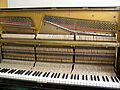
Internal mechanism of an upright piano
-
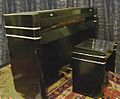
A vintage compact minipiano
-
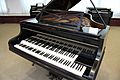
An Emánuel Moór piano with a double keyboard
-
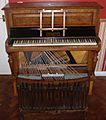
An upright pedal piano played with hands and feet


See also
- Piano extended technique
- Piano trio
- Piano stool
- Street piano
- Agraffe
- Chiroplast
- List of classical pianists
- List of films about pianists
- List of piano manufacturers
- List of piano brand names
- List of piano makers
- List of piano composers
