
Reginald Pinney facts for kids
Quick facts for kids
Reginald John Pinney
|
|
|---|---|

Pinney, photographed here between 1915 and 1919.
|
|
| Born | 2 August 1863 Clifton, Bristol, England |
| Died | 18 February 1943 |
| Allegiance |  United Kingdom United Kingdom |
| Service/ |
 British Army British Army |
| Years of service | 1884−1919 |
| Rank | Major-general |
| Unit | Royal Fusiliers General Staff |
| Commands held | 4th Battalion, Royal Fusiliers Devon and Cornwall Brigade 23rd Brigade 33rd Division 35th Division |
| Battles/wars | Boer War |
| Awards | Knight Commander of the Order of the Bath |
Major-General Sir Reginald John Pinney (2 August 1863 – 18 February 1943) was a British Army officer. He led large groups of soldiers called divisions during the First World War. He became well-known because of a poem called "The General" by Siegfried Sassoon. In the poem, he was called a "cheery old card."
Pinney fought in South Africa during the Second Boer War. When the First World War began, he was given command of a brigade, which is a group of army units. This brigade was sent to the Western Front in France in November 1914. He led his soldiers in early 1915 and they faced heavy losses at the Battle of Neuve Chapelle. Later, he took command of the 35th Division. This division was made up of "bantam" soldiers, who were shorter than average. They first fought at the Battle of the Somme. After three months, he switched commands with the leader of the 33rd Division.
He led the 33rd Division at the Battle of Arras in 1917. In 1918, during the German spring offensive, his division helped to hold the line when other forces struggled. After the war, he retired to Dorset, England. There, he became a local judge, the High Sheriff for the county, and a Deputy Lieutenant.
Contents
Reginald Pinney's Early Life and Army Start
Reginald Pinney was born in 1863 in Clifton, Bristol. He was the oldest son of Reverend John Pinney. His grandfather, Charles Pinney, was a well-known merchant and a former mayor of Bristol. Reginald had five younger brothers and a sister. At least one of his brothers, John, also joined the army.
Reginald went to Winchester College for four years. Then, in 1882, he joined the Royal Military College, Sandhurst. This is where officers are trained for the British Army. He finished his training and became a lieutenant in the Royal Fusiliers in 1884. The Royal Fusiliers was one of the oldest regiments in the British Army.
After five years, he went to the Staff College, Camberley in 1889. This college trains officers for important leadership roles. He was promoted to captain in 1891. From 1896 to 1901, he worked as a staff officer in Quetta, India. He became a major in 1898. In 1900, he married Hester Head. They had three sons and three daughters.
Pinney in the Boer War
Pinney fought in the Second Boer War in South Africa. He arrived there in November 1901. He became the second-in-command of the 2nd Battalion, Royal Fusiliers. This battalion had been in South Africa since the war started in 1899.
He served with his battalion until the war ended in June 1902. Four months later, he returned to England. After his return, he was promoted to lieutenant-colonel. He was given command of the 4th Battalion of his regiment. He also received a special promotion to colonel in 1906. He left command of the battalion in 1907. Later, in 1909, he became an assistant adjutant-general in Egypt. He held this job until 1913. At 50 years old, he was then transferred to lead a reserve unit called the Devon and Cornwall Brigade.
Pinney in the First World War
Leading a Brigade in France
When the First World War started in August 1914, Britain sent its main army, called the Expeditionary Force, to France. Other army units from around the world were also brought back to join the fight.
Pinney was given command of the new 23rd Brigade in October 1914. This brigade was made up of regular army units that had been stationed in places like Malta and Egypt. They were not as well-trained as the main forces already in France.
His brigade went to France in November 1914. They helped hold a part of the front line during the end of the First Battle of Ypres. Their first big battle under Pinney was on March 10, 1915, at the Battle of Neuve Chapelle. The 23rd Brigade faced very strong resistance. One of their leading battalions, the 2nd Middlesex, was almost completely wiped out. Another battalion, the 2nd Cameronians, also suffered heavy losses. Pinney was close to the front line and decided to continue the attack. However, without artillery support, the attack was very difficult. The reserve battalions also faced many casualties and the attack had to be stopped. After this, the fighting became very difficult for the 23rd Brigade.
At the Battle of Aubers on May 9, Pinney's brigade was kept in reserve. This meant they avoided the heavy losses that other brigades faced. Some of Pinney's units were later sent forward to help.
Leading a Division
In June 1915, Pinney was promoted to major-general. He returned to England to command the new 35th Division. This division was made up of volunteers from industrial areas in Northern England. Many of these soldiers were "bantams," meaning they were shorter than the usual army height. One of the officers Pinney met in this division was Bernard Montgomery, who later became a famous general.
The 35th Division moved to France in early 1916. They prepared for the big summer attack. They started fighting in February and Pinney ordered small raids on enemy lines. The 35th Division fought in the Battle of the Somme. They were held back at first but then fought in the Battle of Bazentin Ridge and attacks on High Wood. They suffered many casualties there. One brigade lost a thousand men in a week.
In September, Pinney switched commands with Major-General Herman Landon. Pinney took over the 33rd Division. This change was likely made because Pinney was seen as a more effective leader for a division that would be in active fighting. When Pinney met his new officers, they thought he seemed "pleasant and human."
However, Pinney had some habits that were not popular. He stopped the regular issue of rum (an alcoholic drink) to the soldiers. Instead, he gave them tea. The soldiers were not happy about this. Pinney was very religious. This is why Siegfried Sassoon, an officer in the 33rd Division, wrote his famous poem "The General" about Pinney.
The 33rd Division was also a new volunteer division. It had originally been formed from "Pals battalions," where men from the same towns joined together. It also had units from famous schools. Many of these close-knit units were still in the division.
After Pinney arrived, the division rested for two months. They then fought at the very end of the Somme battles. In March 1917, they moved to Amiens for the Arras Offensive. They fought at the Second Battle of the Scarpe in April, taking 700 prisoners but also suffering many losses. They then attacked the Hindenburg Line in May. Pinney planned a successful night attack on May 20. One observer noted that Pinney was "out for a gamble with his troops and he had it." However, he still refused to give out rum. Another attack on May 27 failed completely.

After the fighting around Arras, the 33rd Division moved to Nieuwpoort, Belgium. Pinney became ill and had to go to the hospital for two months. During this time, he missed heavy fighting by the 33rd Division at the Battle of Passchendaele. He returned to his division on November 30.
The division remained in reserve until April 1918. Then, German forces launched a big attack called the German spring offensive. During the Battle of the Lys, a gap opened in the British lines. The 33rd Division was sent in. Pinney personally led the divisional machine-gun battalion. With help from other soldiers, they stopped a strong German attack at the Battle of Hazebrouck on April 12 and 13. For his brave service in April, Pinney received a special award called the Knight Commander of the Order of the Bath.
The 33rd Division then helped train the U.S. 30th Division during the summer. In September, they went on the attack. They fought at the Battle of the St Quentin Canal, the Battle of Cambrai, and the Battle of the Selle. At the Selle, Pinney planned a dawn attack using quickly built bridges. This allowed the 33rd to cross the river and clear the enemy bank quickly. The division finished the war in the Sambre valley. In February 1919, Pinney retired from the army at 55 years old, after 35 years of service.
Life After the Army
After his army career, Pinney lived at Racedown Manor in Broadwindsor, Dorset. He lived as a retired country gentleman. He became a Justice of the Peace (a local judge) and a Deputy Lieutenant for the county. He also served as the High Sheriff in 1923.
He did not return to active army duty. However, he was the ceremonial Colonel of his old regiment, the Royal Fusiliers, from 1924 to 1933. He was also an Honorary Colonel for other local army units.
Reginald Pinney passed away on February 18, 1943. His wife and five of his children survived him. All three of his sons served in the Second World War. His oldest son, Bernard, was killed in action in November 1941. His daughter Rachel was part of a group called "Ferguson's Gang." This group became famous for raising money to save historic properties for the National Trust. After Pinney's death, a scholarship fund was created in his name in June 1943. This fund helps children of ex-servicemen in Dorset go to college.
Images for kids
-
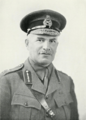
Major-General Reginald Pinney
