
Ulf Kristersson facts for kids
Quick facts for kids
Ulf Kristersson
|
|
|---|---|
.jpg)
Ulf Kristersson in 2025
|
|
| Prime Minister of Sweden | |
| Assumed office 18 October 2022 |
|
| Monarch | Carl XVI Gustaf |
| Deputy | Ebba Busch |
| Preceded by | Magdalena Andersson |
| Leader of the Moderate Party | |
| Assumed office 1 October 2017 |
|
| Deputy |
|
| Party Secretary |
|
| Preceded by | Anna Kinberg Batra |
| Leader of the Opposition | |
| In office 1 October 2017 – 18 October 2022 |
|
| Monarch | Carl XVI Gustaf |
| Preceded by | Anna Kinberg Batra |
| Succeeded by | Magdalena Andersson |
| Minister for Social Security | |
| In office 5 October 2010 – 3 October 2014 |
|
| Preceded by | Cristina Husmark Pehrsson |
| Succeeded by | Annika Strandhäll |
| Chairman of the Moderate Youth League | |
| In office 26 November 1988 – 24 October 1992 |
|
| Preceded by | Beatrice Ask |
| Succeeded by | Fredrik Reinfeldt |
| Member of the Riksdag | |
| Assumed office 4 October 2014 |
|
| Constituency | Södermanland County |
| In office 5 October 1991 – 30 April 2000 |
|
| Constituency | Stockholm Municipality |
| Personal details | |
| Born |
Ulf Hjalmar Kristersson
29 December 1963 Lund, Sweden |
| Political party | Moderate Party |
| Spouse |
Birgitta Ed
(m. 1991) |
| Children | 3 |
| Alma mater | Uppsala University (Civilekonom) |
| Cabinet | Kristersson's cabinet |
| Signature | |
| Military service | |
| Branch/service | Swedish Army |
| Rank | Sergeant |
| Unit | Uppland Regiment |
Ulf Hjalmar Kristersson is a Swedish leader who serves as the Prime Minister of Sweden. He began leading the Swedish government in October 2022. Following a national vote, he became head of a temporary caretaker government. He has been the chief of the Moderate Party since autumn 2017. He has also worked as an active member of the Riksdag, which is the national parliament of Sweden. Before leading the whole country, he worked as the Minister for Social Security from 2010 to 2014.
During his leadership, Sweden made major historical choices. Kristersson guided his nation to finish Sweden's accession to NATO. This was a major change in how Sweden defends itself. His team decided to increase national defence spending to protect the country. He sent strong support for Ukraine to help during difficult times. His team also made strict new rules about immigration to Sweden. These new rules lowered the number of arriving newcomers. In this article, you will learn about his youth, his career, and his work as prime minister.
Contents
- Early Life and Education of Ulf Kristersson
- Early Political Career and Public Work
- Municipal Politics and City Leadership
- Return to National Government and Opposition
- Becoming the Prime Minister of Sweden
- Major Domestic Policies and Reforms
- Foreign Affairs and Global Partnerships
- Personal Life and Family
- Caretaker Government and the 2026 Election
- Honours and Awards
- Images for kids
- Related Pages
Early Life and Education of Ulf Kristersson
Growing Up in Sweden

Ulf Kristersson was born on 29 December 1963 in Lund, Sweden. Lund is an ancient university town in southern Sweden. He was the oldest child of Lars Kristersson and Karin Kristersson. His father Lars worked in business and economics. His mother Karin worked as a school teacher. When Ulf was five years old, his family moved north. They settled in Torshälla, a pleasant town near the larger city of Eskilstuna.
As a young boy, Ulf loved staying active and energetic. He became a skilled gymnast and trained with a local sports troupe. Gymnastics taught him discipline, physical balance, and teamwork. He attended primary school locally and later went to S:t Eskils gymnasium in Eskilstuna. At this secondary school, he studied academic subjects and learned how to debate. He enjoyed reading about history, public society, and government systems.
Military Service and University Studies
After finishing secondary school, Kristersson served in the national military. Every young recruit learned discipline and teamwork in the Swedish Army. Kristersson joined the Uppland Regiment between 1983 and 1984. He trained as a platoon commander and achieved the rank of sergeant. This military role taught him how to guide other people under pressure.
Once his military service concluded, he decided to study higher education. He enrolled at the famous Uppsala University, one of the oldest universities in northern Europe. Kristersson decided to focus his academic studies on economics and business. He earned an economics degree known in Sweden as a Civilekonom. Understanding money, trade, and markets gave him valuable skills for his future government roles.
Early Political Career and Public Work
Leadership in the Youth League
Kristersson became interested in national politics while he was still quite young. During the 1985 Swedish general election, he was hired as an energetic campaigner. He worked for the youth wing in Sörmland. The group was called the Moderate Youth League, often shortened to MUF. Kristersson quickly impressed senior leaders with his speaking style and energy.
In November 1988, he earned a major promotion. He was chosen to be the nationwide chairman of the Moderate Youth League. He succeeded Beatrice Ask in this important leadership post. As youth chairman, he traveled across the country to talk to young voters. He spoke about personal freedom, economic markets, and lower taxes. He believed that young people should take personal responsibility for their futures.
The Battle of Lycksele
During the early 1990s, big debates occurred inside the youth movement. Some members favored conservatism, while others preferred open market ideas. In 1992, another rising young politician named Fredrik Reinfeldt challenged Kristersson for the leadership. The two leaders held different views on how the organization should be run.
The big contest took place in a northern town called Lycksele. Political reporters called this famous vote the Battle of Lycksele. It was an extremely close election among the youth delegates. Reinfeldt won the vote by a very narrow margin. Losing the election was difficult for Kristersson, but it taught him resilience. He took a brief step back from front-line student politics to gain experience elsewhere.
Work in Think Tanks and Private Business
In the middle of the 1990s, Kristersson took on jobs outside of running for office. He worked for Timbro, a famous research group called a think-tank. Timbro supports the free market and wants businesses to operate with fewer government rules. Kristersson worked as their chief of marketing between 1995 and 1998.
While working at Timbro, Kristersson wrote essays and published a book. He argued that government systems should encourage people to work hard. He also served in the parliament during these years, sitting on committees. In 2000, he decided to leave his seat in the Riksdag for a while. He entered the business world to work for a communications company called Adcore. Working in private business helped him learn how companies hire workers and handle budgets.
Municipal Politics and City Leadership
Serving in Strängnäs and Stockholm
.jpg)
After working in the business world, Kristersson returned to public service in local towns. In 2002, he was elected as the local finance leader in the town of Strängnäs. Running a municipal government is very hands-on work. He had to balance budgets, fund local schools, and improve public roads. He held this important local role until 2006.
In 2006, he moved up to work for the city government of Stockholm. Stockholm is the capital city and largest city in Sweden. Kristersson was named Vice Mayor for social welfare and jobs. In this role, he was responsible for helping elderly people and finding jobs for residents. He learned how large cities operate and how social assistance programs function.
Working on National Family Policies
While Kristersson worked in city politics, his former rival Fredrik Reinfeldt became Prime Minister of Sweden. Reinfeldt recognized Kristersson's skills and asked him to lead a special family committee. The committee had the goal of creating modern family ideas for the Moderate Party. Kristersson wanted to help both mothers and fathers share family duties at home.
He suggested that fathers should take dedicated months of parental leave to support their children. At first, some conservative politicians disagreed with this idea. They preferred letting each family choose without government suggestions. However, Kristersson believed it was good for fathers to bond with their babies. This proposal showed that he was willing to suggest new approaches to traditional policies.
Return to National Government and Opposition
Minister for Social Security
In October 2010, Prime Minister Reinfeldt invited Kristersson back to national government. Kristersson accepted the job of Minister for Social Security. Social security helps people who are retired, sick, or cannot work. It is one of the most expensive parts of any national budget.
Kristersson spent four years managing these nationwide social programs. He worked to make sure public money was used fairly and efficiently. He also encouraged people who were able to work to find new jobs. When the government changed after the 2014 Swedish general election, Kristersson stepped down from his ministerial post. However, voters elected him back to the Riksdag representing Södermanland County.
Leading the Parliamentary Opposition
In autumn 2017, the leader of the Moderate Party, Anna Kinberg Batra, stepped down. The party members held a vote to pick their next chief. On 1 October 2017, Kristersson was elected as the new party leader. He quickly became the official Leader of the Opposition against Prime Minister Stefan Löfven.
As opposition leader, Kristersson spoke out against government spending and high crime rates. He promised that his party would be tougher on street safety and borders. After the 2018 Swedish general election, parliament tried to pick a new prime minister. The Speaker of parliament, Andreas Norlén, asked Kristersson to try forming a team. However, Kristersson could not gather enough votes in the parliament that year. He stayed patient and continued leading the opposition.
Becoming the Prime Minister of Sweden
The 2022 General Election and the Tidö Agreement

In September 2022, Sweden held another national election. The race was very close between left-leaning parties and right-leaning parties. When all the ballots were counted, the right-leaning parties won a small majority. Together, they held 176 out of the 349 total seats in the Riksdag. Outgoing prime minister Magdalena Andersson stepped down from her role.
Kristersson held meetings with three other party leaders to agree on common goals. Together, they created a detailed plan called the Tidö Agreement. The governing coalition included the Moderate Party, the Christian Democrats, and the Liberals. A fourth party, the Sweden Democrats, agreed to vote for their laws from outside the formal cabinet. On 17 October 2022, the Riksdag voted to elect Kristersson as Prime Minister of Sweden.
Taking Office with King Carl XVI Gustaf
The next day, on 18 October 2022, Kristersson formally began his term. He visited the royal palace to meet King Carl XVI Gustaf. In Sweden, the monarch acts as the ceremonial head of state. The King held a formal meeting called the Council of State to confirm the new government.
Kristersson announced a team of ministers to lead different national departments. Ebba Busch became the Deputy Prime Minister of Sweden and energy chief. Elisabeth Svantesson was appointed as the Minister for Finance to look after the national economy. Kristersson pledged to focus on national safety, steady energy, and clean economic growth.
Major Domestic Policies and Reforms
Historic Military Expansion and Joining NATO

For more than two hundred years, Sweden maintained a policy of military neutrality. It did not join military alliances or choose sides in foreign wars. However, when world events changed in Europe, Sweden decided to rethink its safety. Kristersson made it his top priority to complete Sweden's accession to NATO. Joining NATO meant Sweden would stand together with friendly partner countries.
Kristersson traveled to Washington, D.C., to deliver the official papers to US Secretary of State Antony Blinken. On 7 March 2024, Sweden officially became a full member of NATO. Later that day, Kristersson was invited to watch the 2024 State of the Union address. He also gave a live speech to the Swedish public to celebrate this historic turning point.
Inside Sweden, the government spent much more money on national defense. Finance Minister Elisabeth Svantesson set a goal to raise defence spending to two percent of national income. The Swedish military reopened old bases, including the Bergslagen Artillery Regiment. In spring 2023, the Swedish Armed Forces held a huge training exercise called Aurora 23. Over 26,000 soldiers participated to practice protecting Swedish territory. In 2024, Kristersson selected General Michael Claesson to become the new top military leader.
Energy Policy and Nuclear Power
Energy is essential for keeping homes warm during cold Scandinavian winters. Kristersson changed Sweden's official goal from renewable energy to completely "fossil-free energy." This meant Sweden wanted clean electricity that did not create smoke or pollution. He strongly supported building modern nuclear reactor technology alongside renewable power.
The government removed old rules that blocked new nuclear power plants. State companies like Vattenfall began studying sites to build modern nuclear reactors. The government also supported clean hydroelectric power, which generates energy using flowing river water. In 2023, the government tested power grids to ensure they were safe from sudden accidents.
Tackling Crime and Enhancing Public Safety
Another major priority for Kristersson was improving safety on neighborhood streets. He argued that the country needed stronger police tools to prevent criminal acts. His government introduced new laws that gave police officers broader authority to search for illegal weapons. They also worked on plans to let witnesses speak safely in legal courts.
The government reported that these strict measures helped reduce neighborhood danger. Records showed that illegal shootings fell significantly across Swedish towns between 2022 and 2025. Kristersson praised police officers for their hard work in keeping communities calm. However, some citizens debated whether these rules gave police too much power over ordinary life.
Migration Rules and Border Policies
Kristersson's administration introduced major changes to Swedish immigration laws. Sweden had historically welcomed many newcomers from around the world. The new government decided that Sweden needed a much more restrictive system. They reduced the number of international refugees accepted through official programs from 5,000 down to 900 per year.
New rules required asylum seekers to attend classes to learn the Swedish language and local customs. The government made it easier to return individuals who did not receive legal permission to remain. In 2023, Sweden recorded the lowest number of asylum seekers seen in the 21st century. By 2024, more people moved out of Sweden than moved in for the first time in fifty years.
Climate Debates and Environmental Protection
Sweden has long been known as a world leader in protecting the natural environment. However, Kristersson faced significant criticism regarding his climate decisions. His government cut the national climate budget and stopped special financial bonuses for electric cars. They also lowered taxes on fuel and removed the national tax on airline tickets.
Because of these changes, Sweden recorded an increase in greenhouse gas emissions during 2024. Environmental groups and the Environmental Protection Agency warned that Sweden might miss its clean air goals. Kristersson argued that fuel needed to be affordable so families could drive to work. This topic created lively discussions among voters and scientists across the country.
Foreign Affairs and Global Partnerships
Standing with Ukraine
.jpg)
In international affairs, Kristersson spent much of his time helping European neighbors. On 15 February 2023, he traveled by train to Kyiv to meet Ukrainian President Volodymyr Zelenskyy. Kristersson promised that Sweden would send armored vehicles, advanced equipment, and medical aid. He told the world that Ukraine belongs in the European family of free nations.
Sweden also trained Ukrainian soldiers so they could protect their hometowns. Kristersson regularly met with other European heads of government to organize aid packages. In March 2025, he attended a major summit in London led by British Prime Minister Keir Starmer. The leaders discussed ways to keep eastern Europe safe and peaceful.
Working with International Leaders

As prime minister, Kristersson met many world leaders to build strong relationships. In October 2022, he traveled to Helsinki to meet Finnish leaders Sauli Niinistö and Sanna Marin. Sweden and Finland worked closely together to coordinate their national safety policies. In July 2023, he met U.S. President Joe Biden at the White House to discuss shared security goals.
He also had meetings with Japanese Prime Minister Fumio Kishida and Colombian President Gustavo Petro. During his travels, Kristersson worked on trade agreements and shared scientific projects. In January 2023, Sweden took over the rotating leadership post of the presidency of the Council of the European Union. During those six months, Sweden helped guide meetings between all European Union member states.
Handling Overseas Crises
Kristersson also had to manage unexpected emergencies abroad. In April 2023, fighting suddenly broke out in the nation of Sudan. The Swedish government quickly organized a rescue mission using transport airplanes. Swedish soldiers flew into the capital city to bring home diplomats and families safely. The mission also helped rescue more than one hundred citizens from other friendly countries.
In late 2023, other difficult foreign policy challenges arose in the Middle East. Kristersson stressed that countries have a basic right to self-defense under international law. At the same time, he called for civilians and children to be protected from harm. He frequently spoke with European partners to help keep sea routes open for food transport.
Personal Life and Family
Home, Marriage, and Children
Away from government buildings, Kristersson enjoys a quiet family life. He lives with his family in the historical lakeside town of Strängnäs. In 1991, he married Birgitta Ed. His wife worked for many years in communications and business. Later in life, she decided to study religion and became an ordained priest in the Church of Sweden.
Together, Kristersson and his wife have three adopted daughters who were born in China. Kristersson has spoken warmly about how much joy his daughters bring to his life. Even with a busy schedule, he makes time to eat dinner with his family. He has a shared relative by marriage with former Swedish prime minister Carl Bildt.
Hobbies and Personal Interests
Kristersson continues to enjoy athletics and outdoor exercise. Thanks to his background as a youth gymnast, he still likes staying physically fit. He often goes running through neighborhood parks to clear his mind after long meetings. He also likes walking his dog in the forests near his home.
In addition to sports, Kristersson is an enthusiastic reader of history and biographies. He enjoys learning about past leaders who guided their nations through tough times. He likes listening to modern music and watching movies with his family during quiet weekends. Kristersson does not describe himself as deeply religious, but he respects spiritual traditions.
Caretaker Government and the 2026 Election
In September 2026, Sweden held its scheduled national election. Voters across the nation went to polling stations to choose their representatives. The results showed that the four-party coalition lost its combined majority of seats in parliament. This meant the governing group no longer held more than half of the votes.
Because his team did not have a majority, Kristersson offered his resignation to the parliament. However, running a modern country requires steady daily attention. The Speaker of the Riksdag asked Kristersson to lead a temporary caretaker government. A caretaker government makes sure public offices stay open and services run smoothly. Kristersson agreed to manage routine government tasks while lawmakers discuss who will lead next.
Honours and Awards
Kristersson has received several high awards and honors from Sweden and other friendly countries:
- Recipient of the Golden Jubilee Badge Medal of King Carl XVI Gustaf in Sweden (2023)
- Grand Officer of the Legion of Honour from France (2024)
- Grand Cross of the Order of the White Rose of Finland from Finland (2024)
- Grand Cross of the Order of the Dannebrog from Denmark (2024)
- First Class of the Order of Prince Yaroslav the Wise from Ukraine (2024)
- Grand Cross of the Order of the Falcon from Iceland (2025)
- Recipient of the Golden Wedding Medal of King Carl XVI Gustaf and Queen Silvia in Sweden (2026)
Images for kids
-
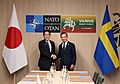
Kristersson meeting Japanese Prime Minister Fumio Kishida at a NATO summit.
-
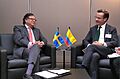
Kristersson holding bilateral talks with Colombian President Gustavo Petro.
-
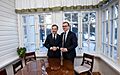
Kristersson with Finnish Prime Minister Petteri Orpo in Helsinki.
-
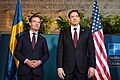
Kristersson with U.S. Secretary of State Marco Rubio in 2026.
-
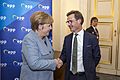
Kristersson meeting with German Chancellor Angela Merkel in 2017.

.jpg)

.jpg)
.jpg)
Related Pages
 In Spanish: Ulf Kristersson para niños
- Prime Minister of Sweden
- Moderate Party
- Riksdag
- Carl XVI Gustaf
