
Łęczna facts for kids
Quick facts for kids
Łęczna
|
|||
|---|---|---|---|

Łęczna town hall
|
|||
|
|||

 Łęczna
Location in Poland
|
|||
| Country |  Poland Poland |
||
| Voivodeship | Lublin | ||
| County | Łęczna | ||
| Gmina | Łęczna | ||
| Town rights | 1467 | ||
| Area | |||
| • Total | 11.00 km2 (4.25 sq mi) | ||
| Population
(2017)
|
|||
| • Total | 18 812 | ||
| Time zone | UTC+1 (CET) | ||
| • Summer (DST) | UTC+2 (CEST) | ||
| Postal code |
21-010
|
||
| Car plates | LLE | ||
| Primary airport | Lublin Airport | ||
| National roads |  |
||
| Voivodeship roads |   |
||


Łęczna (pronounced 'wench-na') is a town in eastern Poland. It's located in the Lublin Voivodeship region and is the main town of Łęczna County. The town sits on hills in the Lublin Upland, where two rivers, the Wieprz and the Świnka, meet. In 2014, about 19,780 people lived here.
Łęczna is a starting point for exploring the "Kameralne Pojezierze," a beautiful area with many lakes. The town is on National Route 82, which connects Lublin to Włodawa.
Contents
History
Early Beginnings
The village of Łęczna was first mentioned in records in the year 1252. Back then, the area east of Lublin was not very populated. There were few towns or villages because groups like the Mongols, Tatars, and Lithuanians often raided the region.
Things started to change in the late 1300s. This was after the Union of Krewo in 1385, which created a strong partnership between the Kingdom of Poland and the Grand Duchy of Lithuania.
Becoming a Town
In 1462, a local nobleman named Zbigniew z Łęcznej sold the village to the powerful Tęczyński family. Just five years later, on January 7, 1467, Jan of Tęczyn, who was a high-ranking official in Kraków, received special permission from King Casimir IV Jagiellon. This permission, called Magdeburg rights, allowed Łęczna to become a town.
The new town was built on a strategic hill, about 175 meters (574 feet) above sea level. Its first residents came from other towns and villages nearby. Łęczna was part of the Lublin Voivodeship within the Lesser Poland Province of the Kingdom of Poland.
A Time of Growth

Łęczna grew quickly thanks to special trading rights given by King Stephen Báthory in 1581. It became a very important place for trading horses and cattle in Poland. Merchants from all over the Polish–Lithuanian Commonwealth and other countries came here.
In the early 1500s, the first Jewish settlers arrived in Łęczna. The town was on a busy trade route leading to Volhynia and Lithuania. Even with raids by Tatars and several fires, Łęczna continued to develop. The period known as the Polish Golden Age (the 16th and early 17th centuries) was a time of great success for the town. Łęczna had a castle, a town hall, many houses, churches, and a synagogue.

This period of growth ended in the mid-1600s. Łęczna was badly damaged many times during the Swedish invasion of Poland and other wars. In 1693, almost everyone in the town died from a disease. In 1710, another terrible illness, the plague, greatly reduced the population. The town also suffered from two more fires in the mid-1700s.
Later History

After Poland was divided for the third time in 1795, Łęczna became part of the Habsburg Empire. Later, it was part of the Duchy of Warsaw (1809) and then Congress Poland under the Russian Empire (1815–1915). During the 1800s and early 1900s, Łęczna was a small town, not connected to major roads or railways.
During the January Uprising in 1863-1864, there were battles between Polish rebels and Russian soldiers in and around Łęczna. Before World War I began in 1914, Łęczna was the smallest of fourteen towns in its region. During the war, many people were forced to leave, and the town lost 41% of its population.
After Poland became independent again in 1918, Łęczna was once more part of Poland. By 1939, about 4,300 people lived there. In September 1939, during the Invasion of Poland, the town was briefly taken by the Red Army before being handed over to Nazi Germany.
In the 1960s, large amounts of Bituminous coal were found near Łęczna. The first coal mine, called Bogdanka Coal Mine, started being built in the nearby village of Bogdanka in 1975. In 1999, Łęczna became the main town of a county for the first time in its history.
Jewish Community History


Łęczna had a significant Jewish community from the 1400s until World War II. For a long time, Łęczna was an important Jewish center in Central Europe. The Council of Four Lands, a major Jewish governing body, met here several times.
By 1803, about 38% of the town's population was Jewish. This number grew to 64% by 1840. The Jewish community remained very important in Łęczna until World War II, when Nazi Germany took control of the town. In January 1940, a local Jewish council called a Judenrat was set up to manage Jewish life under Nazi rules.
During the Holocaust, about 2,500 Jews who lived in Łęczna were sent to the Sobibor extermination camp. Sadly, the Jewish community of Łęczna no longer existed after this time.
Today, some Jewish buildings from the past still stand in Łęczna. These include the large synagogue, which is now a local museum, and the small synagogue, which is now a library. There is also a Jewish cemetery.
Gallery
-
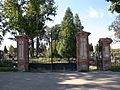
Old Cemetery gate
-
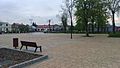
First Market Square of Łęczna
-
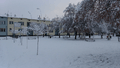
Third Market Square of Łęczna
-
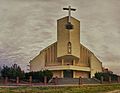
St. Barbara church
-
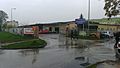
Town's fair
-
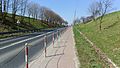
National Road 82


Tourism

Łęczna is in a beautiful area called the Łęczna-Włodawa Lakeland. This region has 68 lakes, covering a total area of 2,726 hectares (about 6,736 acres). There are also many forests filled with different birds and animals. The Polesie National Park is just a few kilometers north of the town.
The Regional Museum of Łęczna, which opened in 1966, is located in a 17th-century synagogue. The town also has the St. Mary Magdalene church, built between 1618 and 1631.
Economy
Since the 1970s, Łęczna has benefited from the nearby coal mining industry. The village of Bogdanka, close to Łęczna, was where the first coal mine in the Lublin Coal Basin was built. The town also has other smaller industries and is seen as the center of the coal region.
Sports & Athletes

- Górnik Łęczna: This is a football (soccer) team that plays in the I liga (as of the 2023–24 season).
- Michał Oleksiejczuk: A mixed martial artist who competes in the middleweight division of the UFC.
See also
 In Spanish: Łęczna para niños
