
Blue poison dart frog facts for kids
Quick facts for kids Script error: The function "infraspeciesboxName" does not exist. |
|
|---|---|
 |
|
| Conservation status | |
Scientific classification  |
|
| Kingdom: | Animalia |
| Phylum: | Chordata |
| Class: | Amphibia |
| Order: | Anura |
| Family: | Dendrobatidae |
| Genus: | Dendrobates |
| Species: | |
| Subspecies: |
D. t. "azureus"
|
| Trinomial name | |
| Dendrobates tinctorius "azureus" (Hoogmoed, 1969)
|
|

The blue poison dart frog (Dendrobates tinctorius "azureus") is a striking amphibian. It is also known as the blue poison arrow frog. You can find this frog in the "forest islands" of southern Suriname. These forests are surrounded by the Sipaliwini Savanna.
Here's a cool fact: the blue poison dart frog doesn't make its own poison! Instead, it gets the poison from the insects it eats. This process is called "sequestration." It means they collect and store the toxins from their food.
If these frogs are raised in zoos or as pets, they won't be poisonous. This is because their diet won't include the toxic insects they eat in the wild. Wild frogs that are brought into captivity also become less poisonous over time.
Local people, the Tiriyo, call this frog okopipi. Its scientific name, "azureus," means "sky blue." This perfectly describes its beautiful color.
Scientists often consider the blue poison dart frog a special type, or "morph," of the dyeing poison dart frog. It belongs to the Dendrobatidae family. This family includes many amazing frogs. Scientists study these frogs to learn about diseases like chytridiomycosis. This fungal disease affects amphibians around the world.
Contents
What Does the Blue Poison Dart Frog Look Like?

This frog is a medium-sized amphibian. It usually weighs about 8 grams. It grows to be about 3 to 4.5 centimeters long. That's roughly the length of your thumb!
Female frogs are a bit larger than males. They can be about half a centimeter longer. However, males often have bigger toes.
The frog's skin is a brilliant blue. It's usually darker near its legs and belly. This bright color is a special warning sign. It tells predators, "Stay away! I am poisonous!" This warning system is called aposematism.
Tiny glands in their skin produce poisonous substances called alkaloids. These act as a defense against animals that might try to eat them. Each frog has unique black spots. These spots are like fingerprints, helping us tell individual frogs apart.
Blue poison dart frogs also have a unique posture. They often look a bit hunch-backed. Their eardrum, called a tympanum, is smaller and more oval than in other dyeing poison dart frogs.
Each foot has four toes. These toes have flat tips with suction cup pads. These pads help the frog grip surfaces. Female frogs have round toe tips. Male frogs have heart-shaped toe tips.
The babies of these frogs are called tadpoles. They have long tails, about 6 millimeters. Their total length is around 10 millimeters. Tadpoles do not have legs. Instead, they have gills to breathe underwater, not lungs.

How Does the Blue Poison Dart Frog Behave?
Blue poison dart frogs live mostly on land. They are called "terrestrial" amphibians. You will usually find them near water sources.
They spend their active time hunting for insects. They move by hopping in short, quick leaps. These frogs are quite protective of their space. They can be aggressive towards other frogs, even those of their own kind. This is common for many poison dart frog species.
When they feel threatened, they perform a "territorial display." This can include making calls, chasing other frogs, and even wrestling!
The Blue Poison Dart Frog's Amazing Poison
The blue poison dart frog uses special poisons called pumiliotoxins (PTXs). These help protect it from predators. PTXs are powerful substances that affect the nervous system. They work by disrupting how nerve signals are sent.
These poisons are strong enough to keep most animals away. However, they are not as strong as the poisons found in some other dart frogs. For example, the golden poison dart frog has even more potent poisons. Interestingly, one type of snake, the Northern redbelly snake, has learned to resist these poisons.
Here's a cool fact: the blue poison dart frog doesn't make its own poison! Instead, it gets the poison from the insects it eats. This process is called "sequestration." It means they collect and store the toxins from their food.
If these frogs are raised in zoos or as pets, they won't be poisonous. This is because their diet won't include the toxic insects they eat in the wild. Wild frogs that are brought into captivity also become less poisonous over time.
Frogs can use many different compounds in their poison. Scientists are still learning about all of them. While they can't create the poisons, some species can change the poisons they eat. This makes them even stronger! Blue poison dart frogs can turn pumiliotoxin into allopumiliotoxin. This new compound is five times more powerful!
The name "poison dart frog" comes from a historical practice. Some indigenous people used the poison from certain frog species on their hunting darts. However, only specific types of dart frogs, mainly from the genus Phyllobates, were used for this purpose.
Life Cycle and Reproduction
Blue poison dart frogs breed at certain times of the year. This usually happens in February or March, when it's rainy.
To find a partner, male frogs sit on rocks. They make soft calls to attract females. Females listen for these calls to find the males. Sometimes, females might even have small fights over a male!
The male then leads the female to a quiet spot near water. This is where the female lays her eggs. The male then fertilizes the eggs outside her body. He covers the eggs with his sperm.
Each time they mate, between five and ten baby frogs are produced. The eggs are laid in the male's territory. He protects this area. The male frog often takes care of the eggs. Sometimes, the female helps too.
The eggs hatch into tadpoles after 14 to 18 days. After about 10 to 12 weeks, the tadpoles grow into fully mature frogs. Both male and female frogs can start having their own babies when they are two years old.
In the wild, these frogs usually live for 4 to 6 years. If they live in captivity, like in a zoo, they can live for about 10 years.
What Do Blue Poison Dart Frogs Eat?
Blue poison dart frogs enjoy a varied diet of insects. They eat many different kinds of bugs.
Scientists believe that fire ants and similar insects are the source of their skin poisons. These frogs get their defensive chemicals from these specific foods.
They also eat other insects and small creatures. These include beetles, flies, mites, spiders, termites, maggots, and caterpillars.
Remember, if these frogs don't eat their natural insect prey, they won't develop their poisonous skin. Their diet is key to their defense!
Keeping Blue Poison Dart Frogs as Pets
If you keep blue poison dart frogs as pets, their diet is different. They usually eat small insects like fruit flies and tiny crickets. They also enjoy rice flour beetle larvae, isopods, and springtails.
More Images
-
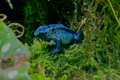
A blue poison dart frog at Singapore Zoo.
-
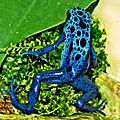
A blue poison dart frog.
-
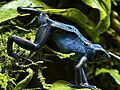
Side view of a blue poison dart frog at London Zoo, UK.
-
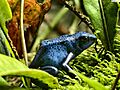
Another blue poison dart frog at London Zoo, UK.


