
Aposematism facts for kids


Aposematism is when animals use clear signals to tell potential predators that they are not good to eat or attack. These signals often mean the animal has defenses like being poisonous, tasting bad, having sharp spines, or being very aggressive. The warnings can be bright colors, loud sounds, strong odours, or other things predators can easily notice. Aposematic signals are helpful for both the predator and the prey, as both avoid getting hurt.
This idea was first called "warning coloration" by Alfred Russel Wallace. Later, in 1877, Edward Bagnall Poulton gave it the name "aposematism." Sometimes, different species that are all dangerous look alike; this is called Müllerian mimicry. This helps predators learn faster to avoid them. Other times, a harmless animal might look like a dangerous one to trick predators; this is called Batesian mimicry.
Contents
What Does Aposematism Mean?
The word "aposematism" was created by the English zoologist Edward Bagnall Poulton in his 1890 book The Colours of Animals. It comes from ancient Greek words: "apo" meaning 'away' and "sema" meaning 'sign'. So, it means 'a sign to keep away'.
How Animals Warn Predators

The main goal of aposematism is to stop predators from attacking. Animals do this by showing clear warnings that they are unpalatable or poisonous. The easy-to-spot warning is the first line of defense. The hidden defenses, like poison, are the second.
Most aposematic signals are visual. They use bright colors and bold patterns, like stripes. These signals are usually honest, meaning the animal really does have a defense. The brighter and more noticeable an animal is, the more toxic it often is. This is different from bluffing displays, where an animal tries to scare a predator with a threatening look but has no real strong defense.
The best and most common warning colors are red, yellow, black, and white. These colors stand out against green plants. They also look clear even in shadows or different lighting. Some warning colors can even act as camouflage from far away, but become clear warnings when a predator gets close. Animals develop these colors based on their surroundings, light, and what their predators can see. Sometimes, animals use more than just colors. They might also use smells, sounds, or special behaviors to make their warning even stronger.
Bright Colors and Bad Tastes

Animals can be unpalatable in many ways. Some insects, like ladybirds or tiger moths, have bitter-tasting chemicals. The skunk sprays a terrible smell. Poison dart frogs have poison glands. The velvet ant has a painful sting, and the black widow spider has a dangerous venom.
Tiger moths warn bats by making ultrasonic noises. They also show off bright body parts or eyespots in warning poses. Velvet ants, which are actually wasps, have bright colors and make loud noises when grabbed. This helps make their warning clear. Giant velvet mites taste bad and have tough skin that is hard to bite through. Even some mammals, like honey badgers, use their aggressive nature, sharp teeth, and claws as a warning to predators.
Where Do We See Aposematism?
On Land: Terrestrial Animals

Aposematism is very common in insects. It's less common in vertebrates, like some reptiles, amphibians, and fish. Some mammals that smell bad or are aggressive also use it. For example, Pitohui birds have toxic feathers and skin from the poisonous beetles they eat.
Poison dart frogs are perhaps the most famous aposematic vertebrates. These frogs, found in Central and South America, come in many bright colors and have different levels of toxicity. Some species, like Dendrobates, Epipedobates, and Phyllobates, are very colorful and have some of the most toxic chemicals found in living things. Other frogs in the same family, like Colostethus, are camouflaged and don't have these toxins. Even with all their different colors and poisons, these frogs are very similar genetically. Their bright colors developed along with their chemical defenses, special diets, unique sounds, and larger body sizes.
Some plants might also use aposematism. They could warn plant-eating animals (herbivores) about bad-tasting chemicals or physical defenses like thorns. Many insects, such as cinnabar moth caterpillars, get toxic chemicals from the plants they eat.
Among mammals, skunks and zorillas show off their smelly chemical defenses with bold black-and-white patterns. Similarly, badgers and honey badgers use their distinct patterns to advertise their sharp claws, strong jaws, and aggressive personalities. Some brightly colored birds, especially females, might also be aposematic. However, male birds are often colorful to attract mates, so it's harder to tell if their colors are also a warning.
The rattlesnake's rattle is an example of a sound-based warning. The caterpillar of the Polyphemus moth, Antheraea polyphemus, also makes sounds, which are linked to its chemical defenses. Many other caterpillars also use sounds to warn predators.
In the Ocean: Marine Animals


Scientists have discussed whether aposematism exists in the ocean. Many marine creatures, especially on coral reefs, are brightly colored or patterned. These include sponges, corals, molluscs, and fish. But these colors don't always mean they have chemical or physical defenses. For example, Caribbean reef sponges are colorful, and many have toxic chemicals, but there isn't a clear link between the two.
Nudibranch molluscs are often mentioned as examples of aposematism in the ocean. However, some argue against this. Reasons include: (1) there are few examples of mimicry among them, (2) many are active at night or hide, and (3) red colors fade quickly in deeper water. For instance, the Spanish Dancer nudibranch, a large, bright red and white sea slug with strong chemical defenses, is nocturnal and has no known mimics.
Still, other studies suggest that nudibranchs, like those in the Phyllidiidae family from Indo-Pacific coral reefs, do have warning colors. Müllerian mimicry has been seen in some Mediterranean nudibranchs, which all get their defensive chemicals from the sponges they eat.

The crown-of-thorns starfish has bright colors and long, sharp spines. It also has chemicals called saponins that can act as a defense. This suggests it is an aposematic species.

Experiments have shown that pink warty sea cucumbers are aposematic. Their honest signals, both colorful and patterned, help reduce attacks from predators.
Blue-ringed octopuses are very venomous. They usually hide in cracks and use camouflage. But if they feel threatened, they quickly change color. They become bright yellow, and their 50-60 rings flash iridescent blue in less than a second. Many believe this is a warning display, but it hasn't been fully tested.
How Aposematic Animals Behave
Aposematism works because predators remember bad experiences. A bird that once ate a foul-tasting grasshopper will try to avoid eating another one. Because of this, aposematic species often live in groups. This way, predators might have their bad experience reinforced by seeing or trying to attack another group member.
Aposematic animals often move slowly. They don't need to be fast or agile because their warning colors protect them. Their bodies are often tough and hard to injure, which helps them escape if a predator tries to attack before learning the warning.
Unlike camouflaged animals, aposematic species don't need to hide. This means they have more freedom to be in open areas and can spend more time looking for food. They might also use bright displays or loud calls to attract mates, which can become even more noticeable over time.
The History of Aposematism Theory

Wallace's Idea in 1867
In 1867, Charles Darwin wrote to Alfred Russel Wallace, asking why some caterpillars were so beautifully colored. Darwin's idea of sexual selection (where animals choose mates based on attractiveness) didn't fit caterpillars, as they are too young to mate.
Wallace replied that if some caterpillars tasted bad or smelled awful, it would be good for them to look different from tasty caterpillars. He thought that a bird's peck could kill a caterpillar, even if it wasn't eaten. So, bright, noticeable colors would help birds easily recognize them as "not food" and avoid attacking them.
Darwin liked this idea, so Wallace asked the Entomological Society of London to test it. In 1869, entomologist John Jenner Weir did experiments with caterpillars and birds. He provided the first scientific proof for warning coloration in animals. At first, naturalists were surprised by the idea of aposematism. They thought standing out would make animals more likely to be eaten, not less.
Poulton Names It in 1890
.jpg)
Wallace first used the term "warning colours" in 1877. In 1890, Edward Bagnall Poulton renamed this concept aposematism in his book The Colours of Animals. He explained that the term comes from Greek words meaning "a sign to keep away."
How Aposematism Evolves
Aposematism seems tricky for evolution. Why would an animal want to stand out to predators? It might seem like the first few brightly colored individuals would be quickly eaten, and the trait would disappear.
However, there are good explanations. Predators sometimes avoid new types of prey because they are unsure about them. This "dietary conservatism" can last a long time. Experiments with birds and fish have shown this.
Also, birds remember and avoid bright, bad-tasting things longer than bad-tasting things that are camouflaged. This supports Wallace's original idea that warning colors help teach predators to avoid certain prey. Some young birds also naturally avoid brightly colored objects, even without a bad experience. This suggests that over time, predators have evolved to understand what these warning signals mean, rather than each new generation having to learn from scratch. These findings show that being bright and new doesn't always mean an animal will be eaten more often.
Other ideas suggest that animals might live in groups. If a group of animals is already unpalatable, predators might learn to avoid the whole group. This would protect any new individuals with warning colors. Also, if there are many aposematic animals, the learning process for predators is spread out, making it less likely to wipe out the trait.
Mimicry: Copying Warning Signals
Aposematism has led to the evolution of other species that copy these warning signals.
Batesian Mimicry
Sometimes, a harmless species evolves to look like a dangerous aposematic one. For example, the hornet moth looks like a yellowjacket wasp but has no sting. A predator that avoids wasps will also tend to avoid the moth. This is called Batesian mimicry, named after Henry Walter Bates. This type of mimicry works best when there are not too many mimics compared to the dangerous models. If there are too many mimics, predators might learn that the warning is a trick.
Müllerian Mimicry
A second type of mimicry happens when two or more dangerous species look alike. This benefits all of them. Fewer individuals from each species need to be attacked for predators to learn to avoid them all. This is called Müllerian mimicry, named after Fritz Müller.
Many species of bees and wasps that live in the same areas are Müllerian mimics. Their similar striped patterns teach predators that these patterns mean a sting. So, a predator that has a bad experience with one will likely avoid any other similar-looking insect in the future. Müllerian mimicry is also seen in vertebrates, like the mimic poison frog (Ranitomeya imitator). This frog has different forms that look very similar to other poison frog species living in its area.
Images for kids
-
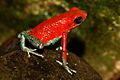
The bright colors of this granular poison frog warn predators that it is toxic.
-
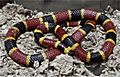
A model (to be mimicked), the venomous and genuinely aposematic coral snake
-
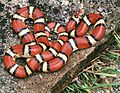
The harmless red milk snake, a Batesian mimic of the coral snake
-
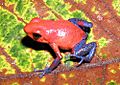
Oophaga pumilio, a poison dart frog, has many alkaloids that keep predators away.
-
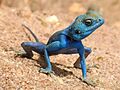
This bright colour is not warning colouration. It is a male lizard, Agama sinaita, from Jordan, near the Red Sea. When it wants to find a mate, the male turns bright blue to attract females. Its colour is a secondary sex characteristic.
-
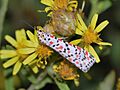
Crimson Speckled Moth. The reason for its colour is not fully known, but it might be a warning. Its hind wings look different and more normal.


See also
 In Spanish: Aposematismo para niños
