
Einstein ring facts for kids

An Einstein ring is a super cool cosmic circle of light. It forms when light from a very distant galaxy or star travels towards Earth. On its way, this light passes by a huge, heavy object, like another galaxy. This massive object acts like a giant magnifying glass in space. It bends the light, making the distant object appear stretched into a ring shape. This amazing effect is called gravitational lensing.
Contents
What is an Einstein Ring?
How Gravitational Lensing Works
Albert Einstein's theory of general relativity helps us understand how light bends. Imagine space and time as a giant fabric. Very heavy objects, like galaxies, create dips or curves in this fabric. When light travels near these heavy objects, it follows these curves instead of going in a straight line. This bending of light is called gravitational lensing. An Einstein ring happens when a distant light source, the massive object (the "lens"), and our telescopes on Earth line up perfectly. This perfect alignment makes the bent light form a beautiful, symmetrical ring.

The Size of an Einstein Ring
The size of an Einstein ring is measured by its Einstein radius. This radius can be calculated using a formula that includes the mass of the lensing object and the distances between the source, the lens, and the observer.
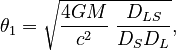
Here,  is the gravitational constant,
  is the mass of the lens, and
  is the speed of light. The
  values represent the distances to the lens, the source, and between them. This formula helps scientists understand the scale of these cosmic rings.
A Brief History of Einstein Rings
Early Predictions and Doubts
The idea that gravity could bend light was first predicted by Albert Einstein in 1912. This was even before he published his famous theory of general relativity in 1916. Later, in 1924, a scientist named Orest Khvolson wrote about a "halo effect" that could happen if a light source, a massive object, and an observer were perfectly lined up.
In 1936, Einstein himself discussed this ring effect. However, he thought it would be impossible to see. He believed that we would never be perfectly aligned enough, and our telescopes wouldn't be powerful enough. Einstein was mostly thinking about rings formed by individual stars. He didn't realize that much larger objects, like entire galaxies or black holes, could create bigger, easier-to-spot rings.
First Discoveries
Scientists later proved Einstein wrong about the impossibility of seeing these rings. The first complete Einstein ring, named B1938+666, was discovered in 1998. This amazing find was made by astronomers using the Hubble Space Telescope and working with the University of Manchester.
While no star has ever been observed forming an Einstein ring with another star, scientists predict a chance of this happening in early May 2028. This is when Alpha Centauri A might pass between us and a distant red star.
Amazing Einstein Rings We've Found

Hundreds of gravitational lenses are known today. About half a dozen of these are partial Einstein rings. A perfect Einstein ring is rare because the objects need to be perfectly aligned. Most of these rings have been found using radio telescopes.
Radio and Optical Rings
The very first Einstein ring was discovered in 1988 by scientists observing a radio source called MG1131+0456. They saw a quasar (a very bright, distant object) that was bent by a closer galaxy. This created two separate, but similar, images of the quasar, stretched into an almost complete ring.
In 1989, another radio ring was found around galaxy MG1654+1346. The image in this ring was a radio lobe from a quasar.
Famous Examples
The first complete Einstein ring, B1938+666, was discovered in 1998. It showed an ancient elliptical galaxy acting as a lens. Through this lens, scientists saw a dark dwarf galaxy that would otherwise be invisible to our current technology.
In 2005, a project called the Sloan Lens ACS (SLACS) Survey used the Sloan Digital Sky Survey and the Hubble Space Telescope. They found 19 new gravitational lenses, and 8 of these showed Einstein rings. This survey has found many Einstein rings, especially in visible light.
Here are some cool examples:
- FOR J0332-3557: Discovered in 2005, this ring has a very high redshift. This means it's incredibly far away, allowing us to study the early universe.
- The "Cosmic Horseshoe": This is a partial Einstein ring discovered in 2007. It was seen through the gravitational lens of a huge galaxy called LRG 3-757.
- SDSSJ0946+1006: This is a special "double Einstein ring" discovered in 2008. It has multiple rings, which helps scientists learn about dark matter and dark energy.
- PKS 1830-211: This Einstein ring is very bright in radio waves and X-rays. It was the first time scientists saw a quasar being lensed by a spiral galaxy that was almost facing us.
More recently, in June 2023, a team of astronomers led by Justin Spilker announced an exciting discovery. They found an Einstein ring of a distant galaxy that was rich in organic molecules.
In September 2023, scientist Bruno Altieri spotted a hint of an Einstein ring in data from the Euclid space telescope. This ring was in galaxy NGC 6505, about 600 million light-years away.
Then, in February 2025, the Euclid space telescope captured a nearly perfect Einstein ring around galaxy NGC 6505. This amazing image showed light from a background galaxy, located 4.42 billion light-years away, being bent by NGC 6505.
Double and Multiple Rings

Seeing More Than One Ring
Sometimes, we can see more than one Einstein ring at once! Using the Hubble Space Telescope, scientists found a "double ring" from three galaxies at different distances: 3, 6, and 11 billion light-years away.
These multiple rings are incredibly useful. They help astronomers understand how dark matter is spread out in the universe. They also give clues about dark energy and the overall curvature of the universe. Finding such a double ring around a massive galaxy is very rare, about 1 in 10,000! Studying many of these double rings could help us measure the universe's dark matter and dark energy with great accuracy.
Black Hole Simulations
Scientists can also create computer simulations to understand Einstein rings better. One simulation shows what it might look like if a black hole passed in front of our Milky Way galaxy. The simulation reveals a series of extra rings, getting thinner and closer to the black hole's shadow. These are actually multiple images of the galactic disc, stretched and bent by the black hole's immense gravity.
Gallery
-
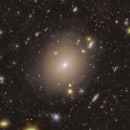
Euclid image of a bright Einstein ring around galaxy NGC 6505
-
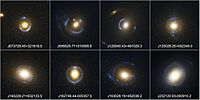
Some observed Einstein rings by SLACS
-
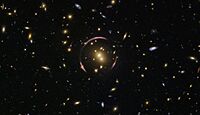
Graceful arcs around SDSSJ0146-0929 are examples of an Einstein ring
-
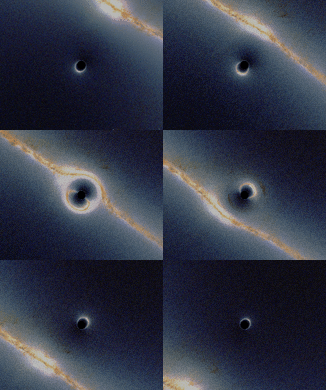
A simulated view of a black hole passing in front of a galaxy
-
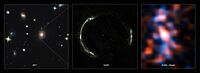
Montage of the SDP.81 Einstein ring and the lensed galaxy
-
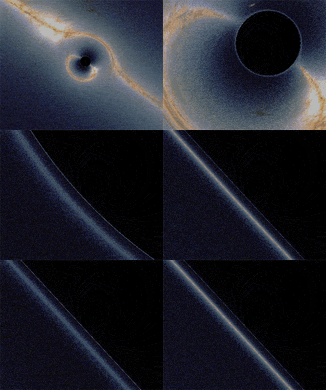
Einstein rings close to a black hole
-
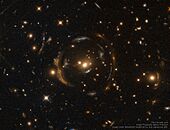
The Carousel Lens shows 7 individual galaxies lensed by one core. Additional lenses are seen further out.
.jpg)


See also
- Einstein Cross
- Einstein radius
- Gravitational mirage
