
HMS Rothesay (F107) facts for kids
_MOD_45139938.jpg)
Saluting HMY Britannia, the royal yacht in the 1960s, before Rothesay's 1966 Seacat/helicopter upgrade – note the 40 mm gun in stern
|
|
Quick facts for kids History |
|
|---|---|
 United Kingdom United Kingdom |
|
| Name | Rothesay |
| Builder | Yarrow, Scotstoun |
| Laid down | 6 November 1956 |
| Launched | 9 December 1957 |
| Commissioned | 23 April 1960 |
| Decommissioned | March 1988 |
| Identification | Pennant number: F107 |
| Fate | Scrapped in 1988 |
| General characteristics | |
| Class and type | Rothesay-class frigate |
| Displacement |
|
| Length | 370 ft (110 m) |
| Beam | 41 ft (12 m) |
| Draught | 17.3 ft (5.3 m) |
| Propulsion |
|
| Speed | 30 knots (56 km/h) |
| Range | 400 tons oil fuel, 5,200 nautical miles (9,600 km) at 12 knots (22 km/h) |
| Complement | 152, later 225, modified to 235 |
| Sensors and processing systems |
|
| Armament |
|
HMS Rothesay was a special type of frigate built for the British Royal Navy. She was the first ship in her class, known as the Rothesay or Type 12M class. These ships were designed to hunt and destroy enemy submarines. Rothesay started her service in 1960 and was taken out of service in 1988.
Contents
Building a Warship: The Rothesay Class Design
The Rothesay-class ships were an improved version of an earlier type of frigate called the Whitby-class. Nine Rothesay-class ships were ordered to join the Royal Navy fleet.
Size and Speed of the Rothesay
Rothesay was about 370 feet 0 inches (112.78 m) long from end to end. She was 41 feet 0 inches (12.50 m) wide and sat 13 feet 6 inches (4.11 m) deep in the water. The ship was powered by two large steam turbines. These engines gave her a speed of about 29.5 knots (33.9 mph; 54.6 km/h), which is very fast for a ship of her size. She had a crew of around 212 sailors.
Weapons and Equipment on Board
When first built, Rothesay had a powerful twin 4.5-inch (113 mm) gun at the front. She also had a 40 mm Bofors anti-aircraft gun at the back to protect against air attacks. For hunting submarines, she carried two Limbo anti-submarine mortars. These fired special bombs into the water. She also had torpedo tubes for anti-submarine torpedoes, but these were later removed because they weren't very effective.
The ship used different types of radar to find targets in the air and on the surface. She also had sonar equipment to detect submarines underwater.
Construction and Launch
Rothesay was built at the Yarrow shipyard in Scotstoun, Scotland. Her construction began on 6 November 1956. She was launched into the water on 9 December 1957. The ship was officially ready for service on 23 April 1960.
Upgrading the Rothesay for Modern Warfare
From 1966 to 1968, Rothesay went through a big upgrade. This made her much more advanced, similar to the newer Leander class class ships.
New Features and Capabilities
A major change was adding a helicopter flight deck and a hangar at the back of the ship. This allowed Rothesay to carry a Westland Wasp helicopter. Helicopters were a huge help in finding and attacking submarines. To make space for the helicopter, one of the Limbo anti-submarine mortars was removed.
The old 40 mm gun was replaced with a Seacat missile system. This gave the ship better defense against aircraft. Two smaller 20 mm cannons were also added. The ship's radar and fire control systems were updated to be more modern and effective.
Rothesay in Action: A Ship's Journey
Rothesay had an active career, taking part in various operations and exercises around the world.
Early Missions and Incidents
In 1961, Rothesay was sent to Bermuda. Her mission was to be ready to protect British interests near Cuba. In 1962, she was involved in an accidental collision with a Turkish submarine during a NATO exercise.
A Star on Screen: Thunderball Appearance
During her time in the West Indies, Rothesay had a special role in the James Bond film Thunderball. She was filmed for three days, appearing for about 30 seconds in the movie. To make her look like James Bond's famous number, a canvas with a "0" was placed over part of her pennant number (F107) to make it read "007". The actors Sean Connery and Claudine Auger even came aboard the ship.
Rescue and Peacekeeping Operations
In January 1966, Rothesay rescued 134 refugees from Haiti. They had been trying to reach the Bahamas in a small fishing boat but got stuck on an uninhabited island. In 1969, Rothesay helped land soldiers from The Parachute Regiment on the island of Anguilla to help restore order.
The Cod War and Later Years
In 1973, Rothesay took part in the Cod War. This was a series of disputes between the UK and Iceland over fishing rights. She helped protect British fishing boats.
In 1977, Rothesay attended the Silver Jubilee Fleet Review, a big parade of ships celebrating Queen Elizabeth II's 25 years on the throne.
Final Years of Service
At the start of the Falklands War in 1982, Rothesay was being repaired. She was later stationed in the Caribbean during the conflict.
Although there were plans to retire her in 1983, Rothesay received another upgrade in 1985. She then served as a training ship for new sailors. Rothesay was finally taken out of service on 13 March 1988. During her long career, she traveled over 800,000 miles. She was later sold to Spain and taken apart for scrap in 1988.
Images for kids
-
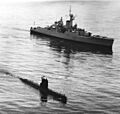
Rothesay with a Whiskey-class submarine in 1987.

