
Heliotropium facts for kids
Quick facts for kids Heliotropium |
|
|---|---|
 |
|
| Heliotropium arborescens | |
Scientific classification  |
|
| Kingdom: | Plantae |
| Clade: | Tracheophytes |
| Clade: | Angiosperms |
| Clade: | Eudicots |
| Clade: | Asterids |
| Order: | Boraginales |
| Family: | Boraginaceae |
| Subfamily: | Heliotropioideae |
| Genus: | Heliotropium Tourn. ex L. (1753) |
| Type species | |
| Heliotropium europaeum L.
|
|
| Species | |
|
250-300, see text |
|
| Synonyms | |
|
List
|
|
The Heliotropium is a group of flowering plants, often called heliotropes. There are about 325 different kinds, or species, in this group. Be careful, as these plants contain natural chemicals that can be harmful if eaten by pets like dogs and cats, or even by humans.
Contents
What Heliotropes Look Like

Heliotropes are usually small plants or shrubs. Their flowers often have five parts, arranged in a neat, star-like shape. They also have special parts for reproduction, like a unique style and stigma. When the flowers turn into fruit, these fruits are usually dry and split into two or four smaller pieces.
How Scientists Group Heliotropes
Scientists study plants to understand how they are related. They use clues like a plant's features and its genetic information. This helps them group similar plants together. For example, some plants once thought to be part of Heliotropium are now in their own group called Euploca. On the other hand, another group called Tournefortia was added to Heliotropium in 2016. The Heliotropium plants belong to a larger plant family called Heliotropiaceae. This family is part of an even bigger group called Boraginales.
How Heliotropes Spread and Changed
Many types of Heliotropium plants first appeared and grew in South America. From there, some of these plants traveled to other parts of the world, like the Old World (Europe, Asia, and Africa). Scientists believe this happened through a single journey long ago.
A big reason why so many different kinds of Heliotropium plants exist in the New World (the Americas) is because of the Andes mountains. When the Andes rose up, they created new environments. This helped different groups of Heliotropium plants to grow and change over time.
For example, as the Andes grew taller, some Heliotropium groups became separated. One group, called Cochranea, ended up mostly on the western side of the mountains. Another group, Tournefortia, grew more on the eastern side. The mountains also changed the weather, creating dry areas like the Atacama Desert. These changes helped new species form because plants adapted to their specific environments.
Different Kinds of Heliotropes
There are about 325 different species in the Heliotropium group. Here are some of them:
- Heliotropium amplexicaule Vahl – clasping heliotrope, summer heliotrope, blue heliotrope
- Heliotropium anderssonii
- Heliotropium angiospermum
- Heliotropium anomalum Hook. & Arn. – Polynesian heliotrope, Pacific heliotrope (Pacific Islands)
- Heliotropium anomalum var. argenteum – hinahina kū kahakai (Hawaii)
- Heliotropium arborescens – garden heliotrope, common heliotrope, cherry pie
- Heliotropium argenteum
- Heliotropium asperrimum R.Br.
- Heliotropium balfourii
- Heliotropium bracteatum R.Br.
- Heliotropium conocarpum F.Muell. ex Benth.
- Heliotropium crispatum F.Muell. ex Benth.
- Heliotropium diversifolium F.Muell. ex Benth.
- Heliotropium chenopodiaceum (A.DC.) Clos.
- Heliotropium claussenii DC.
- Heliotropium curassavicum L. – seaside heliotrope, salt heliotrope, monkey tail, quail plant, Chinese parsley; cola de mico (Spanish)
- Heliotropium dentatum
- Heliotropium derafontense
- Heliotropium ellipticum
- Heliotropium epacrideum F.Muell. ex Benth.
- Heliotropium europaeum L. – European heliotrope, European turnsole (Europe, Asia, and North Africa)
- Heliotropium fasciculatum R.Br.
- Heliotropium flintii F.Muell. ex A.S.Mitch.
- Heliotropium foertherianum Diane & Hilger – tree heliotrope, velvet soldierbush, octopus bush (South Asia, East Asia, Melanesia, western Polynesia, northern Australia)
- Heliotropium foliatum R.Br.
- Heliotropium glabellum R.Br.
- Heliotropium heteranthum (F.Muell.) Ewart & O.B.Davies
- Heliotropium indicum L. – Indian turnsole
- Heliotropium keralense Sivar. & Manilal
- Heliotropium kuriense
- Heliotropium laceolatum Loefg.
- Heliotropium lineariifolium Phil.
- Heliotropium megalanthumn I.M.Johnst.
- Heliotropium nigricans
- Heliotropium paniculatum R.Br.
- Heliotropium pannifolium – St. Helena heliotrope (Saint Helena) (extinct, c. 1820)
- Heliotropium pauciflorum R.Br.
- Heliotropium paulayanum
- Heliotropium pleiopterum F.Muell.
- Heliotropium popovii
- Heliotropium prostratum R.Br.
- Heliotropium ramosissimum
- Heliotropium riebeckii
- Heliotropium shoabense
- Heliotropium sinuatum (Miers) I.M.Johnst.
- Heliotropium socotranum
- Heliotropium stenophyllum
- Heliotropium strigosum Willd.
- Heliotropium tenellum
- Heliotropium ventricosum R.Br.
- Heliotropium wagneri
- Heliotropium aff. wagneri (Samhah, Yemen)
What's in a Name?
The name Heliotropium comes from ancient Greek words. Helios means "Sun" and trepein means "to turn". People in the past thought that the flowers of these plants always turned to face the Sun, just like a sunflower. This is why they were given the name heliotrope, or "turnsole" in Middle English.
Where Heliotropes Grow
You can find Heliotropium plants almost everywhere in the world. They grow in many different places and climates.
Heliotropes and Other Living Things
Some butterflies, like the male queen butterfly, like to visit heliotrope plants. They are drawn to certain natural chemicals in the plants. Also, the caterpillars of a tiny butterfly called the grass jewel enjoy eating the leaves of one type of heliotrope, H. strigosum.
Important Safety Information: Heliotrope Toxicity
It's very important to know that Heliotropium plants are harmful if eaten. They contain natural chemicals that can make animals and people sick. This is why they are considered poisonous to pets like dogs and cats, and also to humans.
While most animals usually avoid eating these plants because they don't taste good, sometimes farm animals like horses, pigs, and cattle can accidentally eat them if the plants get mixed into their hay. Eating too much of these plants can cause serious health problems.
Scientists have known for a long time that parts of the heliotrope plant, especially its seeds, can cause liver problems if eaten in large amounts. This can happen if the seeds accidentally mix with food crops. So, remember, it's best not to eat any part of a heliotrope plant.
How People Use Heliotropes
Many people love to grow heliotropes in their gardens because of their beautiful flowers and pleasant smell. One popular type is the garden heliotrope.
In places like Southern Europe, garden heliotropes are grown to make perfume. Their unique scent is a key ingredient in many well-known fragrances.
Long ago, during the Middle Ages and Early Modern times, the juice from the flowers of the European heliotrope was even used as a food coloring in French cooking.
Heliotropes in Stories and Art
Heliotropes have appeared in old stories and art. In a classical myth from Ovid's Metamorphoses, a water nymph named Clytie was in love with the sun god Helios. When he didn't love her back, she turned into a heliotrope flower, which was said to always face the Sun.
In music, there's a famous ragtime piano song called "Heliotrope Bouquet". It was created in 1907 by Louis Chauvin and Scott Joplin.
Sometimes, a purplish skin rash is called a "heliotrope rash" because its color looks like the flowers of the Heliotropium arborescens plant.
See also
- Turnsole
- Heliotrope (disambiguation)
Images for kids
-
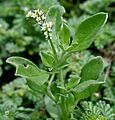
H. ovalifolium in India
-
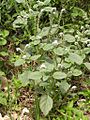
Heliotropium europaeum (European heliotrope)
-
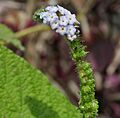
Heliotropium indicum inflorescence
-
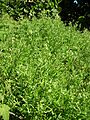
Heliotropium procumbens habit
-
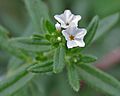
H. strigosum in India
-
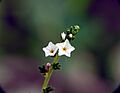
5-merosity in H. strigosum
_W_IMG_9949.jpg)

_W_IMG_9746.jpg)


