
I Have a Dream facts for kids
Quick facts for kids Part of the March on Washington for Jobs and Freedom and the civil rights movement |
|
.jpg)
Martin Luther King Jr. after delivering the speech
|
|
| Date | August 28, 1963 |
|---|---|
| Type | Speech |
| Motive | For African Americans to have civil and economic rights and an end to racism in the United States |
| Participants | Martin Luther King Jr. |
The "I Have a Dream" speech is one of the most famous speeches in American history. Martin Luther King Jr., a leader in the civil rights movement, gave this powerful speech on August 28, 1963. He spoke to over 250,000 people during the March on Washington for Jobs and Freedom. King stood on the steps of the Lincoln Memorial in Washington, D.C..
In his speech, King asked for equal rights and fair treatment for all people. He wanted an end to unfair laws and practices that hurt African Americans. He reminded everyone that even 100 years after slavery ended, many Black people still faced injustice. Towards the end, King spoke from his heart, repeating the famous words, "I have a dream." This part of his speech was inspired by the moment and a shout from singer Mahalia Jackson. Many people consider "I Have a Dream" to be one of the greatest speeches ever given.
Contents
The March for Freedom: Why it Happened
.jpg)
The March on Washington for Jobs and Freedom was a huge event. Its main goal was to show strong support for new laws. These laws, proposed by President John F. Kennedy, aimed to give all Americans equal rights. Leaders like Martin Luther King Jr. wanted the speeches to be peaceful. They wanted to avoid any actions that could lead to trouble. King also wanted his speech to honor Abraham Lincoln's famous Gettysburg Address. This was because the march happened 100 years after Lincoln's Emancipation Proclamation, which freed many enslaved people.
How the "Dream" Speech Came to Be
Martin Luther King Jr. had been talking about his "dream" for equality for several years. Since 1960, he gave speeches about the "American Dream" and how it wasn't a reality for African Americans. He spoke about the unfairness and lack of justice they faced. He believed that Black people could help America become a truly fair nation.
King used the idea of a "dream" in many of his speeches. He talked about students and activists who dreamed of a better, more equal America. In 1962, he gave a speech in Rocky Mount, North Carolina, that included the "I have a dream" phrase. He also used this phrase in a speech in Detroit in June 1963. These earlier speeches helped shape the famous one he gave in Washington.
The "I Have a Dream" speech was not written all at once. It was a mix of ideas from different drafts. King worked on it with help from others. Even the night before the march, he was still deciding what to say. During the speech, he felt inspired and began to speak from his heart. He started repeating "I have a dream," and the crowd loved it. Singer Mahalia Jackson even encouraged him, shouting, "Tell 'em about the dream, Martin!"

The Powerful Words of the Speech
I still have a dream, a dream deeply rooted in the American dream – one day this nation will rise up and live up to its creed, "We hold these truths to be self evident: that all men are created equal." I have a dream ...
King's speech is a masterpiece of public speaking. He referred to important American documents. These included the Declaration of Independence and the United States Constitution. He also mentioned the Emancipation Proclamation. King began by saying, "Five score years ago..." This was a nod to Abraham Lincoln's Gettysburg Address. He spoke about the end of slavery as a "joyous daybreak."
King used a special speaking technique called anaphora. This means repeating a phrase at the start of sentences. He repeated "Now is the time" to show urgency. The most famous example is "I have a dream," which he said eight times. This helped him describe his vision for a united America. Other repeated phrases included "One hundred years later" and "Let freedom ring."
One of the most memorable parts of the speech is: "I have a dream that my four little children will one day live in a nation where they will not be judged by the color of their skin but by the content of their character. I have a dream today!"
John Lewis, another civil rights leader, said King's speech was incredibly powerful. He believed King inspired not just the people there, but also future generations. King's words reflected the unfair treatment Black people experienced. He used America's founding ideas of freedom and justice. He also connected these ideas to a spiritual message. King said that racial justice was part of God's will. He compared America's broken promises to a "bad check" that the marchers had come to cash.

Ideas and Inspirations in the Speech
King's speech drew on many sources. He had used the theme of "dreams" in his own speeches for years. He also quoted from the patriotic song "America (My Country, 'Tis of Thee)". The Bible was another major source of inspiration for his words. The idea that constitutional rights were an "unfulfilled promise" was also part of his message.
The speech's ending, with its call for freedom to ring from different mountains, was similar to a speech given by Archibald Carey Jr. in 1952. King also used ideas from a speech by activist Prathia Hall. She had used the phrase "I have a dream" in 1962. King's speech sounded like a sermon. It included many references to verses from the Bible.
How People Reacted to the Speech
You could feel "the passion of the people flowing up to him," James Baldwin, a skeptic of that day's March on Washington, later wrote, and in that moment, "it almost seemed that we stood on a height, and could see our inheritance; perhaps we could make the kingdom real."
The speech was highly praised right after the event. Many people saw it as the most important part of the March on Washington. James Reston from The New York Times wrote that King's speech touched on all the day's themes. He said King's words were like those of Lincoln and Mahatma Gandhi. Reston also noted that the event was widely covered by television and the press.
Other newspapers also praised King's speech. The Boston Globe said it "caught the mood" of the day. The Washington Post wrote that it "rose above mere oratory." The Los Angeles Times called King "a supreme orator." They said his powerful words inspired America's conscience.
Some government officials were concerned about King's growing influence. They saw him as a powerful leader. President Kennedy watched the speech on television and was very impressed. He felt the march helped his efforts to pass new civil rights laws. The march was seen as a great success. There were no arrests related to the demonstration.
The Speech's Lasting Impact

The March on Washington helped push for new civil rights laws. These laws were later passed as the Civil Rights Act of 1964. After the speech, King was named "Man of the Year" by TIME magazine in 1963. In 1964, he became the youngest person to win the Nobel Peace Prize.
The full text of the speech was not widely published until 1983. This was 15 years after King's death. In 2002, the Library of Congress added the speech to the United States National Recording Registry. This registry preserves important sound recordings. In 2003, a special marble pedestal was placed at the Lincoln Memorial. It marks the exact spot where King delivered his speech.
The Martin Luther King Jr. Memorial was dedicated in Washington, D.C., in 2011. Its main feature is a large sculpture of King. It is based on a line from his speech: "Out of a mountain of despair, a stone of hope."

On August 28, 2013, thousands gathered in Washington, D.C. They celebrated the 50th anniversary of the speech. Former Presidents Bill Clinton and Jimmy Carter attended. President Barack Obama also spoke about the event's importance. Many of King's family members were there.
In 2016, Treasury Secretary Jacob Lew announced a redesign for the US $5 bill. The back of the bill, which features the Lincoln Memorial, will show images from King's speech. Also in 2016, a film called August 28: A Day in the Life of a People debuted. It highlights six important events in African-American history that happened on August 28, including King's speech.
In 2017, a statue of Martin Luther King Jr. was unveiled. It stands on the grounds of the Georgia State Capitol. This happened on the 54th anniversary of the speech. In 2021, Time magazine and Epic Games created an interactive exhibit. It was dedicated to the speech within the game Fortnite Creative.
Images for kids
-
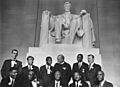
Leaders of the March on Washington in front of the Abraham Lincoln statue on August 28, 1963.
.jpg)
See also
 In Spanish: Yo tengo un sueño para niños
