
Kelp facts for kids
Quick facts for kids Kelp |
|
|---|---|
 |
|
Scientific classification  |
|
| Clade: | SAR |
| Phylum: | Ochrophyta |
| Class: | Phaeophyceae |
| Order: | Laminariales Migula, 1909 |
| Families | |
|
Agaraceae |
|
Kelps are very large brown algae that grow in cold ocean waters. Even though they look like tall underwater trees, kelp is actually a kind of seaweed. Kelp uses chloroplasts to create energy through photosynthesis. However, kelp is not a true plant. Instead, scientists classify it as a stramenopile.
These underwater giants grow together in huge groups called kelp forests. Kelp needs cool water that is full of nutrients, usually between 6 and 14 degrees Celsius (43 to 57 degrees Fahrenheit). Kelp is famous for growing extremely fast. Types like Macrocystis and Nereocystis can grow up to half a meter (20 inches) in a single day! They can eventually reach lengths of 30 to 80 meters (100 to 260 feet).
Contents
Kelp Anatomy and How It Grows

The body of a kelp organism is called a thallus. It has flat, leaf-like parts called blades that soak up sunlight. These blades attach to long, flexible stems called stipes. To keep from washing away in rough waves, kelp anchors itself to rocks on the seafloor with a root-like base called a holdfast.
Many species have small, gas-filled balloons called pneumatocysts. These air sacs provide buoyancy, which lifts the blades toward the surface where sunlight is brightest. The stipes are covered in a slippery mucilage that protects them from ocean friction.
Reproduction and Life Cycle
Kelp has a fascinating life cycle with two main stages. The large plant-like stage is called a diploid sporophyte. When it is mature, it releases millions of tiny spores into the ocean water.
These spores settle down and grow into tiny male and female stages called gametophytes. Through sexual reproduction, they combine to begin the next sporophyte stage, which grows into the giant seaweed we see today.
Kelp Forest Ecosystems


Kelp acts as an ecosystem engineer by creating safe underwater homes for thousands of sea creatures. In places like California and the coast of Norway, these dense forests shelter many kinds of marine life.
Tiny animals called sessile animals, such as sponges and sea squirts, attach directly to the kelp stipes. Countless crabs, snails, and fish hide among the blades. Some animals are even named after this seaweed, including the Northern kelp crab and the kelpfish.
However, these amazing forests face threats. Sea urchins love to eat kelp holdfasts. If predators like sea otters do not keep urchins under control, the urchins can eat an entire forest until it becomes a bare, rocky wasteland called an urchin barren. Ocean warming from climate change and marine pollution also harm these fragile underwater habitats.
Human Uses of Kelp

People have used kelp for thousands of years. Early coastal humans harvested abalone, limpets, and mussels from kelp beds. Today, kelp is harvested for many everyday goods:
- Food: Kelp such as kombu (Saccharina japonica) is an important ingredient in dashi broth and other Asian dishes. It contains lots of iron and iodine, which helps protect people against a throat illness called goiter.
- Alginate: This natural jelly-like substance is taken from kelp and added to foods like ice cream and salad dressing to make them thick and smooth. It is even used to make toothpaste and dental molds!
- Industry: In the 1800s, people burned kelp in Scotland to make soda ash (sodium carbonate), which was useful for making soap and glass.
Images for kids
-

Costaria costata, five-ribbed kelp
-

A diver exploring a kelp forest
-

Giant kelp in an aquarium exhibit
-

Blue rockfish swimming through kelp
-
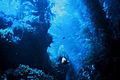
Sunlight shining down through a kelp canopy
-

Close-up view of the blade of Ecklonia maxima
-

Washed-up kelp resting on the sand at La Jolla Shores
-

Diver swimming in a thick kelp forest in California


See also
 In Spanish: Laminariales para niños
- Blue carbon
- Kelp forest
- Sea lettuce
