
Mars landing facts for kids

A Mars landing is when a spacecraft safely reaches the surface of Mars. Many robotic spacecraft have tried to land on Mars. So far, ten of these uncrewed missions have made a successful "soft landing." This means they landed gently without crashing. Scientists are also studying how to send humans to Mars, but no human landing has happened yet.
As of 2026, the Soviet Union, United States, and China have successfully landed spacecraft on Mars. The Soviet Mars 3 was the first to land in 1971. However, it stopped working after only 110 seconds. The American Viking 1 and Viking 2 were NASA's first successful landers, launched in 1975. NASA's Mars Pathfinder, launched in 1996, brought the first Mars rover, Sojourner, to the Martian surface. In 2021, China's first lander and rover, Tianwen 1, also landed successfully. The British Beagle 2 landed in 2003, but contact was lost. Its landing was only confirmed much later in 2015.
Contents
- How Spacecraft Land on Mars
- Future Landing Methods
- Challenges of Landing on Mars
- Talking to Earth from Mars
- History of Mars Landings
- Early Soviet Missions
- The Viking Program
- Mars Pathfinder and Sojourner
- Challenges in the Late 1990s
- Mars Express and Beagle 2
- Mars Exploration Rovers: Spirit and Opportunity
- Phoenix Lander
- Curiosity Rover (Mars Science Laboratory)
- ExoMars Schiaparelli
- InSight Lander
- Mars 2020 and Tianwen-1
- Future Missions
- Finding Landing Spots
- Twinned Locations on Earth
- See also
How Spacecraft Land on Mars
Landing on Mars is tricky! All spacecraft use a special shield called an aeroshell and a large parachute to slow down as they enter the Martian atmosphere. After the parachute separates, there are a few ways to finish the landing.
Landing a Stationary Lander
A stationary lander, which stays in one spot, can use small rockets called retrorockets. These rockets fire downwards to slow the craft even more, allowing it to land gently on its legs.
Landing Lighter Rovers with Airbags
For lighter rovers, engineers use a clever airbag system. The rover is packed inside a pyramid-shaped structure, which is then surrounded by airbags. After the parachute slows it down, the airbags inflate. The craft then bounces on the surface like a giant beach ball! Once it stops bouncing, the airbags deflate, and the rover opens up, ready to explore.
Landing Heavy Rovers with a Sky Crane
Heavier rovers, like Curiosity and Perseverance, are too big for airbags. They use something called a sky crane. This is a special platform with rockets. The sky crane lowers the rover on a long cable. Just before the rover touches the ground, it cuts the cable. The sky crane then flies away and crashes safely in the distance, leaving the rover ready to roll.
-
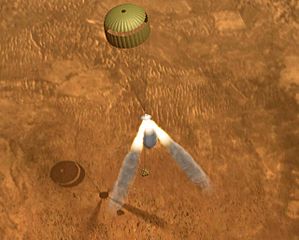
Landing in an airbag
-
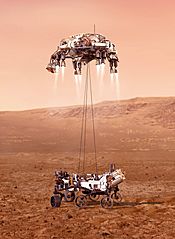
An illustration of Perseverance tethered to the sky crane
-
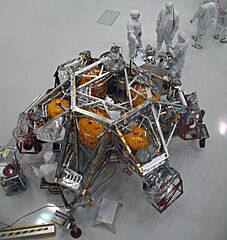
The MSL Descent Stage under construction on Earth
-
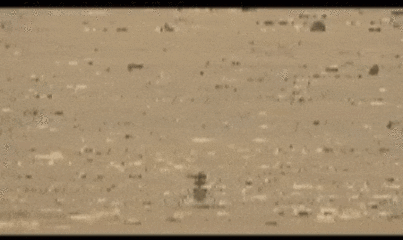
Ingenuity helicopter executing a vertical takeoff and landing

.jpg)


Future Landing Methods

Scientists are always looking for ways to land even bigger and heavier spacecraft on Mars. For very heavy landers, much larger than the Curiosity rover, new technologies are being developed. One idea is a special inflatable decelerator that can be much wider than current aeroshells. This would help slow down massive payloads more effectively.
Challenges of Landing on Mars
Landing on Mars is very difficult! It takes amazing technology to get a robotic spacecraft, and one day maybe even humans, safely to the surface. Here are some of the main challenges:
- The Martian atmosphere is very thin. This makes parachutes less effective for slowing down.
- It's hard to accurately measure the exact distance to the surface during a fast descent.
- The time available for the "entry, descent, and landing" (EDL) sequence is very short.
- We need even better technology for slowing down spacecraft using rockets and for entering the atmosphere.
NASA successfully landed the InSight lander in 2018. It used technology similar to the older Viking missions. However, this technology isn't enough to land very large amounts of equipment, living spaces, or humans for future crewed missions. To do that, we need to invent even more advanced technologies and launch vehicles.
Talking to Earth from Mars
Once a spacecraft lands on Mars, it needs to talk to Earth! Since the Viking missions, all Mars landers have used other spacecraft orbiting Mars as relay stations. The landers send their information to these orbiters using special radio signals. The orbiters then send that data much faster to Earth. This method helps save time for the large antennas on Earth that listen for signals from space.
History of Mars Landings

Many countries have tried to land on Mars. Some attempts have been successful, while others have faced challenges.
Early Soviet Missions
The Soviet Union made the first attempts to land on Mars. In 1962, Mars 1962B was the first probe designed to hit Mars, but it didn't succeed. Later, in 1971, Mars 2 crashed, but Mars 3 made the first soft landing. Sadly, it stopped working after only 14.5 seconds, possibly due to a huge dust storm. These missions also carried small rovers, but they were never deployed. In 1973, Mars 6 failed upon impact, and Mars 7 missed the planet entirely.
The Viking Program

In 1976, the American Viking probes successfully landed on Mars. These were a huge success! They sent back the first color pictures and lots of scientific information for several years. The Viking missions looked for signs of life. One experiment showed possible evidence, but other tests didn't confirm it.
Mars Pathfinder and Sojourner

NASA's Mars Pathfinder landed on July 4, 1997. It landed in a rocky area called Ares Vallis. This mission was special because it carried Sojourner, the first successful Mars rover. Sojourner explored the area, took pictures, and studied rocks. This mission showed that Mars might have been warm and wet with liquid water in the past.
Challenges in the Late 1990s
After Mars Pathfinder, there were several failures. Russia's Mars 96 failed to reach Mars. NASA also had problems with missions like Mars Climate Orbiter and Mars Polar Lander. The Mars Climate Orbiter even burned up because engineers used different measurement units by mistake!
Mars Express and Beagle 2
In 2003, the European Space Agency (ESA) sent Mars Express to Mars. It included an orbiter and a lander called Beagle 2. The Beagle 2 lander carried tools to dig and analyze the soil. Unfortunately, contact with Beagle 2 was lost during landing. It was declared lost, but its presence was finally confirmed in 2015. The orbiter, Mars Express, successfully found water ice at Mars's south pole.
Mars Exploration Rovers: Spirit and Opportunity
NASA launched two twin rovers, MER-A (Spirit) and MER-B (Opportunity), in 2003. Spirit landed in Gusev Crater in January 2004. Opportunity landed in Meridiani Planum later that month. Both rovers searched for signs of past water. Opportunity found strong evidence that its landing site was once covered by a salty sea!
These rovers were designed for only three months but lasted much longer. Spirit worked for over six years, and Opportunity explored for more than 14 years! They discovered many new things, including the first meteorite found on another planet.

Phoenix Lander

The Phoenix lander launched in 2007 and landed in Mars's northern polar region in 2008. It was the first time one spacecraft captured a photograph of another spacecraft landing on a planet!
Curiosity Rover (Mars Science Laboratory)
.png)
The Mars Science Laboratory mission, carrying the Curiosity rover, launched in 2011. It landed successfully in Gale Crater on August 6, 2012. NASA named the landing site "Bradbury Landing" after author Ray Bradbury. Curiosity continues to explore Mars, studying its geology and searching for signs of past microbial life.
ExoMars Schiaparelli

The Schiaparelli lander was part of the ExoMars project by the European Space Agency (ESA) and Roscosmos. It launched in 2016 and attempted a landing on October 19, 2016. Most of the landing steps worked, but contact was lost just before it touched down. Imagery later showed it had crashed.
InSight Lander

NASA's InSight lander launched in 2018. It landed successfully in Mars's Elysium Planitia on November 26, 2018. InSight was designed to study Mars's deep interior, including its "Marsquakes" and heat flow.
Mars 2020 and Tianwen-1
In July 2020, NASA launched Mars 2020 with the Perseverance rover, and China launched Tianwen-1. Perseverance landed successfully in Jezero Crater on February 18, 2021. It also deployed the Ingenuity helicopter, which made the first powered flights on another planet! Tianwen-1's lander and Zhurong rover landed in Utopia Planitia on May 14, 2021.
Future Missions
The ESA Rosalind Franklin rover is planned for launch in the late 2020s. It is designed to dig deep into the soil to look for signs of past life. There is also a proposal for a Mars Sample Return Mission by ESA and NASA, which would bring Martian samples back to Earth. The Indian Space Research Organisation (ISRO) has also proposed a Mars Lander Mission around 2030.
Finding Landing Spots

As a Mars lander gets closer to the surface, it's very important to find a safe place to land. Scientists use special cameras and maps to choose the best spots, avoiding dangerous rocks or steep slopes.

Twinned Locations on Earth
A filmmaker named Christopher Riley found places on Earth that match the exact latitude and longitude of NASA's Mars landing sites. He took pictures of these "twinned" spots on Earth and Mars to show how different they are. In 2022, a listener from India traveled to the Earth location that matches where the Perseverance rover landed. This person became the first to knowingly visit a spot on Earth that matches a robotic presence on another world! China's Tianwen-1 landing site maps to an area in Southern China.
See also
- Colonization of Mars
- Exploration of Mars
- Google Mars
- Human mission to Mars
- List of missions to Mars
- Mars race
- Mars rover
- Space weather
