
Moree, New South Wales facts for kids
Quick facts for kids MoreeNew South Wales |
|||||||||
|---|---|---|---|---|---|---|---|---|---|
.JPG)
Main Street, Moree, 2008
|
|||||||||

 Moree
Location in New South Wales
|
|||||||||
| Population | 7,070 (2021 census) | ||||||||
| Established | 1862 | ||||||||
| Postcode(s) | 2400 | ||||||||
| Elevation | 212 m (696 ft) | ||||||||
| Location |
|
||||||||
| LGA(s) | Moree Plains Shire | ||||||||
| County | Courallie | ||||||||
| State electorate(s) | Northern Tablelands | ||||||||
| Federal Division(s) | Parkes | ||||||||
|
|||||||||
Moree is a vibrant country town located in northern New South Wales, Australia. It sits along the banks of the Mehi River in the middle of vast, rich black-soil plains. The town serves as the main centre for the Moree Plains Shire local government area.
Moree is famous across Australia for two big things: its massive agricultural industry and its natural hot thermal springs. Farmers around Moree grow huge amounts of cotton, wheat, and other crops. Beneath the ground lies the famous Great Artesian Basin, which supplies natural mineral water to popular public thermal baths.
According to the official census, Moree had a population of 7,070 people. It connects easily to larger cities by both road and rail. The Newell Highway and Gwydir Highway intersect directly in the centre of town, making it a busy transport hub.
Contents
The Early History and Heritage of Moree
Indigenous Peoples and Traditional Lands
Long before European settlers arrived, the Kamilaroi and Weraerai peoples lived in this fertile region for thousands of years. They understood the waterways, plants, and animal life deeply. The name "Moree" is derived from an Aboriginal language word that translates to "rising sun," "water hole," or "long spring."
The Kamilaroi people built rich communities with complex social structures and deep spiritual connections to the land and waterways like the Gwydir River and Mehi River.
Early Exploration and Settlement
In 1832, the British surveyor and explorer Major Thomas Mitchell led an expedition into the area. He heard stories of a large river from an escaped convict named George Clarke. During this journey, Mitchell explored the surrounding plains and crossed the Mehi River just east of modern-day Moree.
Soon after Mitchell's reports, pastoralists and squatters arrived with flocks of sheep and herds of cattle. They claimed large tracts of land called pastoral stations. These stations included "Boolooroo" in 1837 and "Mooree" in 1838.
This rapid arrival caused major disruption to the traditional lifestyles of the Kamilaroi people. The newcomers took control of vital water sources and traditional hunting grounds, leading to severe conflicts during the era known as the Australian frontier wars.
Establishing the Township
In 1851, settlers James Brand and Mary Geddes arrived in the district. They established a general store along the Mehi River in 1852. A post office was added the following year to serve local farms.
After her husband passed away, Mary Brand returned to Moree and opened the town's first inn in 1861. She played a major role in establishing the early community.
Moree was officially gazetted as a town in 1862. Land sales began immediately, bringing new builders, traders, and families.
- 1863: A local court was established to settle legal matters.
- 1865: The first police constable was stationed in town.
- 1867: The first church, a Wesleyan Methodist building, was completed.
- 1876: The first commercial bank branch opened.
- 1881: The first local newspaper was published for 295 residents.
- 1890: Moree was officially proclaimed a municipality.
The town grew even faster when the railway opened in 1897. The rail line connected local farmers to markets in Sydney, allowing goods to travel quickly across the state.
.JPG)
The 1965 Freedom Ride and Civil Rights
Moree holds an important place in modern Australian history. In February 1965, a group of university students led by Aboriginal activist Charles Perkins organised the famous Freedom Ride.
The Freedom Riders travelled across regional New South Wales on a bus to highlight discrimination against Indigenous Australians. When the bus arrived at the Moree Baths and Swimming Pool, they found that Indigenous children were barred from swimming with other townspeople.
The Freedom Riders held peaceful demonstrations outside the swimming pool. Despite facing strong opposition, their actions drew national media coverage and sparked widespread discussion across Australia. Following the protests, the town changed its rules, allowing Aboriginal children equal access to the town swimming pool.
Aboriginal Missions and Reserves
During the late 19th and early 20th centuries, government policies required many Aboriginal people to live in state-controlled reserves. The Aborigines Protection Act 1909 led to difficult times, including policies that created the Stolen Generations.
To protect their families, many Aboriginal residents moved off official reserves and created self-managed communities known as Top Camp, Middle Camp, and Bottom Camp near Moree. In 1953, Bottom Camp was developed into the Mehi Crescent Reserve.
The community members created their own sports clubs, school associations, and social groups. Today, these sites remain important cultural landmarks for the local Kamilaroi community.
Heritage Buildings and Famous Landmarks
Moree retains many classic buildings from the late 19th and early 20th centuries. These structures reflect the architectural styles of the boom period when farming and railway transport flourished.
Listed Heritage Sites
- Moree Lands Office: A grand Federation-style two-storey building constructed from 1894 to 1903.
- Moree Courthouse: An impressive heritage courthouse where local law has operated since the late 19th century.
- Moree Club: A historic community building featuring classic regional Australian architecture.
- Victoria Hotel: A large heritage pub built to serve travelers arriving by rail and coach.
- Commercial Banking Company Building: A beautifully preserved brick financial building.
- Moree Baths and Swimming Pool: An iconic civil rights location and recreation centre.
Cultural Sites
Cultural sites around the town include the Steel Bridge Campsite, the Gamilaroi Nature Reserve, and the historic reserve at Terry Hie Hie. These locations celebrate the deep, continuing connection of Indigenous Australians to the regional landscape.
Geography, Farming, and Local Economy
The Agricultural Industry
Moree is known as an agricultural powerhouse. The surrounding plains feature deep, nutrient-rich black soil that retains moisture very well.
- Cotton Growing: Cotton was introduced on a large commercial scale during the 1960s. Moree became one of Australia's largest cotton-producing regions.
- Grain Farming: Farmers grow massive crops of wheat, barley, chickpeas, and sorghum.
- Pecan Nuts: The Trawalla Pecan Nut Farm, located east of Moree, is the largest pecan orchard in the Southern Hemisphere, home to around 75,000 nut trees.
- Olive Groves: The region produces high-quality olives and cold-pressed extra virgin olive oil.
- Livestock: Cattle and sheep farming remain central to the district economy.
The Great Artesian Basin and Thermal Springs
In 1895, engineers drilled a deep hole into the ground to find water for irrigation. When they tapped into the Great Artesian Basin at a depth of nearly 914 metres (3,000 feet), hot mineral water surged to the surface.
While the mineral-rich water was not ideal for watering crops, it proved perfect for thermal bathing. The natural hot springs stay warm year-round and contain dissolved minerals. The Moree Artesian Aquatic Centre attracts tens of thousands of visitors every year who visit to soak in the soothing hot pools.
Weather and Regional Climate
Moree experiences a humid subtropical climate with warm, sunny conditions throughout most of the year. Summers are hot and sometimes humid, while winters are mild and dry with cool nights.
- Summer (December to February): Daytime highs average between 33°C and 35°C (91°F to 95°F), with occasional high heat waves exceeding 40°C.
- Winter (June to August): Daytime temperatures average around 18°C to 20°C (64°F to 68°F), with overnight lows dropping near 4°C (39°F) and occasional light frosts.
- Sunshine: Moree receives over 3,300 hours of bright sunshine each year.
| Climate data for Moree Aero (1995–2024) | |||||||||||||
|---|---|---|---|---|---|---|---|---|---|---|---|---|---|
| Month | Jan | Feb | Mar | Apr | May | Jun | Jul | Aug | Sep | Oct | Nov | Dec | Year |
| Mean daily maximum °C (°F) | 34.4 (93.9) |
33.3 (91.9) |
31.2 (88.2) |
27.3 (81.1) |
22.6 (72.7) |
18.9 (66.0) |
18.4 (65.1) |
20.7 (69.3) |
24.6 (76.3) |
28.2 (82.8) |
30.9 (87.6) |
33.0 (91.4) |
27.0 (80.5) |
| Mean daily minimum °C (°F) | 20.5 (68.9) |
19.7 (67.5) |
17.5 (63.5) |
12.8 (55.0) |
8.3 (46.9) |
5.9 (42.6) |
4.6 (40.3) |
5.5 (41.9) |
9.0 (48.2) |
12.9 (55.2) |
16.4 (61.5) |
18.6 (65.5) |
12.6 (54.8) |
| Average precipitation mm (inches) | 77.1 (3.04) |
66.6 (2.62) |
61.8 (2.43) |
23.6 (0.93) |
29.2 (1.15) |
36.8 (1.45) |
33.2 (1.31) |
25.8 (1.02) |
35.1 (1.38) |
50.2 (1.98) |
74.1 (2.92) |
66.4 (2.61) |
577.8 (22.75) |
| Source: Bureau of Meteorology | |||||||||||||
Floods and Water Management
Because Moree is built on a very flat floodplain along the Mehi and Gwydir river systems, major rainfall upstream can cause large floods.
Historic Floods
- 1955: The largest flood on record peaked at 10.85 metres, submerging over 800 homes and the town business centre.
- 1971 and 1976: Major floods reached peaks over 10.3 metres, isolating the town for days.
- 2012: The second-highest flood in town history reached 10.69 metres, forcing town-wide evacuations.
- 2021 and 2022: Heavy regional rains caused the Mehi River to rise above major flood stages, requiring extensive rescue and emergency management efforts.
Community Life, Arts, and Culture

Moree has a rich community life with galleries, libraries, parks, and sporting clubs.
Art and Museums
- BAMM (Bank Art Museum Moree): Located in a restored historic bank building, BAMM houses one of the most significant regional collections of Indigenous Australian art in New South Wales. It features regular exhibitions by local and national artists.
- Photography Collections: The museum holds A Common Place: Portraits of Moree Murries, a renowned photographic collection created in 1990 by Indigenous artist Michael Riley.
- Moree Community Library: A modern hub providing learning resources, reading programs, and internet access for local students and families.
Sports and Recreation
Rugby league is by far the most popular sport in Moree. The town supports two major teams:
- Moree Boars: Competing in the Group 4 Rugby League competition at Boughton Oval.
- Moree Boomerangs: A famous and historic Indigenous rugby league club competing in Group 19 Rugby League at Burt Jovanovich Oval.
Other popular sports include rugby union with the Moree Weebolla Bulls, Australian rules football with the Moree Suns, cricket, netball, and swimming.
Transport and Infrastructure

Moree is a well-connected regional crossroads:
- Road: The town sits at the intersection of the Newell Highway (linking Victoria to Queensland) and the Gwydir Highway (linking the coast to the outback).
- Rail: Moree railway station opened in 1897. Daily NSW TrainLink Xplorer passenger trains connect Moree directly to Sydney.
- Air: Moree Airport provides scheduled regional passenger flights to Sydney.
- Bus and Coach: Long-distance bus services connect Moree to Grafton, Brisbane, and surrounding regional towns.
Notable People
Several famous Australians were born in Moree or lived there:
- Mary Brand (1827–1900): Pioneer businesswoman, first shopkeeper, and hotelier in Moree.
- Edward Dickens (1852–1902): Politician and the youngest son of world-famous author Charles Dickens.
- Mary Gaudron: The first female Justice appointed to the High Court of Australia.
- Emma Moffatt: Olympic triathlete who won a bronze medal at the 2008 Beijing Olympics and two World Championships.
- Cameron Hammond: Professional boxer who represented Australia at the 2012 Summer Olympics in London.
- Michael Riley (1960–2004): Acclaimed Indigenous artist, photographer, and documentary filmmaker.
- John Williamson: Award-winning Australian country music singer and songwriter who has strong family roots in Moree.
- Peter Taylor: Former international spin bowler for the Australian national cricket team.
Images for kids
-
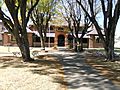
Moree Courthouse on Frome Street
-
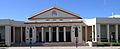
Moree Memorial Hall and Library
-
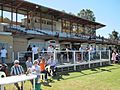
Moree Racecourse
-
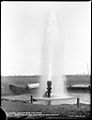
Historic Artesian Bore in East Moree
-
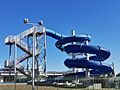
The Moree Artesian Aquatic Centre pools
-

A bridge across the waterway in Moree
.JPG)


.jpg)


