
Romance languages facts for kids
Quick facts for kids Romance |
|
|---|---|
| Neo-Latin, Latinic | |
| Geographic distribution: |
Originated in Old Latium on the Italian Peninsula Spoken in Latin Europe (parts of Eastern, Southern, and Western Europe), much of the Americas, parts of Africa, and small parts of Asia and Oceania |
| Linguistic classification: | Indo-European
|
| Proto-language: | Proto-Romance |
| Subdivisions: |
Southern Romance
Pannonian †
British †
African Romance †
|
| ISO 639-2 and 639-5: | roa |
 Romance languages in Europe
|
|
 Romance languages globally
Majority native language Co-official and majority native language Official but minority native language Cultural or secondary language |
|
The Romance languages, or Latin languages, are modern languages that came from Vulgar Latin. They belong to the larger family of Indo-European languages. Long ago, people living in the Roman Empire spoke Latin every day. Over centuries, local accents and word habits changed into brand-new tongues. The largest Romance languages today are Spanish, Portuguese, French, Italian, and Romanian. More than 900 million people speak a Romance language as their native tongue. These languages are heard across Europe, the Americas, and parts of Africa.
Contents
What Are the Romance Languages?

The name Romance comes from an old Latin word, romanice. That word meant "to speak like a Roman." Long ago, common people spoke ordinary street speech called the vernacular. In contrast, scholars used formal Latin in books and laws. Over time, that spoken everyday tongue came to be called Romance.
These languages form what linguists call a dialect continuum. That means speech changes slightly from town to town. If you travel slowly across the countryside, neighbors always understand one another. However, towns far apart sound like completely different tongues. Linguists test whether travelers can understand each other using mutual intelligibility. When speech forms become very different, they count as separate languages.
Romance languages are sorted into several broad geographic families:
- Ibero-Romance: Spanish, Portuguese, Galician, Asturleonese, and Aragonese.
- Occitano-Romance: Catalan and Occitan.
- Gallo-Romance: Oïl languages including French, and Franco-Provençal.
- Rhaeto-Romance: Romansh, Ladin, and Friulian.
- Gallo-Italic: Piedmontese, Ligurian, Lombard, and Emilian.
- Venetian in northeastern Italy.
- Central Romance: Italian, Corsican, Sicilian, and Neapolitan.
- Eastern Romance: Romanian, Aromanian, and Megleno-Romanian.
- Southern Romance: Sardinian and the extinct African Romance.
Where Are Romance Languages Spoken Today?

Romance tongues serve as an official language or national language in dozens of countries. In Europe, they are official in Spain, France, Portugal, Italy, Romania, Moldova, Switzerland, Belgium, Luxembourg, Andorra, Monaco, San Marino, and Vatican City. Five of them are official working tongues of the European Union. Furthermore, Spanish and French serve as official languages of the United Nations.
Outside Europe, these languages spread through history and trade. Spanish is an official language across Mexico, much of Central America, and nine countries in South America. It is also widely spoken across the Caribbean in Cuba, the Dominican Republic, and Puerto Rico. In the United States, Spanish is spoken by over 45 million people. Many Hispanic and Latino Americans use Spanish daily in states like California, Texas, and Florida. In Africa, Spanish is the main official tongue in Equatorial Guinea.
Portuguese has over 200 million speakers in Brazil alone. That makes Portuguese the most spoken Romance language within a single nation. In Africa, Portuguese is an official tongue in Angola, Mozambique, Cape Verde, Guinea-Bissau, and São Tomé and Príncipe. In Asia, speakers live in East Timor and Macau. Many Japanese Brazilian families who returned to live in Japan also speak Portuguese.
French has millions of native speakers in Canada, mostly in Quebec, New Brunswick, and Ontario. Official bilingualism in Canada ensures public services exist in both English and French. Across the Caribbean, French is spoken alongside local tongues like Haitian Creole in Haiti. In many nations across western and central Africa, French is used in schools and government offices.
Italian is spoken mainly in Italy and parts of Switzerland. Immigrant families also carried Italian to Australia, the United States, and South America. Meanwhile, Romanian is spoken across Romania and Moldova, with regional speakers in Serbia, Ukraine, and Hungary. Small communities of speakers also live in Israel.
Around the world, people speak many smaller regional languages. Catalan is official in Andorra, Catalonia, the Valencian Community, and the Balearic Islands. It is also spoken in the town of Alghero on the island of Sardinia. Galician is spoken in northwestern Spain. Other unique regional tongues include Romansh in Switzerland, Asturian in Spain, and Friulian in Italy. Today, the Red Book of Endangered Languages helps experts protect rare dialects from disappearing.
How Did Romance Languages Develop?

All Romance languages began with the ancient campaign history of the Roman military. Roman soldiers, traders, and settlers marched across Europe, North Africa, and the Mediterranean. Wherever they settled, they brought their speech with them. Latin gradually replaced older local tongues like Celtic languages.
The Rise of Vulgar Latin
The everyday spoken tongue of the people was called Vulgar Latin. It was different from formal classical Latin used by famous authors like Cicero. Everyday speech was spoken by soldiers, farmers, and traders across Southern Europe, Western Europe, and Central Europe.
Spoken words constantly changed over time. People began simplifying grammar rules. For instance, classical Latin used complex noun endings called cases. Vulgar Latin slowly dropped cases, using simple prepositions instead. Word order settled into a neat SVO pattern.
The Breakup of the Roman Empire
During the fifth century, the fall of the Western Roman Empire changed everything. Large groups moved across Europe during the Migration Period. Roads fell into disrepair, travel slowed, and regions lost regular contact with Rome.
In some places, Latin faded away completely. British Latin vanished from Roman Britain, and Latin disappeared from Pannonia. However, in lands like Roman Italy, Gaul, and Hispania, local populations kept using Romance forms. The newly arrived Germanic tribes learned the local Romance speech. Each region developed its own unique accent and vocabulary.
In the east, migrations of Slavs altered speech patterns across the Balkans. The Eastern Roman Empire fell after the capture of Constantinople in 1453. In those eastern lands, two Romance branches survived: the extinct Dalmatian language and early Romanian.
Early Written Romance

By the eighth century, ordinary churchgoers could no longer follow Latin services. In 813, church leaders at the Council of Tours 813 ordered priests to give sermons in local Romance speech. This famous decision proved that Romance had officially become separate languages.
Scholars can study these early changes in old word lists like the Reichenau Glossary. This eighth-century list translated difficult old Latin words into everyday words. By the ninth century, rulers wrote treaties in local speech, including the famous Oaths of Strasbourg. Over time, great writers used vernacular speech for poetry. In Italy, famous poets like Dante Alighieri wrote classic books in early Italian. Later, the invention of the printing press helped turn selected dialects into the standard national languages we know today.
How Sounds and Words Changed
As Latin transformed into modern tongues, sounds changed in regular, predictable ways. Linguists compare words across different languages to trace these transformations.
Dropping Endings and Softening Sounds
Latin words once featured many final consonant sounds. Over time, speakers stopped pronouncing word endings. This process is called apocope. For instance, final -m disappeared almost everywhere in spoken Latin.
Consonants sitting between two vowels often softened through a shift called lenition. Strong stop consonants like p, t, and c turned into softer voiced sounds like b, d, and g. Sometimes they disappeared entirely.
- Latin vītam ("life") stayed vita in Italian.
- It softened into vida in Spanish and Portuguese.
- It softened so much that it became vie in French.
Vowels and Accent Changes
Ancient Latin relied on vowel length, meaning vowels were pronounced either long or short. Over centuries, speakers stopped using length to tell words apart. Instead, vowels changed into open and closed sounds.
Many languages turned simple vowels into two sounds called a diphthong. This step is called diphthongization:
- Latin focum ("fire") became fuoco in Italian.
- It became fuego in Spanish.
- It became feu in French.
In French and Portuguese, vowels placed before m or n turned into nasal vowel sounds. In Western Romance, words starting with s and a consonant added an extra vowel at the start. For example, Latin spatha ("sword") became espada in Spanish and Portuguese, and épée in French.
Comparing Words Across Languages
Here is how one simple sentence looks in various Romance languages: "She always closes the window before dining."
- Latin: Ea semper antequam cenat fenestram claudit.
- Italian: Lei chiude sempre la finestra prima di cenare.
- Spanish: Ella siempre cierra la ventana antes de cenar.
- Portuguese: Ela fecha sempre a janela antes de jantar.
- French: Elle ferme toujours la fenêtre avant de dîner.
- Catalan: Ella sempre tanca la finestra abans de sopar.
- Romanian: Ea închide întotdeauna fereastra înainte de a cina.
- Romansh: Ella clauda adina la fanestra avant ch'ella tschainia.
Many words share a single root because they are cognate words. For example, the Latin word for window was fenestra. It survives directly in Italian finestra, French fenêtre, Romanian fereastră, and German Fenster. Meanwhile, Spanish ventana comes from the Latin root for wind, ventus.
Alphabets, Creoles, and New Tongues
.svg)
Romance languages rely on the Latin alphabet. Over time, writers added new letters and combinations to spell sounds that ancient Latin never possessed.
Special Letters and Marks
The original Roman alphabet contained 23 letters. Writers later split V into vowel U and consonant V. They also split I into letter I and consonant J. Writers created pairs of letters called digraphs to write new sounds:
- CH makes the "k" sound in Italian, but the "ch" sound in Spanish.
- GN makes a special sound in French and Italian, like in champignon.
- NH in Portuguese and NY in Catalan write that very same nasal sound.
- Spanish created the letter ñ with a little wavy mark called a tilde.
Writers also added accent marks called diacritics. An acute accent (é) or grave accent (è) can show which syllable is stressed. Accents also show whether a vowel is open or closed. Small marks can even tell words apart, like Spanish si ("if") versus sí ("yes").
Creoles and Invented Tongues
When Romance languages spread across the oceans, they mixed with local languages. This created unique, expressive new varieties called creole languages.
- French creoles: Haitian Creole in Haiti, Mauritian Creole in Mauritius, and Seychellois Creole in the Seychelles.
- Portuguese creoles: Cape Verdean Creole in Cape Verde, Papiamento in the Caribbean, and Forro Creole in São Tomé.
- Spanish creoles: Chavacano in the Philippines and Palenquero in Colombia.
Latin also inspired scholars to invent new languages. A created tongue is called a constructed language. In 1903, mathematician Giuseppe Peano created Latino sine flexione, a simplified form of Latin. Later, linguists designed Interlingua so speakers of different Romance tongues could understand each other easily.
Images for kids
-
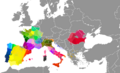
Map showing Romance languages and dialects

Related pages
- Romance linguistics
- Italic languages
- Legacy of the Roman Empire
- Latin influence in English
See also
 In Spanish: Lenguas romances para niños
