
Akhenaten facts for kids
Quick facts for kids
|
|
|---|---|
| Amenophis IV, Naphurureya, Ikhnaton | |

Statue of Akhenaten at the Egyptian Museum
|
|
| Pharaoh | |
| Reign |
|
| Predecessor | Amenhotep III |
| Successor | Smenkhkare |
| Consorts |
|
| Children |
|
| Father | Amenhotep III |
| Mother | Tiye |
| Died | 1336 or 1334 BC |
| Burial |
|
| Monuments | Akhetaten, Gempaaten |
| Religion | |
Akhenaten was an ancient Egyptian pharaoh who ruled from about 1353 to 1336 BC. He was the tenth ruler of the Eighteenth Dynasty. He was first known as Amenhotep IV, meaning "Amun is satisfied." In the fifth year of his rule, he changed his name to Akhenaten, which means "Effective for the Aten."
Akhenaten is famous for changing Egypt's traditional religion. He stopped the worship of many gods and introduced Atenism. This new religion focused on worshipping only one god, the Aten, represented by the sun disc. After his death, this religious change was reversed. His monuments were taken apart, his statues were broken, and his name was removed from official lists of rulers. Traditional religious practices slowly returned, especially under his successor, Tutankhamun. Later pharaohs even called Akhenaten "the enemy" or "that criminal."
Akhenaten was largely forgotten until the late 1800s. That's when his new capital city, Amarna, or Akhetaten, was discovered. In 1907, a mummy that might be Akhenaten's was found in KV55 in the Valley of the Kings. Genetic testing showed this mummy was Tutankhamun's father, but whether it is Akhenaten is still debated. His rediscovery sparked much interest in Akhenaten and his queen, Nefertiti. People have called him "mysterious," "revolutionary," and even "mad." His connection to Tutankhamun, the unique Amarna art he supported, and his attempt to create a new religion continue to fascinate people.
Contents
Akhenaten's Family Life
.jpg)
Akhenaten was born as Amenhotep, a younger son of pharaoh Amenhotep III and his main wife, Tiye. He had an older brother, Thutmose, who was supposed to become pharaoh. But Thutmose died young, making Akhenaten the next in line for the throne. Akhenaten also had several sisters.
Akhenaten married Nefertiti, who became his Great Royal Wife. They likely married around the time he became pharaoh. He also had another wife named Kiya. Some historians believe Kiya was the mother of Tutankhamun.

Akhenaten had six daughters who are often shown in ancient art. These include Meritaten, Meketaten, Ankhesenamun (who later married Tutankhamun), Neferneferuaten Tasherit, Neferneferure, and Setepenre. Tutankhamun, originally named Tutankhaten, was most likely Akhenaten's son, possibly with Nefertiti or another wife. The relationship between Akhenaten and Smenkhkare, who ruled with or after Akhenaten, is less clear. Smenkhkare married Akhenaten's eldest daughter, Meritaten.
Akhenaten's Early Years

Not much is known about Akhenaten's childhood as Prince Amenhotep. He was likely born around 1363–1361 BC. He might have grown up in Memphis, where he could have been influenced by the worship of the sun god Ra. However, sun worship was common throughout Egypt.
We know that a man named Parennefer served the prince as a tutor. Some historians think Akhenaten might have been a High Priest of Ptah in Memphis, a role his older brother Thutmose held. This could have influenced his interest in art and craftsmanship.
Akhenaten's Rule as Pharaoh
Sharing Power with Amenhotep III
Historians debate whether Akhenaten ruled alongside his father, Amenhotep III, for a few years. Some evidence, like inscriptions found in a tomb in Luxor, suggests they might have shared power for at least eight years. However, other experts believe these inscriptions simply show that the tomb was built during both their reigns.
Starting as Amenhotep IV

Akhenaten became pharaoh as Amenhotep IV around 1353 or 1351 BC. He was probably between 10 and 23 years old. At first, his rule followed traditional Egyptian ways. He worshipped many gods, including Amun, and continued his father's building projects at Karnak. He even decorated temple walls with images of himself worshipping Ra-Horakhty, a traditional sun god.
Early in his reign, Amenhotep IV also started building new places of worship for the Aten. He ordered temples for the Aten in several cities, including a large complex at Karnak. These new Aten temples were open to the sky, allowing people to worship the sun directly.
Around his second or third year, Amenhotep IV held a Sed festival. These festivals usually happened after a pharaoh had ruled for 30 years to renew their power. It's unclear why he held one so early, but it might have been to honor the Aten or to prepare for his big religious changes.
Changing His Name to Akhenaten
Around his fifth year as pharaoh, Amenhotep IV made a big change. He changed his name to Akhenaten to show his strong devotion to the Aten. His old name, Amenhotep, honored the god Amun. His new name, Akhenaten, means "Effective for the Aten." This change showed his complete focus on the sun disc god. He also changed his royal titles to reflect his new religious beliefs.
| Amenhotep IV | Akhenaten | ||||||||||||||||||||
|---|---|---|---|---|---|---|---|---|---|---|---|---|---|---|---|---|---|---|---|---|---|
| Horus name |
Kanakht-qai-Shuti "Strong Bull of the Double Plumes" |
Meryaten "Beloved of Aten" |
|||||||||||||||||||
| Nebty name |
Wer-nesut-em-Ipet-swt "Great of Kingship in Karnak" |
Wer-nesut-em-Akhetaten "Great of Kingship in Akhet-Aten" |
|||||||||||||||||||
| Golden Horus name |
Wetjes-khau-em-Iunu-Shemay "Crowned in Heliopolis of the South" (Thebes) |
Wetjes-ren-en-Aten "Exalter of the Name of Aten" |
|||||||||||||||||||
| Prenomen |
Neferkheperure-waenre "Beautiful are the Forms of Re, the Unique one of Re" |
||||||||||||||||||||
| Nomen |
Amenhotep Netjer-Heqa-Waset "Amun is Satisfied, Divine Lord of Thebes" |
Akhenaten "Effective for the Aten" |
|||||||||||||||||||


Building a New Capital: Amarna

Around the same time he changed his name, Akhenaten decided to build a brand new capital city. This city was called Akhetaten, meaning "Horizon of the Aten," and is known today as Amarna. He chose a location that was previously empty, about halfway between the old capitals of Thebes and Memphis. Boundary markers around the city explained that the land belonged to no other god or ruler, only to the Aten.
Historians believe Akhenaten moved the capital to break away from the powerful priests of Amun in Thebes. The priests of Amun had gained a lot of power and wealth. By moving, Akhenaten might have wanted to reduce their influence and focus all worship on the Aten.

Akhetaten was built very quickly using smaller, standardized building blocks called talatats. These blocks were easier to move and build with. By his eighth year, the royal family could live in the new city. Only Akhenaten's most loyal followers moved with him. While Akhetaten was being built, construction in Thebes stopped, but work continued in other parts of Egypt to build Aten temples.
International Relations

The Amarna letters are a collection of diplomatic messages found at Akhetaten. They tell us a lot about Akhenaten's foreign policy. These letters were sent between Akhenaten, his father, and other rulers from places like Babylonia, Syria, and the Hittites.
Egypt had been a powerful empire before Akhenaten. However, during his reign, the Hittite Empire grew stronger in Syria. Akhenaten seemed to prefer diplomacy over large wars. He received many pleas for help from Egyptian allies who were being attacked by the Hittites or other groups. While he sent some troops, he often did not send large armies to protect distant vassal states. For example, Rib-Hadda of Byblos sent 60 letters begging for help, but Akhenaten did not send enough aid.

Some earlier historians thought Akhenaten was a pacifist who ignored foreign affairs. However, the Amarna letters also show that he kept in touch with his vassals and sent instructions. There is evidence that Egyptian troops were sent to various places. Only one major military campaign is known for sure during his reign: an expedition to Nubia to stop rebellions.
Overall, Akhenaten focused on keeping control of Egypt's main territories in the Near East. He tried to avoid big conflicts with the rising Hittite Empire.
Later Years of Akhenaten's Reign

We know less about the last five years of Akhenaten's rule. In 2012, an inscription was found that showed Akhenaten and Nefertiti were still ruling together in his sixteenth year.
Before this discovery, the last known event was a royal reception in his twelfth year. Akhenaten and his family received gifts from allied countries like Nubia and Syria. Historians see this as a high point of his reign.
Some historians believe an epidemic, possibly a plague, affected Egypt around this time. This might explain the deaths of some of his daughters, including Meketaten, Neferneferure, and Setepenre.
Coregency and Death
Akhenaten might have ruled with Smenkhkare and Nefertiti for a few years before he died. Smenkhkare might have been a co-ruler around Akhenaten's thirteenth or fourteenth year. Nefertiti might have become a co-ruler later.

Akhenaten died in his 17th year. He was first buried in a tomb in the Royal Wadi near Akhetaten. His burial chamber was the only part of the tomb that was finished. Work on the tomb stopped when the royal family moved back to Thebes after his death.
Akhenaten's mummy was later moved from Akhetaten, likely to tomb KV55 in the Valley of the Kings. This tomb was later damaged. The identity of the mummy found in KV55 as Akhenaten is still debated, even after DNA analysis in 2010 identified it as Tutankhamun's father.
Akhenaten's Legacy
After Akhenaten's death, the Aten cult he created slowly lost its power. Tutankhamun, who was originally named Tutankhaten, changed his name and left Akhetaten. Later rulers tried to erase Akhenaten and his family from history. Temples to the Aten were destroyed, and their blocks were used to build new temples for the god Amun.
Seti I, a pharaoh from a later dynasty, ordered Akhenaten and his immediate successors to be removed from official lists of pharaohs. This made it seem like Amenhotep III was followed directly by Horemheb. Akhetaten was also gradually destroyed.
Some historians believe Akhenaten's reign led to a decline in the pharaoh's power. Before him, the pharaoh was seen as the gods' representative on Earth. Akhenaten changed this by saying only he could worship the Aten. After his reign, people started to believe that gods could interact directly with them, without the pharaoh as an intermediary. The god Amun became very powerful again.
Akhenaten's changes also affected the Egyptian language. His royal and religious texts started to use more everyday language. Even though later pharaohs tried to undo his changes, these new language elements remained in official texts. Akhenaten is also recognized as a Prophet in the Druze faith.
Understanding Atenism

Egyptians had worshipped sun gods for a long time, and sun worship was growing before Akhenaten. His father, Amenhotep III, even used a title meaning "the Dazzling Sun Disk." However, Amenhotep III still worshipped many gods, especially Amun-Ra.
How Atenism Developed
_to_the_figure._Reign_of_Akhenaten._From_Amarna,_Egypt._The_Petrie_Museum_of_Egyptian_Archaeology,_London.jpg)
Atenism developed in stages. At first, the sun disc was shown with the traditional falcon-headed sun god. Then, the Aten was given more importance, and its name was placed in cartouches, like a royal name. Finally, the Aten was shown as a sun disc with rays ending in human hands, giving life. It was called "the great living Disc which is in jubilee, lord of heaven and earth."
In his early years, Akhenaten allowed traditional worship to continue. But he also built many temples for the Aten that had no roofs, so people could worship under the open sky. In his second year, he gave a speech saying that other gods were not working, but the Aten continued forever. This speech hinted at his big religious changes.

In his fifth year, Akhenaten took strong action. He closed the temples of other gods and used their money to support the Aten. He changed his name to Akhenaten to show his full loyalty. The Aten itself started to be shown with royal symbols, like a uraeus.
By his ninth year, Akhenaten declared that Aten was the *only* god to be worshipped. He ordered the names of other gods, especially Amun, to be removed from temples. The Aten was seen as a universal god, the source of all life. Akhenaten also changed the Aten's name to remove its connections to other solar deities, making it truly unique.

Akhenaten's beliefs are best seen in the Great Hymn to the Aten. This hymn, possibly written by Akhenaten, praises the sun and daylight. It describes the Aten as the one and only creator of all life. It also states that Akhenaten was the only person who could truly understand and communicate with the Aten.
Atenism and Other Gods
Historians debate how much Akhenaten forced his new religion on people. He certainly removed references to other gods and encouraged his court to change their names. However, some people in Akhetaten still kept names linked to other gods. Also, many amulets of traditional household gods were found, suggesting that people still used them. This means that while Akhenaten promoted Atenism strongly, he might have been somewhat tolerant until later in his reign.
Archaeological finds show that many people in Akhetaten removed references to Amun from their personal items. This was likely out of fear of being seen as disloyal to the Aten.
After Akhenaten's Rule
After Akhenaten died, Egypt slowly returned to its traditional religion. Atenism remained for a few years under his immediate successors, Smenkhkare and Neferneferuaten, and early in Tutankhamun's reign. However, the worship of Amun soon returned.
Tutankhamun and his wife Ankhesenamun changed their names to remove "Aten" from them. Tutankhamun also restored the temples of other gods. He even used blocks from Akhenaten's Aten temples for his own building projects. Later pharaohs, like Horemheb and Seti I, continued to dismantle Aten temples and erase Akhenaten's name from history.
A key reason Atenism failed was its lack of beliefs about the afterlife. Traditional Egyptian religion offered a clear path to the afterlife. Atenism focused more on life in the present world.
Artistic Styles of Akhenaten's Time

The art style during Akhenaten's reign, known as Amarna art, was very different from traditional Egyptian art. It was more realistic, expressive, and naturalistic. This was especially true for animals, plants, and people. Art from this time showed more action and movement, unlike the usually still poses in older Egyptian art.
Akhenaten's own portrayals were very unusual. While pharaohs were traditionally shown as young and athletic, Akhenaten was depicted with a long face, thick lips, and a softer, more rounded body. Historians believe these unique depictions were not because of a medical condition. Instead, they were a symbolic way to show Akhenaten's connection to the Aten. Since the Aten was seen as the "mother and father of all humankind," Akhenaten's art might have made him look androgynous (having both male and female qualities) to represent the Aten's life-giving power.
.jpg)
Art from this period also showed the royal family in new ways. For the first time, the pharaoh's family life was depicted in relaxed, casual, and intimate moments, showing affection like holding hands.

Nefertiti also appeared in art in ways usually reserved for a pharaoh, like "smiting the enemy." This suggests she had a very important role as queen. Her early artistic images were similar to Akhenaten's, but later ones showed her unique features.
Cultural Depictions of Akhenaten

Akhenaten has been shown in many books, movies, and other forms of art since his rediscovery. He is one of the most popular ancient figures in fiction.
Novels about Akhenaten often focus on his journey to establish Atenism and build Akhetaten, or on what happened after his reign. Early stories, before the 1920s, often showed him as a mysterious figure. Later works, after more archaeological discoveries, portrayed him more realistically. Famous examples include Akhnaton King of Egypt (1924) by Dmitry Merezhkovsky and The Egyptian (1945) by Mika Waltari, which was made into a movie in 1954.
Akhenaten has also appeared as a villain in comic books and video games. For example, he is a main enemy in the comic series Marvel: The End (2003) and in the Assassin's Creed Origins video game (2017). The band Nile also featured Akhenaten in their music and album artwork.
Akhenaten's Ancestry
| 16. Thutmose III | |||||||||||||||||||
| 8. Amenhotep II | |||||||||||||||||||
| 17. Merytre-Hatshepsut | |||||||||||||||||||
| 4. Thutmose IV | |||||||||||||||||||
| 9. Tiaa | |||||||||||||||||||
| 2. Amenhotep III | |||||||||||||||||||
| 5. Mutemwiya | |||||||||||||||||||
| 1. Akhenaten | |||||||||||||||||||
| 6. Yuya | |||||||||||||||||||
| 3. Tiye | |||||||||||||||||||
| 7. Tjuyu | |||||||||||||||||||
See also
- Pharaoh of the Exodus
- Osarseph
Images for kids
-
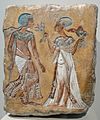
This limestone relief of a royal couple in the Amarna style has been attributed to Akhenaten and Nefertiti, Smenkhkare and Meritaten, or Tutankhamun and Ankhesenamun.
-
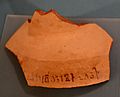
Hieratic inscription on a pottery fragment. It records year 17 of Akhenaten's reign and references wine of the house of Aten.
-
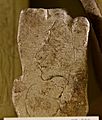
Limestone trial piece of a king, probably Akhenaten, and a smaller head of uncertain gender.
-
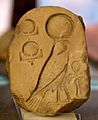
Inscribed limestone fragment showing early Aten cartouches, "the Living Ra Horakhty".
-
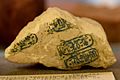
Fragment of a stela, showing parts of three late cartouches of Aten.
-
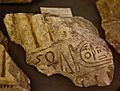
Limestone fragment column showing reeds and an early Aten cartouche.
-

A "blue faience" magical throwstick belonging to Akhenaten found at Amarna.
-
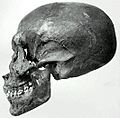
Profile view of the skull (thought to be Akhenaten) recovered from KV55.
-

Akhenaten's original tomb burial chamber at Amarna.
-
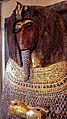
The desecrated royal coffin found in Tomb KV55.
-
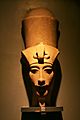
Head of Akhenaten.
-
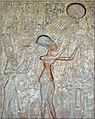
Pharaoh Akhenaten (center) and his family worshiping the Aten, with characteristic rays seen emanating from the solar disk.


.jpg)


.jpg)

_(Mus%C3%A9e_du_Caire)_(2076972086).jpg)
.jpg)
See Also
 In Spanish: Akenatón para niños
- Pharaoh of the Exodus
- Osarseph
Images for kids
-

Horus name hieroglyph

