
Carrack facts for kids


A carrack (called nau in Portuguese and nao in Spanish) was a large, strong sailing ship. It had three or four masts and was built in Europe, especially in Portugal and Spain, during the 14th and 15th centuries. These ships were a big step up from smaller, single-masted ships like the cog.
Carracks were first used for trading goods across Europe, from the Mediterranean Sea to the Baltic Sea. Soon, they became super important for new trade routes. They carried valuable goods between Europe and Africa, and later across the Atlantic Ocean to the Americas. By the late 15th century, Portuguese and Spanish sailors used advanced carracks for long journeys between Europe, Africa, and Asia. Later, in the 16th and 17th centuries, the galleon ship design slowly took over.
A fully developed carrack was a strong, ocean-going vessel. It was big enough to stay steady in rough seas and had lots of space for cargo and supplies for very long trips. These later carracks had square sails on their front (foremast) and main masts. They also had triangular (lateen) sails on their rear (mizzenmast). They featured a high, rounded back (stern) with a raised deck (aftcastle) and a front deck (forecastle). A long pole (bowsprit) stuck out from the front. Carracks were a very important ship design. They led to the creation of the galleon and influenced ship building for centuries.
What's in a Name?

The English word carrack came from the Old French word caraque in the late 1300s. This word came from carraca, which was used in Spanish, Italian, and Latin for a big, square-sailed ship.
These ships had different names in other languages. In Portuguese, they were called nau. In Genoese and Spanish, they were carraca. The French called them caraque or nef, and in Dutch, they were known as kraak.
The exact origin of carraca is a bit of a mystery. Some think it came from the Arabic word qaraqir, meaning "merchant ship." Others believe it might come from the Latin word carricare, which means "to load a car," or even from a Greek word for a timber load. It's interesting how words for ships traveled across different languages and cultures!

How Carracks Were Born

By the end of the Middle Ages, ships like the cog were common along European coasts. These ships had square sails and a steering rudder at the back. In the Mediterranean Sea, galley ships and two-masted ships like caravels (with their lateen sails) were also widely used. Portuguese sailors and shipbuilders knew all these types of vessels well.
As Portuguese and Spanish explorers sailed further south along Africa's Atlantic coast in the 1400s, they needed bigger, stronger, and more advanced ships. These new ships had to handle long journeys across the open ocean. So, they started combining and changing ideas from the ships they knew. They created their own ocean-going carracks.
These new carracks had better sails and rigging. This allowed them to sail much better in the strong winds and big waves of the Atlantic Ocean. Their hull (the main body of the ship) was also shaped and sized to carry more cargo. By the end of the 15th century, carracks were commonly used for travel between different oceans. Some Portuguese carracks were very large for their time, often weighing over 1000 tons.
A typical three-masted carrack, like the famous São Gabriel, usually had six sails. These included a sail on the bowsprit (the pole at the front), a foresail, a mainsail, a mizzensail, and two topsails.

In the Republic of Ragusa (a city-state in what is now Croatia), a special type of three or four-masted carrack was used. It was called the Dubrovačka karaka (Dubrovnik Carrack). These ships carried goods between the 14th and 17th centuries.
Around the mid-1500s, the first galleons were developed. Galleons eventually replaced carracks. However, carracks were still used until the mid-1600s because they could carry more cargo.
Carracks in Asia
Starting in 1498, Portugal began direct and regular trade between Europe and India. This was done using the Cape Route, which involved sailing around Africa. This journey was incredibly long, taking about six months. It absolutely required the use of strong, large ships like carracks.
Usually, four carracks sailed from Lisbon to Goa. They carried gold to buy spices and other special items, especially pepper. From Goa, one carrack would continue to Ming China to buy silks. In 1541, the Portuguese started trading with Japan. They exchanged Chinese silk for Japanese silver. By 1550, the Portuguese Crown began to manage this trade. They would lease the right to send one carrack to Japan each year to the highest bidder in Goa.
In 1557, the Portuguese gained control of Macau. This helped them develop their trade with China. This trade continued for many years. However, in 1638, the rulers of Japan stopped it. They believed the ships were secretly bringing Catholic priests into the country. The Japanese called the Portuguese carracks "Black Ships" (kurofune). This was because of the dark color of their hulls. Later, this term was used for any Western ship.

Other parts of the world also built and used carrack-like ships. In the Ottoman Empire and the Indian Ocean, similar large ships were used for trade. For example, a drawing of an Ottoman barca shows a deep ship with a tall front deck and a lateen sail. Merchants from Gujarat (in India) also used large ships, which the Portuguese often called naos (carracks). These ships sailed between Malacca and the Red Sea and were sometimes even bigger than Portuguese carracks. The Bengalis also used carracks, sometimes called "Moorish carracks" by the Portuguese.
Famous Carracks
Many carracks became famous throughout history for their important voyages and roles:
- Santa María: This was the flagship of Christopher Columbus when he made his first voyage to America in 1492.
- Gribshunden: The main ship of Danish-Norwegian King Hans. It was built in 1485 and served the crown until it sank in 1495.
- São Gabriel: The flagship of Vasco da Gama. He used it in 1497 for the first Portuguese expedition from Europe to India by sailing around Africa.
- Flor do Mar (or Flor de la Mar): This ship served for over nine years in the Indian Ocean. It sank in 1512 with Afonso de Albuquerque after the conquest of Malacca. It carried a huge treasure, making it one of history's legendary lost treasures.
- Victoria: This was the first ship in history to sail all the way around the world (from 1519 to 1522). It was the only ship from Magellan's expedition for Spain to return.
- La Dauphine: Giovanni da Verrazzano used this ship to explore the Atlantic coast of North America in 1524.
- Grande Hermine: Jacques Cartier used this ship to explore the Saint Lawrence River in 1535. It was the first European ship to sail on this river past the Gulf.
- Santo António (or St. Anthony): This ship belonged to King John III of Portugal. It was wrecked off Gunwalloe Bay in 1527. The recovery of its cargo almost caused a war between England and Portugal.
- Great Michael: A Scottish ship that was once one of the largest in Europe.
- Mary Rose, Henri Grâce à Dieu, and Peter Pomegranate: These were English military carracks, often called "great ships," built during the reign of King Henry VIII of England.
- Grace Dieu: Commissioned by King Henry V of England. It was one of the largest ships in the world at the time.
- Santa Catarina do Monte Sinai: A warship built in India by the Portuguese.
- Santa Anna: A very modern ship ordered by the Knights Hospitaller in 1522. Some consider it the first armored ship.
- Jesus of Lübeck: This ship was chartered by Queen Elizabeth I of England in 1563. It was involved in important trade voyages across the Atlantic.
- Madre de Deus: Built in Lisbon in 1589, it was one of the world's largest ships. It was captured by the English off Flores Island in 1592. It carried an incredibly valuable cargo from the East Indies, which is still considered one of the largest treasures ever captured.
- Cinco Chagas: Thought to be the largest and richest ship ever to sail to and from the Indies. It exploded and sank during the action of Faial in 1594.
- Santa Catarina: A Portuguese carrack seized by the Dutch East India Company off Singapore in 1603.
- Nossa Senhora da Graça: A Portuguese carrack sunk in a Japanese attack near Nagasaki in 1610.
- Peter von Danzig: A ship of the Hanseatic League in the 1460s–1470s.
- La Gran Carracca: The ship of the Order of St. John when they ruled Malta.
- Bom Jesus: A Portuguese ship that disappeared in 1533 after sailing from Lisbon. Its well-preserved shipwreck was found in 2008 off the coast of Namibia. It carried copper, elephant ivory, and over 2000 gold and silver coins.
Gallery
-
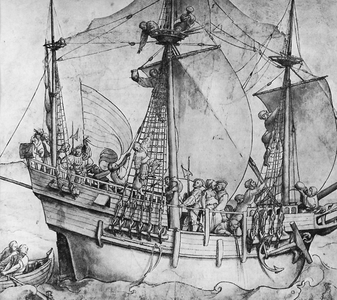
A small carrack from the 16th century.
-
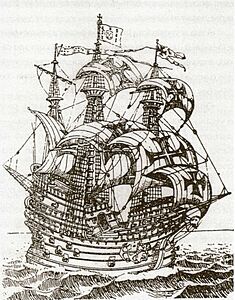
The famous Portuguese nau Flor de la Mar, shown in a 16th-century map.
-
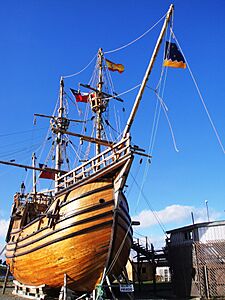
A replica of the Nao Victoria, the first ship to sail around the world in 1522.
-
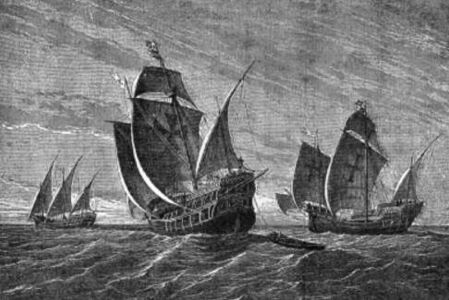
Columbus' Ships (1892). The Santa Maria and Pinta are shown as carracks. The Niña (left) is a caravel.
-
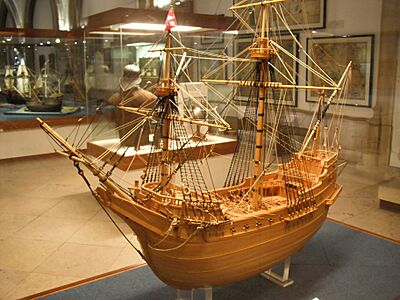
A model of the carrack Madre de Deus in the Maritime Museum, Lisbon. Built in Portugal in 1589, it was one of the largest ships of its time with seven decks.
-
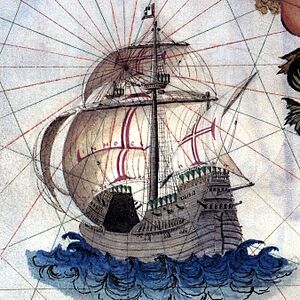
A Portuguese carrack, as drawn on a map in 1565.
-
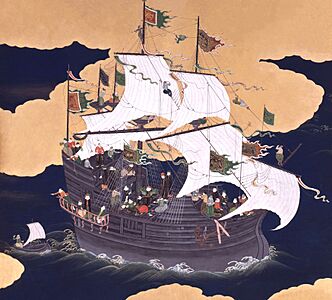
A Japanese drawing of a Portuguese carrack, called kurofune (black ship).
-
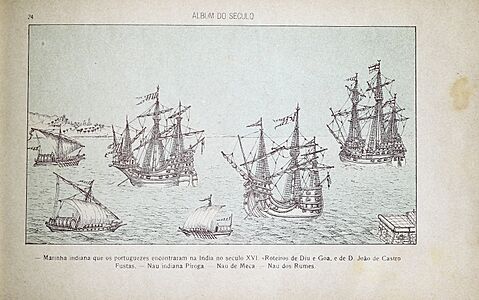
Carracks from the Indian Ocean: Indian "Piroga" carrack, Mecca carrack, and Rumes (Ottoman) carrack.
-
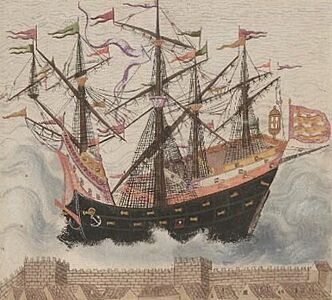
A four-masted Turkish carrack from 1586.


.jpg)


See also
- Medieval ships
- Chinese junk ship
- Javanese jong
- Arabs baghlah
- Portuguese India Armadas
