
Chaco (Paraguay) facts for kids

The Paraguayan Chaco, also called the Western Region, is a huge area in Paraguay. It's mostly dry and has very few people living there. This region makes up over 60% of Paraguay's land but has less than 3% of its population. This makes it one of the emptiest places in South America.
The larger Gran Chaco area around it is also very big and has few people. Many of the people living here are native groups. The Paraguayan Chaco covers three departments in Paraguay: Boquerón, Alto Paraguay, and Presidente Hayes.
The Chaco was once the site of the longest war over land in South America. This war was between Paraguay and Bolivia from 1932 to 1935. Today, you can still find important historical places from this war, like Boquerón and Nanawa.
Contents
Where is the Paraguayan Chaco?
The Paraguayan Chaco sits between two important rivers: the Pilcomayo and the Paraguay River. These rivers create salty soils that help many different plants and animals grow.
Its borders are:
- To the west: Argentina along the Pilcomayo River.
- To the south-east: Brazil near the mouth of the Apa River.
- To the north: Bolivia.
- To the south: Paraguay's Eastern Region (Región Oriental).
Native Peoples of the Paraguayan Chaco

Most of the Indigenous peoples in Paraguay live in the Chaco region. Here are some of the groups you can find there:
These groups speak different languages and live in specific areas:
- Toba Maskoy: By the Paraguay River in the central-east.
- Nivaclé: Near the Pilcomayo River in the south-east.
- Zamuco and Chamacoco: Along the Paraguay River in the north-east.
- Enxet-Enenhlet: In the central and lower parts of the Chaco.
Animals of the Chaco
The Chaco is full of amazing wildlife! Some of the larger animals you might see include:
- Big cats like the jaguar, ocelot, and puma.
- Unique animals like the tapir, giant armadillo, and giant anteater.
- Many types of foxes and small wildcats.
- Rodents like the agouti and the capybara (which is like a giant guinea pig!).
- The maned wolf, palustrian deer, and peccaries (wild pigs), including the special Chacoan peccary.
- The guanaco, which is a wild relative of the llama.
The region also has many birds, including one of the largest groups of the greater rhea, a big bird that cannot fly. The rivers are home to over 400 kinds of fish, like the salmon-like dorado and the famous piranha.
You'll also find lots of insects, lizards, and at least 60 types of snakes, including some venomous ones and constrictors. The Chaco even has special amphibians, like the waxy monkey tree frog that makes a waxy coating to stay moist, and the coraline frog that hides underground during dry times.
Plants of the Chaco

The plants in the Chaco change from east to west because the soil is different. In the east, it looks like a park with groups of trees and bushes mixed with tall grasses. As you go west, it slowly changes into a dry forest with thorny bushes and small trees.
Chaco plants are very good at living in dry places. One impressive plant area is called the quebrachales. These are huge forests of tough, low trees called quebracho trees. The quebracho tree is important because it provides tannin (used for leather) and lumber (wood). These forests cover large areas away from rivers. Near rivers, they grow on higher, drier spots, making the forests look like islands in a sea of tall grasses.
In the drier western Chaco, you'll find thorn forests. These are sometimes broken up by palm groves or grassy areas caused by fires or cutting down trees. Another type of quebracho tree grows here, which is mostly used for wood.

There are also more thorny plants here. One famous thorny plant is the vinal (Prosopis ruscifolia). Its thorns can be up to a foot long! In Argentina, it was even called a "national plague" because its thorns were dangerous for farm animals.
What Makes the Chaco Special?
The Chaco has a lot of different plants and animals, which means it could be a great place for ecotourism, like what you see in the Amazon.
The region is also famous for the annual Trans Chaco Rally, a big car race. It's known as one of the toughest races in South America because of its dusty, dry roads and extreme heat.
The Chaco is rich in different cultures, religions, and ways of life. The Indigenous peoples of the Gran Chaco keep their traditions alive, especially in the northern Chaco. This area is also a good place to buy beautiful native crafts. For example, the Sanapaná and Nivaclé people speak their own languages, Sanapaná and Nivaclé language, in the forest reserves.
The karanda'y (Copernicia alba) palm tree is used to make many things like handbags, wallets, baskets, and mats. The native people are also very skilled in using natural plants for medicine.
The Chaco is also a great spot for rural tourism. For example, Estancia La Patria in the Boquerón Department was created to help develop this part of the country. It's located about 110 kilometers from Infante Rivarola, a military post near the border with Bolivia.
The Chaco is a flat area that slopes gently to the east. It doesn't get much rain (about 400 mm per year). Sometimes, parts of it flood, and then you can see plants and animals that are used to wet conditions. The soil is often salty, which limits how it can be used because it's so dry. The Pilcomayo and Paraguay rivers, with their many smaller streams, help water the Chaco.
National Parks
The Chaco has several important national parks that protect its unique environment:
- National Park Defensores del Chaco - 7,800 square kilometers
- National Park Tinfunqué - 2,800 square kilometers
- National Park Teniente Enciso - 400 square kilometers
Main Cities
Some of the main cities in the Paraguayan Chaco are:
Filadelfia is very important for the region's economy, especially because of its successful dairy farms.
Images for kids
-
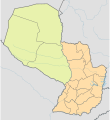
Paraguayan Chaco, represented in light green.
-
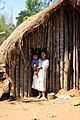
Indigenous mother and child in the Paraguayan Chaco.
-

Chaco Boreal, Paraguay.
-
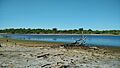
Lagoon in the Paraguayan Chaco.
See also
 In Spanish: Región Occidental del Paraguay para niños
- Chaco (disambiguation)
- Departments of Bolivia
- Departments of Paraguay
