
Gene facts for kids

A gene is like a set of instructions found inside every living thing. These instructions are made of DNA and tell your body how to grow, develop, and work. Think of genes as tiny blueprints that decide many of your traits, like eye color or how tall you might be.
Genes are passed down from parents to their children. This is called heredity. Sometimes, a gene can have slightly different versions, called alleles. These different versions can lead to different traits. For example, one allele might give you blue eyes, while another gives you brown eyes.
The complete set of all the DNA in an organism, including all its genes, is called its genome.
Contents
What is a Gene?
A gene is a specific section of DNA that holds the instructions for making something important for your body. These instructions can tell your cells how to make a protein or a special type of RNA molecule. Both proteins and RNA molecules have important jobs in your body.
Some genes give instructions for making proteins, which are like tiny machines that do most of the work in cells. Other genes make RNA molecules that have their own jobs, like helping to build proteins or controlling other genes.
How We Discovered Genes
Mendel's Pea Plants
The idea that traits are passed down in specific units started with Gregor Mendel. In the 1800s, he studied pea plants. He noticed how traits like flower color or plant height were inherited from parent plants to their offspring.
Mendel showed that these traits didn't just blend together. Instead, they were passed on as distinct units. He also discovered that some traits are dominant (they show up more often) and others are recessive (they are hidden if a dominant trait is present). Even though he didn't use the word "gene," his work laid the foundation for genetics.
Unraveling DNA
Scientists continued to learn more about heredity. In the 1940s and 1950s, they discovered that Deoxyribonucleic acid (DNA) is the molecule that carries genetic information.
In 1953, James D. Watson and Francis Crick published their famous model of the DNA double helix. Their work was based on research by Rosalind Franklin and Maurice Wilkins. This discovery helped us understand how genetic information is stored and copied.
Later, in 1965, scientists successfully isolated a single gene for the first time. In 1972, a team led by Walter Fiers determined the exact sequence of a gene. These breakthroughs helped us understand genes at a molecular level.
The Building Blocks of Genes
DNA: The Genetic Blueprint
Most living things store their genes in long strands of DNA. DNA is like a twisted ladder, called a double helix. Each side of the ladder is made of a sugar and phosphate backbone. The "rungs" of the ladder are made of four chemical bases: adenine (A), cytosine (C), guanine (G), and thymine (T).
These bases pair up in a specific way: A always pairs with T, and C always pairs with G. This specific pairing is crucial for how DNA copies itself and how genes work.
Chromosomes: Organizing Genes
All the genes in an organism are organized into structures called chromosomes. A chromosome is a very long strand of DNA tightly packed together. Humans have 23 pairs of chromosomes in most of their cells.
Each gene has a specific spot on a chromosome, called a locus. At each locus, you have two copies of a gene, one from each parent. These copies might be slightly different versions, or alleles.
In complex organisms like humans, chromosomes are found inside the cell nucleus. They are wrapped around special proteins called histones. This packaging helps organize the DNA and controls which genes are turned on or off.

How Genes Work: Structure and Function
Gene Structure
A gene isn't just the part that codes for a protein. It also includes other important sections. For example, every gene has a promoter region. This is like a "start" signal that tells the cell where a gene begins and when to start reading its instructions.
Genes also have regulatory regions that act like switches. These switches can turn a gene on (increase its activity) or off (decrease its activity). They make sure genes are expressed at the right time and in the right cells.
Many genes in complex organisms contain sections called introns, which are like filler material. These introns are removed before the gene's instructions are fully used. The important parts that remain are called exons, which are then joined together.
Gene Expression: From DNA to Product
The process of using a gene's instructions to make a functional product (like a protein or RNA) is called gene expression. It usually happens in two main steps:
- Transcription: First, the cell makes a copy of the gene's DNA into a molecule called messenger RNA (mRNA). Think of this as making a temporary working copy of the blueprint.
- Translation: If the gene codes for a protein, the mRNA copy then travels to a cellular machine called a ribosome. The ribosome "reads" the mRNA and uses its instructions to build a protein by linking together amino acids.

The Genetic Code
The instructions in DNA and mRNA are written in a special language called the genetic code. This code uses groups of three DNA or RNA bases, called codons. Each codon tells the ribosome which specific amino acid to add to the growing protein chain. There are also "start" and "stop" codons that tell the ribosome where to begin and end making the protein.
How Genes are Passed Down (Inheritance)
Mendelian Inheritance
You inherit your genes from your parents. In sexual reproduction, you get one copy of each gene from your mother and one from your father. This is why you might have traits from both sides of your family.
Mendel's work showed that for many traits, one allele can be dominant over another. If you inherit a dominant allele and a recessive allele for the same trait, the dominant trait is usually the one you will see.
DNA Replication and Cell Division
For an organism to grow and develop, its cells must divide. Before a cell divides, it must make an exact copy of all its DNA, including every gene. This process is called DNA replication. Special enzymes "read" the DNA strands and build new, matching strands.
After DNA is copied, the cell divides into two new cells. Each new cell gets a complete set of genes. This ensures that all cells in your body have the same genetic information.
Our Genome and Its Genes
Number of Genes
The size of an organism's genome and the number of genes it contains can vary greatly. Viruses have very small genomes with just a few genes. Plants, on the other hand, can have extremely large genomes with tens of thousands of genes.
For humans, scientists have been refining the estimated number of genes over time. As of 2026, current estimates suggest that the human genome contains about 19,000 protein-coding genes. There are also many thousands of non-coding RNA genes.
Essential Genes
Some genes are so important that an organism cannot survive without them. These are called essential genes. They are critical for basic cell functions, like making energy or building cell parts. Only a small portion of an organism's total genes are considered essential. For example, humans are estimated to have around 2,000 essential genes.
Changing Genes: Genetic Engineering

Genetic engineering is a way for scientists to change an organism's genome using special tools. Since the 1970s, many techniques have been developed to add, remove, or edit specific genes.
This technology is used in many fields. In research, scientists can change genes in model organisms like mice to study what those genes do. In agriculture, genetic engineering can create crops that are more resistant to pests or diseases. In medicine, it can be used in gene therapy to treat genetic diseases by correcting faulty genes in a patient's cells.
Related Pages
- Allele#Dominance
- Sequence analysis
- Genetics
- ENCODE, the complete analysis of the human genome
- Gene therapy
Images for kids
-
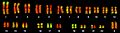
A close-up view of human chromosomes, which are structures that hold our genes.
-

A look at histone proteins, which help organize DNA inside cells.


See also
 In Spanish: Gen para niños
- Biological patent
- Epigenetics
- Gene-centric view of evolution
- Gene dosage
- Gene redundancy
- Gene silencing
- Genetic algorithm
- Haplotype
- List of gene prediction software
- Lists of human genes
- Predictive medicine
- Quantitative trait locus
- Selfish genetic element
- Whole genome sequencing
