
Michael Phelps facts for kids

Phelps at the 2016 Summer Olympics
|
|
| Personal information | |
|---|---|
| Nickname(s) | The Baltimore Bullet, Flying Fish |
| Born | June 30, 1985 Baltimore, Maryland, U.S. |
| Height | 6 ft 4 in (1.93 m) |
| Weight | 194 lb |
| Spouse(s) |
Nicole Johnson
(m. 2016) |
| Sport | |
| Sport | Swimming |
| Strokes | Butterfly, individual medley, freestyle, backstroke |
| Club | North Baltimore Aquatic Club |
| Coach | Bob Bowman |
Michael Fred Phelps II is an American former competitive swimmer. He is widely considered the greatest swimmer of all time. He is also regarded as one of the greatest athletes in world history. Over his career, Phelps earned 28 Olympic medals. This total is the highest ever achieved by any athlete in the history of the Olympic Games. Phelps holds the all-time records for the most Olympic gold medals with 23. He also won the most individual Olympic gold medals with 13.
Phelps grew up in Maryland and showed remarkable talent in the pool from a very young age. His powerful swimming style and dedication made him a star athlete. He competed across five different Olympic Games between 2000 and 2016. During his peak competitive years, he held numerous world records in butterfly, medley, and freestyle races. His most famous achievement came at the 2008 Summer Olympics in Beijing. There, he won eight gold medals at a single Games, breaking the legendary record set by Mark Spitz.
Beyond the Olympics, Phelps captured dozens of medals at the FINA World Aquatics Championships and the Pan Pacific Swimming Championships. His incredible speed earned him nicknames such as "The Baltimore Bullet" and the "Flying Fish." After stepping away from racing, he started the Michael Phelps Foundation to teach water safety and healthy living to young people. His achievements transformed competitive swimming into a globally popular sport watched by millions of fans.
Contents
- Early Life and Childhood Background
- Road to the Olympic Games
- Olympic Glory and Record-Breaking Years
- World Competitions and London 2012
- The 2016 Rio Olympics Comeback
- Technique, Training, and Athletic Secrets
- Personal Life and Charity Work
- Michael Phelps Quotes
- Major Competition Results
- Awards and Honors
- Images for kids
- See also
Early Life and Childhood Background
Michael Phelps was born on June 30, 1985, in Baltimore, Maryland. He grew up in the quiet neighborhood of Rodgers Forge in nearby Towson. Michael was the youngest of three children in his family. His mother, Deborah Sue Phelps, worked as a middle school principal and dedicated teacher. His father, Michael Fred Phelps, served as a Maryland State Trooper. His father had also played football during his school days. Michael's parents divorced when he was nine years old. While this was a difficult period for Michael, he leaned on his family and sports for comfort.
Phelps attended local schools, including Rodgers Forge Elementary and Dumbarton Middle School. He later studied at and graduated from Towson High School in 2003. When he was in the sixth grade, doctors diagnosed him with ADHD. This condition made sitting still in regular classrooms quite difficult for him. Sometimes other kids teased him because of his large ears and long arms. Rather than letting teasing get him down, Michael directed his energy into the swimming pool. Swimming became an amazing outlet where he could move quickly and use his natural focus.
Discovering the Swimming Pool
Michael first stepped into a pool at seven years old. His older sisters, Whitney and Hilary, were already active swimmers on local swim teams. At first, young Michael felt nervous about putting his face underwater. His instructors wisely taught him how to float on his back first. Because of this back-floating practice, the backstroke became the first swimming stroke he mastered. Once he grew comfortable in the water, Michael began practicing other swimming strokes, such as the butterfly stroke and freestyle.
He quickly realized how much fun racing could be. By age ten, Michael was already outswimming other boys in his age bracket. He set an American national age-group record for ten-year-olds in the 100-meter butterfly. Recognizing his special gifts, his family enrolled him at the famous North Baltimore Aquatic Club. It was there that he met a coach named Bob Bowman. Coach Bowman immediately noticed Michael's natural body shape, huge energy, and fierce competitive attitude. Bowman began designing challenging practice sets that pushed the young swimmer to become faster every single week.
Training Under Coach Bob Bowman
Coach Bob Bowman became one of the most important figures in Phelps's life. Bowman swam collegiately at Florida State University during the 1980s. Swimmers often compared Bowman's strict coaching style to a drill instructor. He believed in rigorous discipline, perfect technique, and absolute consistency. Every practice was planned out down to the exact second. Phelps soon understood that hard training was necessary if he wanted to break world records. Bowman taught Phelps how to manage pressure and remain calm behind the starting blocks.
Their training sessions started early in the morning before school began. Phelps swam thousands of laps every week to build endurance and lung capacity. When Bowman accepted a coaching position at the University of Michigan, Phelps moved to Ann Arbor to continue their workouts. Michael attended college classes and served as a volunteer assistant coach with the Michigan team. Later, when Bowman became head coach at Arizona State University, Phelps moved out west as well. The partnership between Bowman and Phelps became one of the most successful coach-athlete teams in sports history.
Road to the Olympic Games
The 2000 Sydney Games
Phelps developed into an elite athlete very quickly. In the summer of 2000, he attended the U.S. Olympic Trials. He was only 15 years old at the time. Phelps finished near the top in the 200-meter butterfly. By making the team, he became the youngest American male Olympic swimmer since Ralph Flanagan in 1932. This selection amazed swimming coaches across the entire country.
At the 2000 Summer Olympics in Sydney, Australia, Phelps was eager to learn. Competing against grown men, the teenage swimmer kept his cool. He reached the finals of the 200-meter butterfly and finished in fifth place. While he did not leave Australia with a medal, the experience gave him enormous confidence. Phelps saw what it took to race against the best athletes on Earth. He returned home determined to stand on top of the podium at the very next Olympic Games.
First World Records in 2001
In 2001, Phelps proved that his fifth-place finish in Sydney was just the beginning. During the national trials for the 2001 World Aquatics Championships, Phelps made history. On March 30, 2001, he broke the world record in the 200-meter butterfly. He was only 15 years and 9 months old on that day. This race made him the youngest male swimmer ever to set an official world record. He broke the previous age record held by Australian champion Ian Thorpe.
A few months later, Phelps traveled to Fukuoka, Japan, for the World Championships. Facing huge international attention, he swam the 200-meter butterfly final with superb technique. He touched the wall in 1:54.58, breaking his own world record and winning his very first international gold medal. News outlets around the world hailed the American teenager as the future superstar of swimming.
Dominating the 2002 Pan Pacific Games
By 2002, Phelps had expanded his repertoire into several strokes. At the national selection meet in Florida, he broke the 400-meter individual medley world record previously held by Tom Dolan. In the individual medley, a swimmer must swim equal parts of butterfly, backstroke, breaststroke, and freestyle. It is considered one of the toughest tests in the entire sport. Phelps also posted remarkable times in the freestyle against top American swimmers like Klete Keller.
Later that summer, at the 2002 Pan Pacific Swimming Championships in Yokohama, Japan, Phelps earned three gold medals and two silver medals. He captured gold in the 400-meter medley and the 200-meter medley. In the 4×100-meter medley relay, Phelps joined Aaron Peirsol, Brendan Hansen, and Ian Crocker. Swimming the butterfly leg, Phelps swam an astonishing split time of 51.1 seconds. The team won the gold medal in a world-record time of 3:33.48, proving the Americans were unstoppable in relay events.
Historic World Championships in Barcelona 2003
The 2003 World Aquatics Championships took place in Barcelona, Spain. This competition showed that Phelps could race every day without running out of steam. During the meet, he broke five individual world records. He set records in the semi-finals of the 200-meter butterfly and both medley races. In the 200-meter individual medley final, he clocked 1:56.04, beating Australia's Ian Thorpe by almost three seconds.
Phelps also captured gold in the 400-meter individual medley with a world record of 4:09.09. He earned silver in the 100-meter butterfly, where teammate Ian Crocker set a new record. By the end of the championships, Phelps had won four gold medals and two silvers. His incredible versatility proved that he could swim sprints, distance races, and complex multi-stroke events equally well.
Olympic Glory and Record-Breaking Years
The 2004 Athens Summer Olympics

Phelps arrived at the 2004 Summer Olympics in Athens, Greece, with tremendous goals. Reporters wondered if he could match Mark Spitz, who won seven golds in 1972. In his first race, the 400-meter individual medley, Phelps won gold in a world-record time of 4:08.26. He followed that up by winning bronze in the 4×100-meter freestyle relay alongside Ian Crocker, Neil Walker, and Jason Lezak.
Next came the famous 200-meter freestyle, nicknamed the "Race of the Century." Phelps raced against legends Ian Thorpe and Pieter van den Hoogenband. Phelps finished third for bronze, setting an American record. He was thrilled to compete against the two fastest freestylers ever. Phelps went on to win gold in the 200-meter butterfly and the 4×200-meter freestyle relay alongside Ryan Lochte, Peter Vanderkaay, and Klete Keller.
Phelps added another gold in the 200-meter individual medley. In the 100-meter butterfly final, Phelps edged out teammate Ian Crocker by just 0.04 seconds. As the top butterfly swimmer, Phelps had an automatic spot in the medley relay final. However, he generously gave his spot to Crocker so his teammate could earn gold. The U.S. relay team won the final, and Phelps received a gold medal for swimming in the heats. Phelps finished Athens with six gold and two bronze medals, tying Alexander Dityatin for the most medals at a single Olympics.
Championship Successes Between 2005 and 2007
At the 2005 World Aquatics Championships in Montreal, Phelps decided to challenge himself in new races. He won gold in the 200-meter freestyle, defeating Australian star Grant Hackett. He also won gold in the 200-meter individual medley and two relay events. Phelps finished the meet with five gold medals and one silver medal, continuing his international dominance.
The 2006 Pan Pacific Swimming Championships in Canada brought even more victories. Phelps set world records in the 200-meter butterfly, the 200-meter individual medley, and the 4×100-meter freestyle relay alongside Cullen Jones. He also won the 400-meter medley easily ahead of Robert Margalis. In the 200-meter backstroke, he claimed silver behind world-record holder Aaron Peirsol. Phelps was performing at a level never before seen in competitive swimming.
The 2007 World Aquatics Championships in Melbourne, Australia, served as the launchpad for his greatest Olympic bid. Phelps competed in seven events and won gold in every single one. He broke five world records during the week. In the 200-meter freestyle, he took down the six-year-old world record of Ian Thorpe. He also shattered records in the 200-meter butterfly, the 200-meter medley, and the 400-meter medley, finishing well ahead of friend Ryan Lochte. His seven golds broke the world championship record held by Thorpe.
The Historic 2008 Beijing Olympics

The 2008 Summer Olympics in Beijing, China, became Phelps's crowning athletic achievement. He entered eight events with the goal of winning eight gold medals. In his first final, the 400-meter individual medley, Phelps won gold and broke his world record by nearly two seconds. That swim began an unbelievable run of victories at the Beijing National Aquatics Center.
His second gold arrived in the 4×100-meter freestyle relay. The French team, anchored by Alain Bernard, was heavily favored to win. Phelps led off with an American record time of 47.51 seconds. On the final leg, American swimmer Jason Lezak chased Bernard from behind. Lezak touched the wall first by eight hundredths of a second. Phelps celebrated with wild excitement on the pool deck. The relay smashed the previous world record by several seconds.
Phelps quickly picked up his third gold in the 200-meter freestyle, beating South Korea's Park Tae-hwan. In his fourth race, the 200-meter butterfly, Phelps faced a major problem. His swimming goggles filled completely with water at the start. He was unable to see anything for the final 100 meters. Phelps counted his strokes in the dark and still won the gold medal in a world-record time of 1:52.03, beating Hungarian rival László Cseh.
An hour later, Phelps anchored the 4×200-meter freestyle relay with teammates Ricky Berens, Ryan Lochte, and Peter Vanderkaay. They became the first team ever to swim the race in under seven minutes. Phelps won his sixth gold on August 15 in the 200-meter medley. In his seventh event, the 100-meter butterfly, Phelps faced Serbian star Milorad Čavić. Čavić led for almost the entire race. Phelps took an extra half-stroke at the wall and touched first by one hundredth (0.01) of a second. The victory tied Mark Spitz's famous record of seven gold medals.
On August 17, Phelps swam the butterfly leg of the 4×100-meter medley relay alongside Aaron Peirsol, Brendan Hansen, and Jason Lezak. Phelps surged through his split in 50.1 seconds, giving the Americans a huge lead. Lezak touched the wall to secure Phelps's eighth gold medal of the Games. Phelps broke Spitz's 36-year-old record and became the most decorated champion in Olympic history.
World Competitions and London 2012
Fast Suits and World Records in 2009

The 2009 World Aquatics Championships were held in Rome, Italy. This meet was famous for new high-tech swimsuits made of polyurethane. In the 200-meter freestyle, Germany's Paul Biedermann wore an Arena X-Glide suit and beat Phelps. It was Phelps's first defeat in that race in four years. Phelps handled the loss politely, but coach Bob Bowman urged swimming organizations to ban plastic suits to keep the sport fair.
Phelps responded like a true champion in his other events. In the 200-meter butterfly, he won gold and set a world record of 1:51.51. In the 100-meter butterfly, Phelps wore an LZR Racer suit against Milorad Čavić. Phelps powered through the second lap to touch the wall in 49.82 seconds. He became the first human being to swim the event in under 50 seconds. Phelps also helped the U.S. relay team, including Eric Shanteau and David Walters, win gold in world-record time.
Pan Pacific Games and Shanghai 2011
At the 2010 Pan Pacific Swimming Championships in California, Phelps continued his winning ways. He captured gold medals in both butterfly races. In the relays, he joined stars like Nathan Adrian to collect two more team victories. Phelps showed great leadership by guiding younger swimmers who were joining the national team for the very first time.
The 2011 World Aquatics Championships in Shanghai, China, brought fierce challenges from teammate Ryan Lochte. Phelps took silver behind Lochte in the 200-meter freestyle and 200-meter medley. However, Phelps earned individual gold medals in the 100-meter butterfly and 200-meter butterfly. He also teamed with Nick Thoman, Mark Gangloff, and Nathan Adrian to win the medley relay. Shanghai showed that even when he was not at his absolute peak, Phelps could still win the biggest races.
The 2012 London Olympics and First Retirement

Phelps entered the 2012 Summer Olympics in London knowing it would be a tough meet. In his opening race, the 400-meter medley, he placed fourth behind winner Ryan Lochte, Thiago Pereira, and Japan's Kosuke Hagino. It was the first time Phelps had missed an Olympic podium since 2000. But Phelps quickly rebounded. He earned silver in the 4×100-meter freestyle relay with teammates like Garrett Weber-Gale.
In the 200-meter butterfly, South African swimmer Chad le Clos passed Phelps on the very last stroke to win gold. Phelps received the silver medal. Moments later, Phelps swam the anchor leg of the 4×200-meter freestyle relay to win gold. That medal was his 19th career Olympic medal, moving him past Soviet gymnast Larisa Latynina for the most Olympic medals in history. Latynina was watching in the arena and cheered for his success.
Phelps was not finished yet. On August 2, he beat Lochte to win the 200-meter individual medley. This win made him the first male swimmer ever to win the same event at three consecutive Olympic Games. He matched that achievement the next night by winning gold in the 100-meter butterfly over Le Clos and Yevgeny Korotyshkin. Phelps finished his meet by helping the U.S. win the 4×100-meter medley relay. After London, Phelps had 22 Olympic medals, including 18 golds, and announced his retirement from competitive swimming.
The 2016 Rio Olympics Comeback
Returning to the Water in 2014
After spending time away from racing, Phelps missed the excitement of competition. In April 2014, he announced that he was coming out of retirement. He convinced coach Bob Bowman that he was not swimming for fame or medals anymore. This time, he simply wanted to enjoy the sport on his own terms. Phelps improved his nutrition, worked hard in the gym, and practiced underwater dolphin kicks with heavy weights.
Because he missed the 2015 World Championships, Phelps swam at the U.S. National Championships in San Antonio. He swam with incredible speed and passion. Phelps won the 100-meter butterfly, 200-meter butterfly, and 200-meter individual medley. Remarkably, his times in all three races were the fastest times recorded in the entire world that year. Everyone knew that Michael was ready to compete on the Olympic stage once again.
Final Triumphs in Rio de Janeiro

At the 2016 U.S. Olympic Trials in Omaha, Phelps qualified for his fifth Olympic team. No other American male swimmer had ever achieved this milestone. When the team arrived at the 2016 Summer Olympics in Rio de Janeiro, Brazil, his fellow athletes chose him as the American flag bearer for the opening ceremony. Phelps was also named a team captain. He smiled, spent time with younger teammates, and enjoyed every single moment of his final journey.
Phelps won his first gold medal of the Rio Games in the 4×100-meter freestyle relay alongside Ryan Held and Caeleb Dressel. Swimming the second leg, Phelps executed a brilliant turn to pass French swimmer Fabien Gilot. His blazing split time helped the Americans capture the gold medal. On August 9, Phelps faced Chad le Clos in the 200-meter butterfly. In a thrilling finish, Phelps held off Japan's Masato Sakai by 0.04 seconds to reclaim his Olympic title. At age 31, he became the oldest individual swimming champion in Olympic history, breaking an old record set by Duke Kahanamoku in 1920.
Later that same evening, Phelps swam on the winning 4×200-meter freestyle relay with Conor Dwyer and Townley Haas. On August 11, Phelps won the 200-meter individual medley, defeating silver medalist Kosuke Hagino by nearly two seconds. This marked his fourth consecutive Olympic gold in that event. It also gave him his 13th individual Olympic gold medal, breaking a 2,000-year-old record set by Leonidas of Rhodes in the Ancient Olympic Games.
In his final individual race, the 100-meter butterfly, Phelps tied with Le Clos and László Cseh for silver behind Singapore's Joseph Schooling. On August 13, 2016, Phelps swam his last competitive race in the 4×100-meter medley relay. Along with Ryan Murphy, Cody Miller, and Nathan Adrian, the team won gold in Olympic-record time. It was the 1,001st gold medal in United States Summer Olympic history. Having won 23 gold medals and 28 medals overall, Phelps stepped out of the pool and retired for good.
Technique, Training, and Athletic Secrets
Body Mechanics and Swimming Form
Michael Phelps possessed physical traits that made him naturally suited for swimming. He stood 6 feet 4 inches tall, but had a wingspan of 6 feet 7 inches. This arm length acted like long boat paddles in the water. His torso was long like that of a taller person, while his legs were relatively short. This unusual body shape reduced water resistance and let him ride high on top of the surface.
Phelps also had large hands and size 14 feet. His ankles and elbows were hyper-flexible, allowing him to bend them farther than normal people. When kicking underwater, his feet worked almost like dolphin flippers. His powerful legs pushed huge amounts of water backward. This incredible flexibility helped him produce maximum forward movement with every single kick and stroke.
The Underwater Dolphin Kick
One of Phelps's greatest weapons was his underwater dolphin kick. When turning at the pool wall, swimmers push off and glide underwater. Rules allow swimmers to stay underwater for up to 15 meters before breaking the surface. Phelps trained his body to kick powerfully while completely submerged.
Coach Bowman spent years perfecting Phelps's body wave motion. By staying underwater where there are fewer surface waves, Phelps maintained top speed longer than his rivals. Many of his closest races, including his relay legs in Beijing and Rio, were won because of his fast turns and deep underwater dolphin kicks.
Daily Nutrition and Recovery Habits
During his hardest training years, Phelps burned huge amounts of energy every day. Rumors spread in newspapers that he ate 12,000 calories each day. Phelps later laughed and explained that this number was an exaggeration. However, he did eat large portions of pasta, eggs, and sandwiches to fuel his long workouts.
Recovery was just as important as swimming laps. Phelps took cold ice baths after hard races to reduce soreness in his muscles. He also received massages and stretched regularly to keep his joints loose. Getting enough sleep every night allowed his body to rebuild muscle tissue so he could swim fast day after day.
Personal Life and Charity Work

Phelps married Nicole Johnson in 2016. The couple met in 2007 and dated for several years before getting engaged. They have four sons together. The family lives in Arizona, where Phelps enjoys spending time at home and playing sports outdoors. Coach Bob Bowman noted that behind his fierce competitive face, Phelps has always been kind-hearted and loves helping young kids learn to swim.
Outside the pool, Phelps enjoys playing golf. He has played in several celebrity golf tournaments alongside professional golfers like Paul Casey. At a tournament in Scotland in 2012, Phelps sank a putt from 159 feet away, setting a record for the longest televised putt ever made. He also follows American sports closely and is a loyal fan of the Baltimore Ravens football team. Phelps has cited basketball legend Michael Jordan as one of his greatest athletic inspirations.
The Michael Phelps Foundation
After winning eight gold medals in Beijing, Phelps received a $1 million bonus from his sponsor Speedo. Instead of keeping the money for himself, he used the entire bonus to start the Michael Phelps Foundation. The main goal of the foundation is to expand the sport of swimming and encourage children to lead active, healthy lives.
The foundation partnered with KidsHealth and the Boys & Girls Clubs of America to create the "im" program. This program teaches kids about water safety, goal-setting, and positive mental health. The program has expanded around the world through Special Olympics International. Phelps frequently visits community pools to talk with children, share his story, and show them how swimming can build confidence and strength.
Advocacy for Mental Health
In his post-swimming life, Phelps became an open speaker about mental wellness. He shared how living with ADHD and coping with stress challenged him throughout his athletic journey. By speaking honestly about his personal feelings, Phelps helped remove the stigma around mental health in sports.
In 2019, Phelps received the Morton E. Ruderman Award in Inclusion for his advocacy work. He encourages young athletes to talk openly with parents, teachers, and coaches whenever they feel overwhelmed. Phelps believes that asking for help is a sign of true courage and strength.
Michael Phelps Quotes
- "Records are always made to be broken no matter what they are. Anybody can do anything that they set their mind to."
- "It's not how you start, but it's how you finish."
- "Dream as big as you can dream, and anything is possible."
Major Competition Results
| Competition | Year | Event | Result | Time |
|---|---|---|---|---|
| Olympic Games | 2000 | 200 m butterfly | 5th | 1:56.50 |
| World Championships | 2001 | 200 m butterfly | Gold | 1:54.58 |
| Pan Pacific Championships | 2002 | 200 m medley | Gold | 1:59.70 |
| 2002 Pan Pacific Championships | 2002 | 400 m medley | Gold | 4:12.48 |
| 2002 Pan Pacific Championships | 2002 | 4×100 m medley relay | Gold | 3:33.48 |
| World Championships | 2003 | 200 m butterfly | Gold | 1:54.35 |
| 2003 World Championships | 2003 | 200 m medley | Gold | 1:56.04 |
| 2003 World Championships | 2003 | 400 m medley | Gold | 4:09.09 |
| Olympic Games | 2004 | 100 m butterfly | Gold | 51.25 |
| 2004 Olympic Games | 2004 | 200 m butterfly | Gold | 1:54.04 |
| 2004 Olympic Games | 2004 | 200 m medley | Gold | 1:57.14 |
| 2004 Olympic Games | 2004 | 400 m medley | Gold | 4:08.26 |
| 2004 Olympic Games | 2004 | 4×200 m freestyle relay | Gold | 7:07.33 |
| 2004 Olympic Games | 2004 | 4×100 m medley relay | Gold | 3:35.10 (heats) |
| 2004 Olympic Games | 2004 | 200 m freestyle | Bronze | 1:45.32 |
| 2004 Olympic Games | 2004 | 4×100 m freestyle relay | Bronze | 3:14.62 |
| World Championships | 2005 | 200 m freestyle | Gold | 1:45.20 |
| 2005 World Championships | 2005 | 200 m medley | Gold | 1:56.68 |
| 2005 World Championships | 2005 | 4×100 m freestyle relay | Gold | 3:13.77 |
| 2005 World Championships | 2005 | 4×200 m freestyle relay | Gold | 7:06.58 |
| 2005 World Championships | 2005 | 100 m butterfly | Silver | 51.65 |
| Pan Pacific Championships | 2006 | 200 m butterfly | Gold | 1:53.80 |
| 2006 Pan Pacific Championships | 2006 | 200 m medley | Gold | 1:55.84 |
| 2006 Pan Pacific Championships | 2006 | 400 m medley | Gold | 4:10.47 |
| 2006 Pan Pacific Championships | 2006 | 4×100 m freestyle relay | Gold | 3:12.46 |
| 2006 Pan Pacific Championships | 2006 | 4×200 m freestyle relay | Gold | 7:05.28 |
| World Championships | 2007 | 200 m freestyle | Gold | 1:43.86 |
| 2007 World Championships | 2007 | 100 m butterfly | Gold | 50.77 |
| 2007 World Championships | 2007 | 200 m butterfly | Gold | 1:52.09 |
| 2007 World Championships | 2007 | 200 m medley | Gold | 1:54.98 |
| 2007 World Championships | 2007 | 400 m medley | Gold | 4:06.22 |
| 2007 World Championships | 2007 | 4×100 m freestyle relay | Gold | 3:12.72 |
| 2007 World Championships | 2007 | 4×200 m freestyle relay | Gold | 7:03.24 |
| Olympic Games | 2008 | 200 m freestyle | Gold | 1:42.96 |
| 2008 Olympic Games | 2008 | 100 m butterfly | Gold | 50.58 |
| 2008 Olympic Games | 2008 | 200 m butterfly | Gold | 1:52.03 |
| 2008 Olympic Games | 2008 | 200 m medley | Gold | 1:54.23 |
| 2008 Olympic Games | 2008 | 400 m medley | Gold | 4:03.84 |
| 2008 Olympic Games | 2008 | 4×100 m freestyle relay | Gold | 3:08.24 |
| 2008 Olympic Games | 2008 | 4×200 m freestyle relay | Gold | 6:58.56 |
| 2008 Olympic Games | 2008 | 4×100 m medley relay | Gold | 3:29.34 |
| World Championships | 2009 | 100 m butterfly | Gold | 49.82 |
| 2009 World Championships | 2009 | 200 m butterfly | Gold | 1:51.51 |
| 2009 World Championships | 2009 | 4×100 m freestyle relay | Gold | 3:09.21 |
| 2009 World Championships | 2009 | 4×200 m freestyle relay | Gold | 6:58.55 |
| 2009 World Championships | 2009 | 4×100 m medley relay | Gold | 3:27.28 |
| 2009 World Championships | 2009 | 200 m freestyle | Silver | 1:43.22 |
| Olympic Games | 2012 | 100 m butterfly | Gold | 51.21 |
| 2012 Olympic Games | 2012 | 200 m medley | Gold | 1:54.27 |
| 2012 Olympic Games | 2012 | 4×200 m freestyle relay | Gold | 6:59.70 |
| 2012 Olympic Games | 2012 | 4×100 m medley relay | Gold | 3:29.35 |
| 2012 Olympic Games | 2012 | 200 m butterfly | Silver | 1:53.01 |
| 2012 Olympic Games | 2012 | 4×100 m freestyle relay | Silver | 3:10.38 |
| Olympic Games | 2016 | 200 m butterfly | Gold | 1:53.36 |
| 2016 Olympic Games | 2016 | 200 m medley | Gold | 1:54.66 |
| 2016 Olympic Games | 2016 | 4×100 m freestyle relay | Gold | 3:09.92 |
| 2016 Olympic Games | 2016 | 4×200 m freestyle relay | Gold | 7:00.66 |
| 2016 Olympic Games | 2016 | 4×100 m medley relay | Gold | 3:27.95 |
| 2016 Olympic Games | 2016 | 100 m butterfly | Silver | 51.14 |
Awards and Honors
Throughout his career, Michael Phelps received many of the highest honors in sports:
- World Swimmer of the Year Award: 2003, 2004, 2006, 2007, 2008, 2009, 2012, 2016
- American Swimmer of the Year Award: 2001, 2002, 2003, 2004, 2006, 2007, 2008, 2009, 2012, 2015, 2016
- FINA Swimmer of the Year: 2012, 2016
- James E. Sullivan Award: 2003
- Sports Illustrated Sportsman of the Year: 2008
- Laureus Comeback of the Year Award: 2017
- Morton E. Ruderman Award in Inclusion: 2019
Images for kids
-

Phelps at the 2016 Summer Olympics
-

Phelps in 2002
-
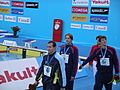
Victory lap of the 100 m butterfly during the 2005 FINA World Championships in Montréal. Phelps is far right.
-

Phelps holds his gold medal on the podium on August 10, 2008. Pictured with Ryan Lochte and László Cseh.
-
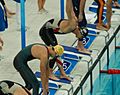
Phelps (in black cap) starting the 4×100 m relay at the Beijing Olympic Games, August 11, 2008
-
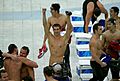
Michael Phelps celebrates with his teammates after winning his 8th gold medal.
-
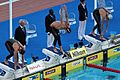
Phelps (center) before the start of the 200-meter butterfly semi-final during 2009 FINA World Championships
-
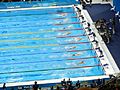
In his 100m butterfly heat, Phelps (fourth from top) was 8th at the 50m split before winning his heat and qualifying for the semi-finals
-
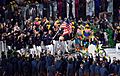
Phelps carrying the flag on behalf of athletes from the United States during the parade of nations within the 2016 Summer Olympics opening ceremony
-
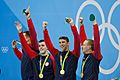
Phelps with Nathan Adrian, Ryan Held and Caeleb Dressel, after winning the 4×100 m freestyle relay
-

Phelps with his wife, Nicole Johnson
-
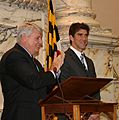
Phelps and Maryland House Speaker Mike Busch in April 2009. Both houses of the Maryland General Assembly honored Phelps that day.


See also
 In Spanish: Michael Phelps para niños
- List of multiple Olympic gold medalists
- List of multiple Olympic gold medalists at a single Games
- List of multiple Olympic medalists
- List of multiple Summer Olympic medalists
- List of multiple Olympic medalists at a single Games
- List of multiple Olympic gold medalists in one event
- List of top Olympic gold medalists in swimming
- List of individual gold medalists in swimming at the Olympics and World Aquatics Championships (men)
- World record progression 100 metres butterfly
- World record progression 200 metres butterfly
- World record progression 200 metres freestyle
- World record progression 200 metres individual medley
- World record progression 400 metres individual medley
- World record progression 4 × 100 metres freestyle relay
- World record progression 4 × 200 metres freestyle relay
- World record progression 4 × 100 metres medley relay
