
Newt facts for kids
Quick facts for kids Newt |
|
|---|---|
 |
|
| Alpine newt | |
Scientific classification  |
|
| Kingdom: | Animalia |
| Phylum: | Chordata |
| Class: | Amphibia |
| Order: | Urodela |
| Family: | Salamandridae |
| Subfamily: | Pleurodelinae |
| Genera | |
A newt is a type of salamander that belongs to the group called Pleurodelinae. Young newts that live on land are known as efts. Unlike many other salamanders, newts are semiaquatic. This means they spend part of their lives in water and part on land. However, not all salamanders that live in water are called newts.
There are over 100 known species of newts. You can find them in North America, Europe, North Africa, and Asia. Newts go through three main stages as they grow: they start as aquatic larvae (like tiny fish), then become terrestrial juveniles (efts), and finally grow into adults. Adult newts look a bit like lizards. They return to the water each year to lay eggs. The rest of the time, they live on land in damp places with lots of cover.
Sadly, newts are in danger. Their homes are being destroyed or broken up, and pollution is a big problem. Many newt species are now endangered. One species, the Yunnan lake newt, has even become extinct recently.
Contents
What is a Newt?

Newts are part of the salamander family. They have a few special features. Their skin is not as smooth as some other salamanders. It's also semipermeable, meaning things can pass through it. Newts have four legs that are all about the same size, and they have a distinct tail.
One amazing thing about newts is their ability to regrow lost body parts! If a newt loses a limb or even an organ, the cells at the injury site can change back to a basic form. Then, they multiply quickly and turn into new cells to rebuild the missing part. Scientists are still studying how they do this.
Where Do Newts Live?

Newts live in many parts of the world. You can find them in North America, Europe, North Africa, and Asia. In North America, there are only a few types, like the Pacific newts and Eastern newts. But in Europe and Asia, there are many more kinds!
Since newts are semiaquatic, they spend part of the year in water and part on land. They usually go into the water to reproduce. Most newts like still water, such as ponds, ditches, or flooded fields. However, some, like the Danube crested newt, can live in slow-moving rivers. There are even special newts, like the European brook newts, that live in cold, fast-flowing mountain streams. When they are on land, newts look for damp places with lots of hiding spots, like under logs, rocks, or in holes in the ground.


How Newts Grow: Life Cycle
Newts have a fascinating life cycle! In the Northern Hemisphere, their main breeding season is usually in June and July. A single female newt can lay hundreds of eggs. For example, the warty newt can lay 200–300 eggs.
From Egg to Adult
Before laying eggs, male and female newts perform special courtship dances in ponds or slow streams. The male then passes a packet of sperm to the female. She uses this to fertilize her eggs. Newts lay their eggs one by one, usually attaching them to aquatic plants. This is different from frogs or toads, which lay eggs in clumps or long strings. Newts often fold a plant leaf over their egg to protect it.
After about three weeks, tiny larvae hatch from the eggs. These larvae look a bit like fish fry, but they have feathery gills on the outside of their bodies. They eat algae, small invertebrates, and even other amphibian larvae.
Over the next few months, the larvae go through a big change called metamorphosis. During this time, they grow legs. Their gills disappear, and they develop lungs to breathe air. Some newts, like those in North America, also get brighter colors during this stage.
Once they have fully changed, they leave the water and live on land. At this stage, they are called "efts." For North American newts, they will only return to the water when they become adults, usually to breed. Most European newts, however, live on land as adults and only visit water to lay their eggs.


Newt Superpowers: Special Abilities
Staying Safe: Newt Toxins

Many newts have a special way to protect themselves from predators: they produce toxins (poisons) in their skin. The Taricha newts in western North America are especially toxic. For example, the rough-skinned newt produces enough toxin to be dangerous to an adult human if swallowed. Some Native American groups even used this toxin to poison their enemies.
However, these toxins are only harmful if they are eaten or get into a cut. You can usually handle most newts safely. Just make sure you don't put your hands in your mouth or touch any cuts after touching a newt. Newts can live safely in the same ponds as frogs and other amphibians. The only animals that can usually eat Taricha newts are certain garter snakes that have become resistant to the toxin.
Breathing and Water Balance
Adult newts breathe mainly through their skin. They also use their lungs and mouth cavity. Lung breathing is especially important when there isn't much oxygen in the water. They also use their lungs when they are very active, like during courtship or feeding.
Newts are also good at dealing with changes in water. If they get dehydrated, they can quickly absorb water when they find it again. This helps them survive in different environments.
Newts and Their Environment
Why Newts Need Our Help
Even though some newt species are still common, many are in trouble. Their populations are shrinking because of habitat loss, fragmentation (when their homes are broken into smaller pieces), and pollution. This is a big problem for their breeding sites in water and their homes on land.
Several newt species are now considered threatened by the IUCN. The Yunnan lake newt is a sad example of a newt species that has recently become extinct.
Protecting Newts
Many countries are working to protect newts. In the UK, for example, great crested newts are legally protected. It's against the law to catch, own, harm, or disturb their homes without a special permit. Other newt species in the UK are also protected from being sold.
In Europe, many newt species are listed as "strictly protected." This means they are very important to conserve.
Newts as Nature's Detectives
Newts, like all amphibians, are great bioindicators. This means they can tell us how healthy an environment is. Their thin, sensitive skin absorbs oxygen and other substances from the water. Because of this, they are very sensitive to small changes in the water's pH level (how acidic or basic it is). If newt populations are healthy, it often means the water quality is good. Scientists study newt populations to check the health of lakes and streams.
Newts as Pets
Many types of newts are popular pets. Some common ones include Chinese warty newts, Chinese fire belly newts, eastern newts, paddletail newts, and Spanish ribbed newts. Some newts, like rough-skinned newts and Kaiser's spotted newts, are rarely seen as pets. If you are thinking about getting a newt, make sure to research its specific needs and how to care for it properly!
Images for kids
-
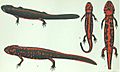
The Yunnan lake newt is considered extinct.

