
PATH (rail system) facts for kids
Quick facts for kids PATH |
|
|---|---|
 PATH Kawasaki 5602c.jpg |
|
| Info | |
| Owner | Port Authority of New York and New Jersey |
| Locale | Newark/Hudson County, New Jersey and Manhattan, New York |
| Transit type | Commuter railroad (de jure) Rapid transit (de facto) |
| Number of lines | 4 |
| Number of stations | 13 |
| Headquarters | PATH Plaza Jersey City, New Jersey |
| Operation | |
| Began operation | February 25, 1908 as H&M Railroad September 1, 1962 as PATH |
| Operator(s) | Port Authority Trans-Hudson Corporation |
| Number of vehicles | 350 PA5 cars |
| Technical | |
| System length | 13.8 mi (22.2 km) |
| Track gauge | 4 ft 8 1⁄2 in (1,435 mm) standard gauge |
| Electrification | Third rail, 600 V DC |
The Port Authority Trans-Hudson (PATH) is a special train system that connects New Jersey and New York City. It's like a subway, but it travels under the Hudson River through strong tunnels! PATH trains run 24 hours a day, every day of the year. During weekdays, four different routes serve 13 stations. On weekends and late nights, two routes keep people moving.
PATH helps people travel between cities like Newark, Jersey City, and Hoboken in New Jersey, and Manhattan in New York City. It's a very busy system, carrying millions of riders each year, making it one of the busiest train systems in the United States.
This train system started a long time ago, in 1908, and was first called the Hudson & Manhattan Railroad (H&M). It was built to connect New Jersey's waterfront with New York City. Over time, as more people started driving cars, the H&M faced financial challenges. In 1962, the Port Authority of New York and New Jersey took over the system and renamed it PATH. Since then, PATH has faced big challenges from major events like the September 11 attacks and Hurricane Sandy. Despite these, it has continued to serve its communities and has seen many improvements.
Even though PATH feels like a subway, it follows special rules because its tracks are close to other big railroads. This means PATH train operators need special licenses, and the trains get extra safety checks. As of 2023, PATH uses modern PA5 train cars to carry its passengers.
Contents
The Story of PATH
How it All Began: The Hudson & Manhattan Railroad
The PATH system is actually older than the first underground subway line in New York City! The idea for the Hudson & Manhattan Railroad (H&M) came about in 1874. However, at that time, it was very difficult to build tunnels safely under the Hudson River.
Building the Tunnels

Construction on the first tunnel, now called the Uptown Hudson Tubes, began in 1873. Engineers used a special method with compressed air to dig through the mud and then lined the tunnel with bricks. This was a very difficult job, and the project faced many challenges, including serious accidents that caused delays. Work stopped in 1883 because there wasn't enough money. Another attempt by a British company a few years later also didn't succeed.
Work started again in 1900, led by a determined lawyer named William Gibbs McAdoo. He later became the president of the H&M. The railroad became so well-known because of McAdoo that people sometimes called the lines the "McAdoo Tubes."
_(cropped).jpg)
When construction restarted in 1902, engineers used a new method. Workers pushed a special tunnelling shield through the mud and then placed strong cast iron plates around the tunnel. This method helped complete the uptown tunnels by 1906.
By 1904, the city allowed the company to build a new subway line through Midtown Manhattan. This line would go under Sixth Avenue to a station at 33rd Street. In 1905, a company was formed to finish the Uptown Hudson Tubes and build the Sixth Avenue line. They also built a second pair of tunnels, known as the Downtown Hudson Tubes.
The Downtown Hudson Tubes were built about 1.25 miles (2 km) south of the first tunnels. They were finished in 1909 using the same cast iron method. Both the uptown and downtown tunnels had two tubes, with each tube carrying trains in one direction.
Opening Day
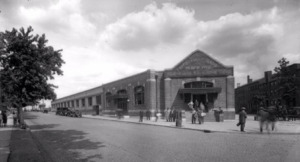
Test runs of empty trains began in late 1907. Regular train service officially started between Hoboken Terminal and 19th Street on February 26, 1908. President Theodore Roosevelt even helped start the electric lines from the White House! This first route became part of today's Hoboken–33rd Street line.
Over the next few years, the H&M system grew. Extensions opened to 23rd Street in June 1908 and to Hudson Terminal in Lower Manhattan by July 1909. By 1910, the lines reached Grove Street in Jersey City, forming routes like the Journal Square–33rd Street line.
In November 1911, the H&M extended its service all the way to Park Place in Newark. By 1913, the system was complete, including new stations like Journal Square and Harrison. The total cost was around $55–$60 million.
Big Plans That Didn't Happen
The Hudson Tubes were first planned to connect several big train stations in New Jersey with New York City. While PATH still connects to stations in Hoboken and Newark, some of the older terminals have since closed.
There were also ideas to build new lines, like one that would go across Manhattan. Some of these plans even started, but they were later stopped. The H&M even had plans to extend its lines to Grand Central Terminal in Manhattan, a very busy station. However, these plans never happened, partly because of disagreements with other train companies.
Challenges and Changes

In 1927, a record 113 million people rode the H&M! But soon, new tunnels and bridges for cars, like the Holland Tunnel and George Washington Bridge, opened. This meant more people started driving instead of taking the train. The H&M faced financial difficulties, especially during the Great Depression.
During the 1930s, some H&M stations in Manhattan were affected by the construction of the new subway lines. The 33rd Street terminal had to be moved, and the 28th Street station closed. In New Jersey, the Manhattan Transfer station closed, and the H&M trains started going to Newark Penn Station instead of Park Place.
Despite efforts to attract more riders, the H&M continued to struggle financially. The 19th Street station in Manhattan closed in 1954. That same year, the H&M faced serious financial trouble and couldn't pay its bills.
PATH Takes Over
_(26080894656).jpg)
In the early 1960s, plans were being made to build the original World Trade Center. As part of this big project, the Port Authority of New York and New Jersey agreed to buy and manage the H&M train lines. This happened in 1962, and the system was renamed Port Authority Trans-Hudson (PATH).
After taking over, the Port Authority invested a lot of money to make the system modern. They ordered 162 new PA1 train cars in 1964 to replace the old H&M trains, some of which were from 1909! More new cars, the PA2 and PA3 models, were ordered in the following years.
Late 20th Century
As the World Trade Center was built, the old Hudson Terminal was replaced with a new World Trade Center Terminal. This new station opened in 1971. The Journal Square Transportation Center also opened in 1973, becoming a major hub.
.jpg)
There were plans in the 1970s to extend the PATH system further into New Jersey, possibly to Plainfield, New Jersey, and even to Newark Airport. However, these plans faced legal and financial challenges and were eventually canceled.
PATH also experienced some worker strikes in the 1970s and 1980s, which caused temporary service interruptions. The longest strike lasted 81 days in 1980.
In the 1980s and 1990s, more people started riding PATH, so the system needed upgrades. The Port Authority invested a lot of money to improve stations, tracks, and communication systems. They also added elevators at several stations to make them accessible for everyone, following the Americans with Disabilities Act of 1990. A new facility for maintaining train cars opened in Harrison in 1990.
In December 1992, high tides from a big storm flooded some PATH tunnels, causing service disruptions. In 1993, a section of the ceiling in the World Trade Center PATH station collapsed during a bombing incident. However, service to the station quickly resumed within three days.
21st Century Challenges and Improvements


The World Trade Center station was destroyed during the September 11 attacks in 2001 when the towers above it collapsed. The station was closed, and all passengers were safely evacuated just before the collapse. The nearby Exchange Place station also had to close due to severe water damage.
The Port Authority worked quickly to restore service. A temporary PATH terminal at the World Trade Center opened in November 2003, bringing trains back to Lower Manhattan. This temporary station used parts of the original station.

Construction of the permanent and beautiful World Trade Center Transportation Hub began in 2008. Different parts of the new station opened over several years, with the full hub officially opening in March 2016.
In October 2012, Hurricane Sandy caused massive flooding in the PATH tunnels and stations, especially in Hoboken and Jersey City. Water levels reached as high as 8 feet (2.4 m) in some tunnels! All PATH service was suspended. It took many weeks and $300 million in repairs to get the Hoboken Terminal back open. Service was gradually restored, with all normal operations returning by March 2013.
Modern Upgrades
The Harrison station was rebuilt starting in 2009, with longer and wider platforms to handle more trains. The new station also included elevators to meet modern accessibility standards. The new platforms fully opened in 2018 and 2019.
PATH also invested in a new signal system called communications-based train control (CBTC) to allow trains to run closer together and increase the number of passengers it could carry. This system was fully operational by December 2018. At the same time, the entire fleet of trains was replaced with 340 new PA5 cars, built by Kawasaki.
Another safety system, positive train control (PTC), was also installed across the PATH system and completed by December 2018. This system helps prevent accidents.
In 2019, the Port Authority launched the PATH Improvement Plan, investing over $1 billion in further upgrades. This included extending platforms for longer trains, completing the CBTC system, and buying more PA5 cars. The goal was to increase train frequencies and capacity, especially during busy times. By March 2023, the Newark–World Trade Center line began operating with nine-car trains.
In 2024, the Port Authority announced a $430 million plan to refurbish four stations and replace railroad switches. The Hoboken Terminal station was closed for extensive refurbishment during February 2025. The Port Authority also announced in November 2025 that weekend service would increase, with all four weekday lines running, and that fares would gradually increase each year until 2029.
Future Ideas
Newark Airport Extension
For many years, there have been discussions about extending PATH service to Newark Liberty International Airport Station. This would allow travelers to connect directly to the airport's AirTrain system. Studies were done to see if it was possible, and in 2014, the Port Authority approved a plan for this extension.
Construction was expected to start around 2018, with service beginning in 2025. However, in December 2025, the Port Authority announced that this extension would be delayed by ten years. This was because the agency decided to focus on replacing the AirTrain Newark first.
Marion Station Idea
West of Journal Square in Jersey City, there's an area called the Marion Section. People have suggested building a new station there since the 1980s. In 2018, Jersey City and the Port Authority agreed to study if a new station could be built. Local leaders have encouraged the Port Authority to continue with this project.
How PATH Trains Run
PATH trains operate 24 hours a day, seven days a week. During weekdays, four different train services are available, connecting New Jersey and Manhattan. On late nights, weekends, and holidays, two services run.
Each line has a special color on maps and timetables. For example, the Journal Square–33rd Street (via Hoboken) service uses two colors (yellow and blue) because it combines two weekday lines. During busy hours, trains run very frequently, every few minutes.
PATH is a very popular system. In 2022, it carried 45,501,400 rides, making it the fifth-busiest rapid transit system in the United States. As of 2024, PATH served 57.25 million passengers. The busiest station is World Trade Center, while 9th Street is the least busy.
PATH operates at a financial loss each year. It is supported by the Port Authority using money from its airports and seaports. This is partly because PATH has to follow strict railroad safety rules, which can be more expensive.
Train Services
The PATH system has 13.8 miles (22.2 km) of routes. During the daytime on weekdays, four services operate:
- Newark–World Trade Center
- Hoboken–World Trade Center
- Journal Square–33rd Street
- Hoboken–33rd Street
Between 11 p.m. and 6 a.m. Monday to Friday, and all day Saturday, Sunday, and holidays, PATH operates two train services:
- Newark–World Trade Center
- Journal Square–33rd Street (via Hoboken)
PATH trains usually don't go directly from Newark to Midtown Manhattan. Passengers traveling this route typically transfer at Journal Square or Grove Street. However, after the September 11 attacks and Hurricane Sandy, special services were run to help people get around.
In 2026, the three weekday lines will start running on weekends as well, replacing the Journal Square–33rd Street (via Hoboken) service pattern.
Most PATH trains are limited to seven cars because some station platforms cannot be extended. However, the Newark–World Trade Center line has been upgraded to run nine-car trains since 2023.
Network map
-
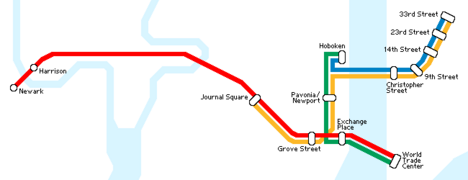
Map of the PATH system (regular service)
-
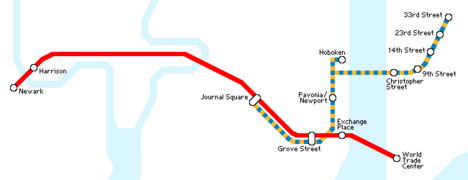
Map of the PATH system (late-night hours and on weekends/holidays)
-

To-scale map of the PATH system


Station List
| Station | Services | State | City | Opened | Closed | County/ |
Ridership (2024) | Rank |
|---|---|---|---|---|---|---|---|---|
| Ninth Street | HOB–33 JSQ–33 |
NY | New York | February 25, 1908 | Manhattan | 1,192,086 | 13 | |
| 14th Street | HOB–33 JSQ–33 |
NY | New York | February 25, 1908 | Manhattan | 1,792,523 | 10 | |
| 19th Street | NY | New York | February 25, 1908 | August 1, 1954 | Manhattan | |||
| 23rd Street | HOB–33 JSQ–33 |
NY | New York | June 15, 1908 | Manhattan | 1,706,994 | 11 | |
| 28th Street | NY | New York | November 10, 1910 | September 24, 1939 | Manhattan | |||
| 33rd Street | HOB–33 JSQ–33 |
NY | New York | November 10, 1910 | Manhattan | 6,720,192 | 3 | |
| Christopher Street | HOB–33 JSQ–33 |
NY | New York | February 25, 1908 | Manhattan | 1,321,256 | 12 | |
| Exchange Place | NWK–WTC HOB–WTC |
NJ | Jersey City | July 19, 1909 | Hudson | 3,525,285 | 8 | |
| Grove Street | NWK–WTC JSQ–33 |
NJ | Jersey City | September 6, 1910 | Hudson | 4,884,577 | 6 | |
| Harrison | NWK–WTC | NJ | Harrison | June 20, 1937 | Hudson | 1,901,908 | 9 | |
| Hoboken | HOB–WTC HOB–33 |
NJ | Hoboken | February 25, 1908 | Hudson | 5,365,820 | 4 | |
| Hudson Terminal | NY | New York | July 19, 1909 | July 2, 1971 | Manhattan | |||
| Journal Square | NWK–WTC JSQ–33 |
NJ | Jersey City | April 14, 1912 | Hudson | 6,868,655 | 2 | |
| Manhattan Transfer | NJ | Harrison | October 1, 1911 | June 20, 1937 | Hudson | |||
| Newark | NWK–WTC | NJ | Newark | June 20, 1937 | Essex | 4,946,510 | 5 | |
| Newport | HOB–WTC JSQ–33 |
NJ | Jersey City | August 2, 1909 | Hudson | 3,653,326 | 7 | |
| Park Place | NJ | Newark | November 26, 1911 | June 20, 1937 | Essex | |||
| World Trade Center | NWK–WTC HOB–WTC |
NY | New York | July 6, 1971 | Manhattan | 13,368,349 | 1 |
All New Jersey stations, as well as the World Trade Center and 33rd Street terminals in New York, are accessible for people with disabilities. Harrison, the last non-accessible station in New Jersey, was made fully accessible in 2019. The only stations that are not yet accessible are Christopher Street, Ninth Street, 14th Street, and 23rd Street in Manhattan.

How to Pay for Your Ride
PATH charges a single fee to ride, no matter how far you travel. As of January 12, 2024, a single ride costs $3.00. You can also buy multi-trip cards or unlimited passes for better deals. Since June 2025, disabled riders have been able to apply for half-fare tickets.
While some PATH stations connect to other train systems like the New York City Subway, there are no free transfers between them. You need a separate ticket for each system.
PATH has been testing a new way to pay called TAPP, which is similar to other modern payment systems. TAPP readers accept TAPP cards, debit and credit cards, and digital wallets.
History of Fares
Old Payment Methods
In the past, the H&M used a fare system where the price changed based on how far you traveled. For example, before 1961, an interstate trip cost 25 cents, while a trip within one state cost 15 cents. When the Port Authority took over, they made the fare the same for all trips in 1970.
From 1965, PATH fares were paid with brass tokens. However, the Port Authority stopped selling tokens in 1971 to save money. They replaced the turnstiles to accept exact change.
Later, a paper ticket called the QuickCard was introduced in 1990. It stored fare information on a magnetic stripe. The QuickCard was eventually replaced by the SmartLink card.
Current Payment Methods

SmartLink
PATH's main way to pay is with a smart card called SmartLink. This card was first available in 2007. You can register your SmartLink card online to keep track of your trips and even set it up to refill automatically.
MetroCard
You could also pay for PATH rides using certain MetroCards, which are used on New York's subway and bus system. However, only single-ride, two-trip, and pay-per-ride MetroCards were accepted on PATH. Unlimited-ride MetroCards did not work. MetroCard sales officially ended on December 31, 2025, but existing MetroCards could still be used until they expired.
TAPP
In November 2021, the Port Authority announced its own new payment system called TAPP, which stands for Total Access PATH Payment. TAPP works like other modern systems, allowing you to pay with debit and credit cards or your phone. TAPP was tested in some stations in December 2023. By early May 2024, TAPP was rolled out at all New Jersey stations, and later that month, it was available at all stations in New York. On December 4, 2025, physical TAPP cards were also introduced.
Ridership
The Trains: Rolling Stock
Current Trains: PA5 Cars


As of 2023, PATH uses only one type of train car, called the PA5. These cars are about 51 feet (15.5 m) long and 9.2 feet (2.8 m) wide. They are a bit smaller than some other trains because the tunnels under the Hudson River are narrow. PA5 trains can travel up to 55 miles per hour (89 km/h).
Each PA5 car has seats for 35 passengers, with extra room for many people to stand. They have shiny stainless steel bodies and three doors on each side. LED screens above the windows show where the train is going. PA5 cars are linked together to form trains up to 8 cars long. The Newark–World Trade Center line will soon use 10-car trains.
In 2005, PATH ordered 340 new PA5 cars to replace its entire older fleet. The old trains were some of the oldest in the United States! The first new PA5 cars started running in 2009. More cars were ordered later, bringing the total to 350. In 2017, another 50 PA5 cars were ordered, and in 2018, 72 more new cars were added, bringing the total to 422 cars. These new cars are built in the U.S. and tested in New York.
All PATH trains are stored and maintained at the Harrison Car Maintenance Facility in New Jersey. There is also another storage yard near the Journal Square station.
Older Trains


Before the Port Authority took over, the H&M system used different types of train cars, often called "black cars" because of their color. Many of these old cars were used for a very long time.
After PATH took over in 1962, they started ordering new trains. The PA1, PA2, and PA3 cars were built in the 1960s and 1970s. These cars had painted aluminum bodies and two doors on each side. Later, the PA4 cars were built in the 1980s. These had stainless steel bodies and three doors. All of these older PA1-PA4 trains were retired from service by 2011, replaced by the modern PA5 cars.
After September 11, 2001, a seven-car PATH train was left under the World Trade Center. Most of the cars were destroyed, but two cars, 745 and 143, survived. These cars were later cleaned and donated to museums to be preserved.
Special Rules for PATH
.jpg)
Even though PATH operates like a city subway, it is legally considered a commuter railroad. This means it follows special rules from the Federal Railroad Administration (FRA), which oversees larger national railroads.
This is because PATH's tracks between Newark and Jersey City are very close to other major train lines, and it even shares the Dock Bridge near Newark Penn Station with Amtrak and NJ Transit trains.
Because of these rules, PATH has stricter safety requirements than other city subway systems. For example, all PATH train operators must have special licenses, and the trains undergo more detailed safety checks. These extra requirements can make PATH more expensive to operate. The Port Authority has tried to change PATH's classification to be regulated like other rapid transit systems, but the FRA has insisted on keeping the current safety oversight.
Important Events
Train Incidents
Over the years, like any busy transportation system, PATH has experienced some train incidents. These have included collisions and derailments. For example, on April 26, 1942, a train derailed at Exchange Place, resulting in a serious incident. On December 17, 1945, a train collided with a barrier near Harrison, causing injuries. More recently, on October 21, 2009, a train crashed into a bumper block at 33rd Street, causing minor injuries. On May 8, 2011, another train crashed into a bumper block at Hoboken Terminal, injuring several people. On July 12, 2025, a PATH train derailed at the Hoboken station. These events have led to investigations to improve safety.
Other Incidents
On August 8, 1983, part of the ceiling at Journal Square fell onto the platform, causing a tragic incident. An investigation found problems with the station's design and maintenance.
In July 2006, a security concern involving the Downtown Hudson Tubes was uncovered by the FBI. Officials stated that the tunnels were very strong, and the threat was managed.
On January 7, 2013, an escalator at Exchange Place suddenly reversed, causing some injuries. After this, all escalators in the PATH system were inspected to ensure safety. On August 4, 2025, a train caught fire at the Newport station.
See also
- Transportation in New Jersey
- Transportation in New York City
- List of metro systems
- PATCO Speedline, a similar rapid transit/commuter line connecting South Jersey to Philadelphia
