
Rhaetian facts for kids
Quick facts for kids Rhaetian |
|
|---|---|
| ~205.7 – 201.4 ± 0.2 Ma | |

Mollweide map of Earth 205 million years ago, with black outlines depicting countries in their locations
|
|
| Chronology | |
|
Triassic graphical timeline
-255 —
–
-250 —
–
-245 —
–
-240 —
–
-235 —
–
-230 —
–
-225 —
–
-220 —
–
-215 —
–
-210 —
–
-205 —
–
-200 —
Subdivision of the Triassic according to the ICS, as of 2024.
Vertical axis scale: Millions of years ago |
|
| Etymology | |
| Name formality | Formal |
| Usage information | |
| Celestial body | Earth |
| Regional usage | Global (ICS) |
| Time scale(s) used | ICS Time Scale |
| Definition | |
| Chronological unit | Age |
| Stratigraphic unit | Stage |
| Time span formality | Formal |
| Lower boundary definition | Not formally defined |
| Lower boundary definition candidates |
|
| Lower boundary GSSP candidate section(s) | |
| Upper boundary definition | FAD of the Ammonite Psiloceras spelae tirolicum |
| Upper boundary GSSP | Kuhjoch section, Karwendel mountains, Northern Calcareous Alps, Austria 47°29′02″N 11°31′50″E / 47.4839°N 11.5306°E |
| Upper GSSP ratified | 2010 |
The Rhaetian was the very last part of the Triassic Period, a long time ago in Earth's history. Think of it as the final chapter of the Triassic book! It came right after the Norian age and was followed by the Hettangian age, which was the beginning of the Jurassic Period.
Scientists use the Rhaetian to describe a specific time in Earth's history (called an age) and also a specific layer of rocks formed during that time (called a stage). The Rhaetian age lasted from about 205.7 million years ago to 201.4 million years ago.
During this time, the supercontinent Pangaea was just starting to break apart. However, the Atlantic Ocean hadn't formed yet.
Contents
How Scientists Date the Rhaetian Period
Scientists work like detectives to figure out exactly when ancient time periods like the Rhaetian began and ended. They use several clues found in rocks and fossils.
Finding the Start of the Rhaetian
The start of the Rhaetian age, which is also the end of the Norian age, is a very important boundary. For many years, scientists debated the exact date. They looked for the first appearance of a tiny marine creature called a conodont, specifically a species named Misikella posthernsteini. This fossil acts like a special marker in the rock layers.
Scientists also use other methods:
- Rock Layers and Fossils: They study different layers of rock in places like Austria and Italy. These layers contain different fossils, which help them understand the order of events.
- Magnetic Signals: Rocks can record Earth's magnetic field at the time they formed. By studying these "magnetic stripes," scientists can match rock layers from different parts of the world.
- Astrochronology: This method looks at natural cycles in Earth's orbit. These cycles affect climate and how sediments are deposited, acting like a geological clock.
- Radiometric Dating: This is like using a very precise stopwatch! Scientists measure certain elements in volcanic ash layers to get exact ages for the rocks.
After much research and using these different methods, scientists now agree that the Rhaetian age began around 205.7 million years ago. This date was updated by the International Commission on Stratigraphy (ICS) in 2024, based on new findings from places like Peru and Italy.

Marking the End of the Rhaetian
The end of the Rhaetian age is also the beginning of the Jurassic Period. This boundary is marked by the first appearance of a specific type of ammonite fossil called Psiloceras. Ammonites were ancient sea creatures with spiral shells.
This boundary is very well-defined at a special location called Kuhjoch in Austria. Here, scientists found the first Psiloceras fossils, along with other clues like tiny plant spores and changes in carbon levels in the rocks.
The Rhaetian age ended about 201.4 million years ago. This date is also supported by radiometric dating of volcanic ash found near the fossil markers. This time also saw a big event called the Triassic-Jurassic extinction event, where many types of plants and animals disappeared.
Stratigraphic Definitions
The Rhaetian is named after the Rhaetian Alps. This is a mountain chain that stretches across parts of eastern Switzerland, northern Italy, and western Austria. The idea for this geological stage was first introduced by geologists Eduard Suess and Albert Oppel in 1856.
Index Fossils and Biotic Events
Index fossils are like special time markers. They are fossils of organisms that lived for a short period but were found all over the world. For the Rhaetian, the main index fossil is the conodont Misikella posthernsteini. Its ancestor, Misikella hernsteini, appeared just before the Rhaetian began.
Another important conodont from this time is Epigondolella mosheri. This fossil can be used in places where M. posthernsteini is harder to find.
At the start of the Rhaetian, there were also changes in other marine life. In the ancient Tethys Ocean, new types of ammonites appeared, like Sagenites reticulatus. Many types of large bivalves called Monotis went extinct. Only a few tiny Monotis species survived in the Tethys Ocean.
Scientists also found a big change in tiny sea creatures called radiolarians. This change marks the beginning of the Proparvicingula moniliformis zone.
The Norian-Rhaetian boundary also saw an extinction event. Many ammonoids, bivalves, conodonts, and radiolarians disappeared. Scientists think this extinction might have been caused by massive volcanic eruptions in Alaska. Another idea is an asteroid impact in France, but the exact timing of these events is still being studied.
GSSP Candidates
A GSSP stands for "Global Boundary Stratotype Section and Point." It's a specific, internationally agreed-upon location in a rock layer that marks the exact boundary between two geological time periods. The Rhaetian doesn't have an official GSSP yet, but scientists have proposed two main candidates.
One candidate is the Steinbergkogel section in Austria. This site has many important fossil markers, including the appearance of the conodonts Misikella hernsteini and M. posthernsteini. It also shows the extinction of large Monotis bivalves.
Another candidate is the Pignola-Abriola section in southern Italy. This site has a wide variety of conodonts, including the Misikella hernsteini-posthernsteini group. It also shows clear changes in radiolarian zones.
Rhaetian-Hettangian Boundary
The top of the Rhaetian stage marks the beginning of the Hettangian Stage, which is the first part of the Jurassic Period. This boundary is defined by the first appearance of the ammonite genus Psiloceras.
In the Tethys Ocean, the Rhaetian contains two ammonite fossil zones. The highest zone is that of Choristoceras marshi, and below it is Rhabdoceras suesii. The end of the Rhaetian is also linked to the Triassic-Jurassic extinction event.
The official GSSP for the start of the Hettangian (and the end of the Rhaetian) is at Kuhjoch in Austria. This site shows the first appearance of Psiloceras spelae and other tiny fossils. It also has a positive carbon isotope spike, which shows Earth's recovery after the Triassic-Jurassic extinction event.
Notable Formations
These are some important rock formations from the Rhaetian age:
- Lower Elliot Formation (South Africa)
- Exter Formation (Norian – Rhaetian) (Germany)
- 'Grès infraliasiques' Formation (Saint-Nicolas-de-Port, France)
- Penarth Group (England and Wales, UK)
Images for kids
-
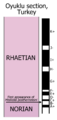
The magnetostratigraphic sequence of the Oyuklu section in Turkey, which Gallet et al. (2007) used to support a "short Rhaetian" hypothesis.
-
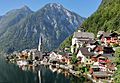
Hüsing et al. (2011) argued that the Rhaetian extended for almost 10 million years based on biomagnetostratigraphy at Steinbergkogel, a candidate GSSP near Hallstatt, Austria.


See also
- Triassic-Jurassic extinction event
- Rhaetian sandstone
