
Smallmouth bass facts for kids
Quick facts for kids Smallmouth bass |
|
|---|---|
.jpg) |
|
 |
|
| Conservation status | |
Scientific classification  |
|
| Kingdom: | Animalia |
| Phylum: | Chordata |
| Class: | Actinopterygii |
| Order: | Perciformes |
| Family: | Centrarchidae |
| Genus: | Micropterus |
| Species: |
M. dolomieu
|
| Binomial name | |
| Micropterus dolomieu Lacépède, 1802
|
|
| Script error: The function "autoWithCaption" does not exist. | |
| Synonyms | |
|
|


Script error: No such module "Check for conflicting parameters".
The smallmouth bass (scientific name: Micropterus dolomieu) is a cool freshwater fish. It belongs to the sunfish family. This fish is very popular for fishing in North America. People have moved them to many cool-water lakes and rivers in Canada and the United States. A smallmouth bass can grow up to about 69 centimeters (27 inches) long and weigh around 5.4 kilograms (12 pounds).
This fish naturally lives in the Mississippi River basin, the Saint Lawrence River–Great Lakes system, and the Hudson Bay basin. Some common nicknames for it are smallmouth, bronzeback, brown bass, and brownie.
Contents
Discovering the Smallmouth Bass

Smallmouth bass have a strong, streamlined body. This shape helps them swim very fast. Their scales are golden-olive to dark brown on top. This color fades to yellowish-white underneath. They have dark brown bars or spots on their body and head. This coloring helps them hide, making them great ambush predators. Their color can change based on their age, where they live, water quality, and what they eat.
Their jaw usually doesn't go past their red or brown eyes. They have two dorsal fins (back fins). The front fin has 9–11 spiny rays. The back fin has 13–15 soft rays.
Male smallmouth bass are usually smaller than females. Males often weigh around 0.9 kilograms (2 pounds). Females can weigh from 1.4 to 2.7 kilograms (3 to 6 pounds). Their size and color also depend on if they live in lakes or rivers. River smallmouth are often long and thin. This helps them move easily in flowing water. Lake smallmouth are shorter and have deeper bodies.
Smallmouth bass in dark river water are often dark brown and torpedo-shaped. This helps them hunt better. Those in sandy lake areas are usually light yellow-brown and more oval.
There are two types of smallmouth bass. The Northern smallmouth bass (M. dolomieui dolomieui) is common. The Neosho smallmouth bass (M. dolomieui velox) lives in a smaller area. This area includes parts of Missouri, Arkansas, and Oklahoma.
They eat tadpoles, smaller fish, aquatic insects, and crayfish.
The biggest smallmouth bass ever caught weighed 5.41 kilograms (11 pounds, 15 ounces). It was caught in the Dale Hollow Reservoir.
Habitat and Reproduction of Smallmouth Bass
The smallmouth bass likes clear water. You can find them in streams, rivers, and rocky parts of lakes. They can handle stronger currents than other black bass. They prefer cooler water temperatures than their cousin, the largemouth bass. So, in summer, they often go to deeper, faster-moving water.
Because they need clean water, smallmouth bass are a good sign of a healthy environment. They eat crayfish, amphibians, insects, and smaller fish. Young smallmouth bass eat tiny water creatures and insect larvae. Adult smallmouth bass sometimes eat young fish from other parents.
Smallmouth Bass Reproduction
A female smallmouth bass can lay up to 21,100 eggs. The male fish guards these eggs in his nest.
-
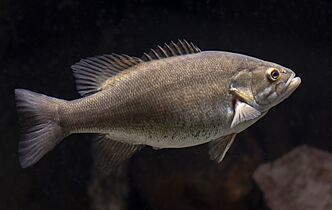
At Gavins Point National Fish Hatchery
-
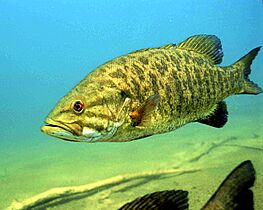
A smallmouth bass underwater
-
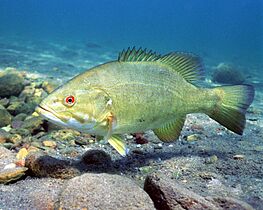
A lighter colored smallmouth bass on a sandy bottom
.jpg)


How Smallmouth Bass Migrate
_(14586465960).jpg)
When the weather gets colder, and water temperatures drop below 16°C (60°F), smallmouth bass move. They look for deeper pools. Here, they enter a state like semi-hibernation. They move slowly and eat very little until warmer weather returns. Smallmouth bass can travel far. It's common for them to move 19 kilometers (12 miles) in a single day in a river. Their total migration can be over 97 kilometers (60 miles).
Smallmouth bass usually start spawning in spring or early summer. This happens when water temperatures are between 15°C and 18°C (59°F and 64°F). They need clean stones, rocks, or gravel to lay their eggs successfully.
Fishing for Smallmouth Bass
Smallmouth bass were first introduced outside their natural home in 1825. This happened with the building of the Erie Canal. Later, in the 1800s, they were moved by train to lakes and rivers across the northern and western United States. They were easy to transport in buckets.
Many eastern trout rivers became polluted or too warm. Smallmouth bass were often put into these rivers. They became a popular fish for anglers. They also adapted well to large, cool lakes.
Over time, smallmouth bass numbers went down. This was due to pollution and dams changing rivers. In recent years, people have worked to keep water clean. Better fishing rules have also helped smallmouth populations grow again. This has made them popular with anglers once more.

Today, smallmouth bass are very popular game fish. Anglers use spinning gear, baitcasting gear, and fly fishing tackle. Many fishing tournaments target smallmouth bass. They are known for being strong fighters when hooked. Old fishing books called them "the gamest fish that swims." Most anglers catch and release smallmouth bass. However, smaller ones from cooler water can be good to eat.
The world record smallmouth bass weighed 5.41 kilograms (11 pounds, 15 ounces). It was caught in 1955 in the Dale Hollow Reservoir.
Best Tackle for Smallmouth Bass Fishing
For fishing, smallmouth bass can be caught with many baits and lures. These include crankbaits, hair jigs, plastic worms, and spinnerbaits. Anglers use spinning or baitcasting reels. Fishing lines are usually 6 to 15 pounds strong. Many people say smallmouth bass fight harder than other black bass. Fishing rods are usually light to medium-heavy.
You can also catch them with a fly rod. People use dry or wet flies, nymphs, or imitations of water creatures like hellgrammites or crayfish. Floating topwater lures are also popular.
For river fishing, spinning or fly tackle is common. In colder water, smaller lures like hair jigs work well. During warmer times, soft plastic tubes or spinnerbaits are often used. Good spots in rivers are behind rocks or in swirling water (eddies). Smallmouth bass can also be found in cool lakes like Lake Erie or any of the northern lakes.
-
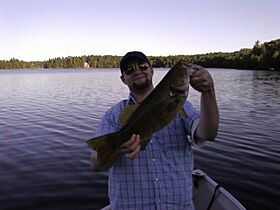
At Eagle Lake in Ontario, Canada (Released)
-
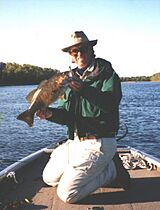
At Rainy River near International Falls, Minnesota (Released)


