
Southern Railway (UK) facts for kids

Coat-of-arms of the Southern Railway
|
|

1926 map of the railway
|
|
| History | |
|---|---|
| 1923 | Grouping; Southern Railway is created |
| 1929 | Electrification scheme finished |
| 1930 | Richard Maunsell's SR V "Schools" class introduced |
| 1937 | Oliver Bulleid becomes chief mechanical engineer |
| 1941 | First SR Merchant Navy Class locomotive built |
| 1948 | Nationalised |
| Constituent companies | |
| London, Brighton and South Coast Railway; London & South Western Railway; South Eastern and Chatham Railway |
|
| Successor organisation | |
| 1948 | Southern Region of British Railways |
| Key locations | |
| Headquarters | London Waterloo |
| Locale | England |
| Workshops |
|
| Major stations |
|
| Mileage | |
| Route length | 2,242 miles 47 chains (3,609 km) |
| Track length | 5,467 miles 60 chains (8,799 km) |
The Southern Railway (often called the SR) was an important British train company. It was started in 1923 during the Grouping. This event merged several smaller train companies into four big businesses. The Southern Railway joined London with towns in Kent, seaside cities, and South West England.
Trains carried millions of passengers each year across 2,186 miles (3,518 km) of track. It was the smallest of Britain's Big Four train systems. Unlike other train networks, it made most money from everyday travelers. In 1948, the company joined British Railways as the Southern Region of British Railways.
Contents
History and Creation of the Southern Railway Network

The Southern Railway was formed by joining several historic companies. The biggest was the London and South Western Railway (LSWR). The other large parts were the London, Brighton and South Coast Railway (LB&SCR) and the South Eastern and Chatham Railway (SE&CR). The first main line reached Southampton by 1840. Tracks spread toward Portsmouth, Salisbury, Exeter, and Plymouth.
The British government united these companies through the Railways Act 1921. Work started on 1 January 1923 under a manager named Sir Herbert Walker. The new main office was set up at London Waterloo. Along with trains, the company owned busy docks at the Port of Southampton and Port of Dover.
World War Two and Nationalisation
During the Second World War, the railway had a very important job. It moved soldiers and heavy cargo to Channel ports. Southern trains moved troops during the rescue at Dunkirk. They also moved supplies for the 1944 Normandy landings called Operation Overlord. German planes bombed London stations like London Cannon Street. After the war ended, the government passed the Transport Act 1947 to buy the lines.
How Did the Southern Railway Modernise Its Train Fleet?

The Southern Railway built the largest electric train system in the world. Engineers used a metal third rail to deliver DC power. By 1929, electric trains ran between London Bridge and East Croydon. Soon, lines ran all the way to Brighton, Eastbourne, and Portsmouth Harbour.
Innovative Steam Engines and Locomotives
The company had two famous designers called the chief mechanical engineer. The first was Richard Maunsell. He designed powerful locomotives like the 1926 SR Lord Nelson class. He also built the fast SR V "Schools" class for express passenger runs.
In 1937, Oliver Bulleid became the top designer. He created the famous SR Merchant Navy class in 1941. He also designed Light Pacific engines. During wartime shortages, he built the sturdy Q1 class freight engine. Bulleid even created the unusual SR Leader class engine with two driver cabs.
Modern Carriages and Bright Colours
The Southern Railway painted its passenger trains in a bright shade called malachite green. Train letters and numbers were painted with bright sunshine yellow paint. Bulleid even tested double-decker passenger cars called the SR Class 4DD to prevent crowding.
Famous Named Express Trains and Travel Routes

The Southern Railway became world famous for luxury passenger travel. Many people rode express trains to South Coast resorts for summer vacations. Other passengers took trains to docks to catch ocean liners or ships to France.
- The Brighton Belle was an all-electric luxury Pullman train between London and Brighton.
- The Golden Arrow carried passengers from London Victoria to Dover for trips to Calais.
- The Night Ferry took sleeping cars all the way across the sea to Paris.
- The Atlantic Coast Express traveled from Waterloo to holiday spots like Bude and Padstow.
- The Bournemouth Belle and Devon Belle carried visitors to sunny beaches.
Other Southern Railway Operations and Ships
.jpg)
The Southern Railway owned many steamships called the Channel Packet fleet. These ships crossed the sea to France and the Channel Islands. The company operated ferries such as the paddle steamer PS Ryde.
It also operated luxury places to stay like the Charing Cross Hotel. The company bought bus lines like Southern National and Southern Vectis. It even flew small passenger airplanes to the Isle of Wight.
Preserving the Southern Railway Heritage
Today, train fans can ride vintage Southern Railway trains on heritage lines. Enthusiasts can visit the famous Watercress Line, the Swanage Railway, and the Bluebell Railway. Beautiful steam engines also wait for visitors at the National Railway Museum.
Images for kids
-
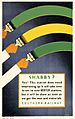
A 1945 railway poster
-
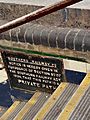
A station sign at Norbiton
-
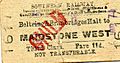
An Edmondson ticket
-
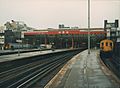
Charing Cross station
-
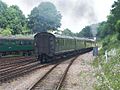
Preserved Maunsell carriages
-
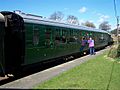
A preserved Bulleid carriage
-
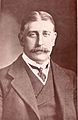
Sir Herbert Walker


.JPG)
.JPG)

