
Strategic bombing facts for kids

Strategic bombing is a type of military attack from the air. It uses special aircraft or missiles to hit targets that are very important to an enemy's ability to fight a war. These targets might include factories, transportation hubs, or military bases.
The main goal of strategic bombing is to weaken the enemy. This can be done by destroying their economy, making it hard for them to produce and move supplies. It can also aim to lower the spirits of the enemy population, hoping they will want to end the conflict. Sometimes, the term terror bombing is used for attacks on civilian areas. These attacks aim to damage an enemy's morale, or will to fight.
Between World War I and World War II, military thinkers developed the idea of strategic air warfare. They believed that an independent air force could play a huge role in future wars. Important thinkers like Giulio Douhet from Italy and Billy Mitchell from the United States helped shape these ideas.
Contents
- Understanding Strategic Bombing
- A Look Back: Early Air Raids
- Images for kids
- See also
Understanding Strategic Bombing
Strategic bombing is a military plan to attack key targets from the air. These targets are chosen because they are vital to an enemy's war effort. This could mean hitting factories that make weapons or roads that transport supplies.
The main purpose is to make it harder for the enemy to continue fighting. It also aims to make people lose hope in their government's ability to win. This strategy is often used in major conflicts.
Why Bomb from the Air?
One of the goals in war is to make the enemy feel discouraged. Facing constant destruction might make people prefer peace or surrender. Supporters of strategic bombing believed that attacking cities directly would quickly break civilian morale. They thought this would pressure leaders to seek peace.
However, early attacks in the 1930s, like in the Spanish Civil War, did not always work as planned. During World War II, the focus changed. Instead of just trying to break morale directly, bombing aimed to disrupt war industries. Destroying homes of workers, for example, could make it harder for factories to operate.
The Term "Terror Bombing"
The term terror bombing describes air attacks meant to weaken or break enemy morale. It suggests that these attacks are wrong, even if they follow some rules of war. The term became more common towards the end of World War II.
During World War II, officials in Nazi Germany often called Allied air attacks Terrorangriffe (terror attacks). Allied governments, however, used softer terms. They might say "area bombing" for attacks on cities. This was to avoid the negative meaning of "terror bombing." The use of such terms often caused public debate about the fairness of these attacks.
Protecting Against Air Attacks
Countries developed many ways to defend against air raids. These measures aimed to protect people and important places.
- Shooting down attackers: Using fighter aircraft, anti-aircraft guns, or surface-to-air missiles to stop enemy planes.
- Shelters: Building air raid shelters to protect civilians during attacks.
- Warnings: Using air raid sirens to alert people to take cover.
- Civil defense: Organizing teams of wardens, firefighters, and rescue workers. These teams helped manage damage and protect citizens.
- Blackouts: Turning off all lights at night to make it harder for bombers to find targets.
- Dispersal: Moving important factories to spread them out. This made them harder for bombers to hit all at once.
- Underground factories: Building factories in tunnels or other protected places.
- Decoy targets: Setting up fake targets in empty areas. These would trick bombers into attacking empty land instead of real cities.
A Look Back: Early Air Raids
Strategic bombing has a history that goes back to the early days of flight. It changed a lot over time as technology improved.
World War I: Zeppelins and Early Bombers
Strategic bombing first appeared in World War I. On August 6, 1914, a German Zeppelin bombed the Belgian city of Liège. This was one of the first aerial bombings of a city.
The Royal Naval Air Service (RNAS) in Britain also started early strategic attacks. They aimed to hit Zeppelin factories in Germany. German airships, like Zeppelins, later bombed English towns. The first aerial bombardment of English civilians happened on January 19, 1915. These raids caused some deaths and damage. More importantly, they created public fear and forced Britain to use many resources for air defense.
Later in the war, the Gotha bomber became the first airplane used for strategic bombing. French and British forces also bombed German towns. By the end of the war, air attacks had shown their potential to cause fear and disrupt enemy efforts.
Between the Wars: New Ideas for Air Power
After World War I, the idea of strategic bombing grew. People realized that future wars might involve heavy air attacks. This fear even influenced political decisions in the 1930s.
Military thinkers like Giulio Douhet believed that bombing an enemy's homeland would be crucial. They thought these attacks would destroy important military sites and break the spirit of the people. A common saying at the time was "the bomber will always get through." This meant that no defense could stop all bombers.
Some air forces, like Britain's Royal Air Force, used air power to control distant territories. They found it an effective way to manage situations with fewer ground troops. For example, in the Middle East, air attacks were used to show the power of the government.
However, early large-scale bombings, like the bombing of Guernica in the Spanish Civil War in 1937, showed something important. While destructive, these attacks did not always break the morale of the civilian population. Sometimes, they even made people more determined to resist.
World War II: A New Scale of Bombing
Strategic bombing in World War II was much larger than ever before. Aircraft dropped thousands of tons of bombs. This included incendiary devices, which caused massive fires.
This period saw the rise of "area bombardment." This meant dropping many bombs over a wide area to destroy cities. The goal was to kill war workers, destroy supplies, and lower enemy morale. If enough bombs were dropped, they could create a destructive firestorm.
German and Japanese forces mostly used smaller bombers. But British and American forces developed much larger, four-engine strategic bombers. These planes could carry huge amounts of bombs.
Bombing in Europe
In Europe, strategic bombing began early in the war. Germany bombed Poland in 1939. Later, the Germans launched the Blitz against Britain, hoping to break British morale. Both sides eventually switched to night bombing due to heavy losses during daylight raids.
The Royal Air Force (RAF) adopted an area-attack strategy. They aimed to disrupt Germany's war production and force them to divert resources to defense. The United States Army Air Forces (USAAF) tried daylight precision bombing for better accuracy. However, bad weather and strong defenses often made this difficult. Important missions included the bombing of Peenemünde, which delayed Germany's V-2 rocket program. The Soviet Air Forces also conducted strategic bombings, for example, against Helsinki, the capital of Finland.
Bombing in Asia and the Pacific
In the Asiatic-Pacific Theater, Japan used strategic bombing against cities in China and Southeast Asia. However, their bombers were smaller and carried less payload than Allied planes.
The United States developed the B-29 Superfortress, a bomber that could reach the Japanese home islands. These planes dropped high-explosive and incendiary bombs. The firebombing of Tokyo in March 1945 caused widespread destruction.
The final stage of strategic bombing in World War II involved nuclear weapons. On August 6 and 9, 1945, the United States dropped atomic bombs on Hiroshima and Nagasaki. These bombs caused immense destruction and a huge psychological shock. On August 15, Emperor Hirohito announced Japan's surrender. He spoke of the "new and most cruel bomb" and the need to prevent the "total extinction of human civilization."
The Cold War Era: Nuclear Power and Precision
The invention of nuclear weapons changed strategic bombing forever during the Cold War. The idea of massive bombing campaigns with conventional bombs became less common. Instead, the focus shifted to more powerful, targeted attacks.
Korean War Bombing
During the Korean War, the United States Air Force (USAF) used strategic bombing against North Korea. They targeted infrastructure like railroads and bridges, and economic sites like oil refineries and chemical plants. This aimed to disrupt supply lines and reduce North Korea's ability to fight. After China joined the war, the bombing campaigns became more intense. They aimed to weaken North Korea's economy and morale.
Vietnam War Bombing
In the Vietnam War, the US conducted Operation Rolling Thunder against North Vietnam. The goal was to lower morale, damage the economy, and force peace talks. However, these bombings did not achieve their aims. Public concern grew over the number of civilian casualties. This led to the development of new, more precise weapons. These "smart bombs" allowed for more effective bombing with fewer civilian deaths.
Laos was also heavily bombed during the Vietnam War. It contained important supply routes for communist troops. The US aimed to destroy these routes before they could be used against American forces in Vietnam.
Other Conflicts: Iran-Iraq War
During the Iran-Iraq War in the 1980s, both sides used strategic bombing. Iraq used large bombers against Iranian cities, including Tehran. These raids hit civilian and industrial targets, causing economic damage. Iran responded with its own air raids and Scud missiles against Iraqi cities.
Modern Air Attacks: Smart Bombs and New Aircraft
After the Cold War, strategic bombing changed again with the rise of "smart munitions." These are guided bombs that can hit targets with much greater accuracy.
In conflicts like the Gulf War, the Kosovo War, and the 2003 invasion of Iraq, precision weapons were used heavily. This meant that widespread area bombing, common in World War II, largely disappeared. As a result, there were significantly fewer civilian casualties compared to earlier campaigns.
Today, even traditionally tactical aircraft, like the F-16 Fighting Falcon or F-15E Strike Eagle, can perform strategic bombing roles. They can destroy targets that once required large formations of heavy bombers. Examples include the bombing of bridges in Novi Sad, Serbia, and power plants around Belgrade during the Kosovo campaign.
Recent Events: Ukraine
Since 2022, during the Russian invasion of Ukraine, missile and drone attacks have targeted Ukrainian infrastructure. These attacks have hit power stations and electrical networks. This has caused widespread damage, affecting energy distribution for millions of civilians. The goal of these attacks is believed to be to break the will of the Ukrainian population to continue the war.
Rules of War in the Air
Like all forms of warfare, air warfare must follow certain rules. These rules are part of international humanitarian law. They aim to protect victims of conflict and prevent attacks on protected people and places.
To be legal, air operations must follow three main principles:
- Military necessity: An attack must be aimed at helping to defeat the enemy.
- Distinction: Attacks must target only legitimate military objectives. They should not target civilians or civilian property.
- Proportionality: Any harm caused to civilians or civilian property must not be excessive. It must be balanced against the direct military advantage expected from the attack.
Key Thinkers in Air Warfare
Many individuals played a key role in developing the ideas and strategies behind strategic bombing:
- Henry H. "Hap" Arnold, USAF
- Giulio Douhet, Regia Aeronautica (Italy)
- Arthur "Bomber" Harris, RAF
- Curtis LeMay, USAF
- Billy Mitchell, USAAS
- Alexander P. de Seversky in Victory Through Air Power (1942 book and 1943 film)
- Carl Spaatz, USAF
- Hugh Trenchard, RAF
Images for kids
-
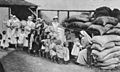
Children evacuating a hospital during an air raid rehearsal in 1918.
-
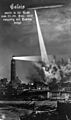
A German airship bombing Calais in February 1915.
-
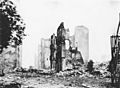
The ruins of Guernica after the bombing in 1937.
-
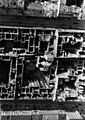
Destroyed townhouses in Warsaw after German bombing in September 1939.
-
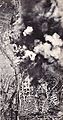
A 1943 USAAF raid on ball bearing factories in Schweinfurt, Germany.
-
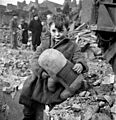
A child amidst ruins after German aerial bombing of London in 1945.
-
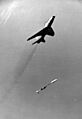
A U.S. Air Force F-100C practicing a nuclear bombing run.
-
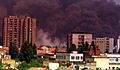
Smoke in Novi Sad, Serbia after NATO bombardment.


See also
 In Spanish: Bombardeo estratégico para niños
- Dahiya doctrine
