
Trumpet facts for kids
The trumpet is a popular brass instrument. You can hear it in many types of music. This includes classical music, jazz, and popular music. Trumpets come in different sizes. The piccolo trumpet plays the highest notes. The bass trumpet plays much lower notes.
People have used instruments like the trumpet for a very long time. They date back over 4,000 years! Early trumpets were used for signals in battles or during hunting. They became musical instruments around the late 1300s or early 1400s. Today, trumpets are found in orchestras, concert bands, and school bands.
To play the trumpet, you buzz your lips into a mouthpiece. This makes the air inside the instrument vibrate and create sound. Most trumpets are made of brass tubing. This tubing is usually bent into a rounded shape. Modern trumpets have three or four valves. These valves help change the pitch of the notes. A person who plays the trumpet is called a trumpeter.

Trumpet in B♭
|
|
| Brass instrument | |
|---|---|
| Classification | |
| Hornbostel–Sachs classification | 423.233 (Valved aerophone sounded by lip vibration) |
| Playing range | |
 |
|
| Related instruments | |
|
|
Contents
Where the Word "Trumpet" Comes From

The word "trumpet" first appeared in English in the late 1300s. It came from an old French word, trompette. This word was a smaller version of trompe. Trompe meant a long, tube-like wind instrument. Many similar words for trumpet exist in other languages. These words likely came from sounds that imitate the trumpet.
A Look Back: The History of the Trumpet


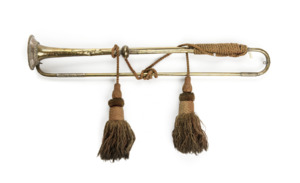
Trumpet-like instruments are very old. Some date back to 2000 BC or even earlier. Ancient Egypt had bronze and silver trumpets in Tutankhamun's tomb. Scandinavia had bronze lurs. China also had metal trumpets from this time. The Oxus civilization in Central Asia made trumpets from a single metal sheet. This was amazing for that time.
Ancient Greeks used a straight trumpet called a Salpinx. It was about 62 inches long. They made it from bone or bronze. The sound of the Salpinx is mentioned in Homer's Iliad. Salpinx contests were even part of the early Olympic Games. The Shofar, made from a ram's horn, and the metal chazozra are mentioned in the Bible. They were played in Solomon's Temple about 3,000 years ago. These instruments are still used today for religious events.
The Moche people of ancient Peru showed trumpets in their art. This was as early as AD 300. Early trumpets were mostly for signals. They were used for military or religious purposes. They were not used for music in the way we think of it today. The modern bugle still carries on this signaling tradition.

During the Middle Ages and Renaissance, trumpets got better. People learned more about making metal instruments. This made the trumpet more useful for music. The natural trumpets of this time had no valves. They could only play a limited set of notes. Players had to change parts of the instrument to play in different keys. The Baroque era became known as the "Golden Age of the natural trumpet." Many difficult pieces were written for skilled trumpeters. Today, some musicians still play these natural trumpets.
In the Classical and Romantic periods, the trumpet's role changed. It became less important in many musical pieces. This was because natural trumpets had limits. They could not play all the notes needed for complex melodies.
How a Trumpet is Made and Works

A trumpet is usually made of brass tubing. This tubing is bent twice into a rounded shape. To make a sound, you blow air through your slightly separated lips. This creates a "buzzing" sound into the mouthpiece. This buzzing starts a vibration in the air inside the trumpet. You can change the pitch of the notes. You do this by changing how tight or loose your lips are. This is called the embouchure.
The mouthpiece has a round rim where your lips vibrate. Behind the rim is the cup. This cup guides the air into a smaller opening. The size of these parts affects the sound quality, how easy it is to play, and how comfortable it feels. A wider and deeper cup usually makes a darker sound.

Modern trumpets have three, or sometimes four, piston valves. Each valve adds more tubing when you press it down. More tubing makes the pitch lower.
- The first valve lowers the pitch by a whole step.
- The second valve lowers it by a half step.
- The third valve lowers it by one and a half steps.
Using these valves together lets you play all the notes in a chromatic scale. If there's a fourth valve, it usually lowers the pitch by a perfect fourth. This helps play lower notes and offers other ways to play certain trills.
You can also change the trumpet's overall pitch with the tuning slide. Pulling the slide out makes the pitch lower. Pushing it in makes the pitch higher. Players can also "bend" notes using only their lips.
Some notes on the trumpet can be a little out of tune. Modern trumpets have slides on the first and third valves. Players can move these slides with their left thumb and ring finger. This helps them play notes more in tune. Trumpets can also be made from other materials, like plastic.
Different Kinds of Trumpets


The most common trumpet is the B♭ trumpet. But you can also find trumpets in keys like A, C, D, E♭, E, low F, and G. The C trumpet is often used in American orchestras. Orchestra players are very good at reading music written for different trumpets. They can play it on their C or B♭ trumpet.

The smallest trumpets are called piccolo trumpets. Most piccolo trumpets can play in both B♭ and A. They have different leadpipes for each key. The tubing in a B♭ piccolo trumpet is half the length of a standard B♭ trumpet. This makes it sound an octave higher. Piccolo trumpets often have four valves instead of three. The fourth valve usually lowers the pitch by a fourth. This helps with lower notes and trills. Famous players like Maurice André and Wynton Marsalis are known for playing the piccolo trumpet.


Trumpets pitched in low G are sometimes called sopranos. They came from military bugles. These are used in drum and bugle corps. They can have either rotary valves or piston valves.
The bass trumpet plays notes as low as a trombone. It is usually played by a trombone player. Most bass trumpets are in C or B♭. They are transposing instruments, meaning they sound lower than written.
The historical slide trumpet was likely developed in the late 1300s. It was an early trumpet with a sliding part. This slide was a bit tricky to use.
The pocket trumpet is a small B♭ trumpet. Its bell is usually smaller. The tubing is wound more tightly to make it compact. This doesn't change the total tube length. Its sound can be warm and unique. Some professional pocket trumpets are available. Jazz musician Don Cherry was famous for playing the pocket trumpet.
The herald trumpet has a straight bell section. This makes it long enough to hold a hanging banner. These trumpets are mostly used for special events like parades.
The flumpet is a mix of a trumpet and a flugelhorn. It was designed in 1989 for jazz musician Art Farmer. It plays in B♭ and has three piston valves.
Rotary valve trumpets are common in German and Austrian orchestras. Other types include alto and Baroque trumpets. The Vienna valve trumpet is used in Viennese orchestras.
The trumpet is often confused with the cornet. The cornet has a more cone-shaped tube inside. The trumpet has a more cylinder-shaped tube. This gives the cornet a slightly softer sound. But both instruments have the same tube length and pitch. So, music written for one can be played on the other. Another related instrument is the flugelhorn. It has an even more cone-shaped tube and a very soft sound.
How to Play the Trumpet
Fingering Notes

On a modern trumpet, pressing certain valves makes different notes. "Open" means no valves are pressed. "1" means only the first valve is pressed. "1–2" means the first and second valves are pressed together. The actual sound depends on the trumpet's key. If there is a fourth valve, it usually lowers the pitch by a perfect fourth. You change notes within each valve combination by changing your embouchure (lip tension).
The fingering system works because each valve adds length to the tubing. Longer tubing makes a lower sound.
- Valve 1 lowers the pitch by a whole step.
- Valve 2 lowers it by a half step.
- Valve 3 lowers it by one and a half steps.
Sometimes, you can play the same note with different valve combinations. Players might use these "alternate fingerings" to make a passage easier or to improve the note's tune.
Using Mutes

Trumpet players can use different types of mutes. Mutes are placed in or over the bell of the trumpet. They change the sound and make it quieter. Common mutes include the straight mute, cup mute, harmon mute (also called wah-wah), plunger, and bucket mute. A straight mute is used if no specific mute is mentioned. Jazz music often uses more types of mutes than classical music.
Mutes can be made from many materials. These include fiberglass, plastic, cardboard, and metal. They are often held in place with cork. Players sometimes dampen the cork to help the mute stay put.
The straight mute is cone-shaped. Metal straight mutes make a bright, sharp sound. Other materials make a darker sound. The cup mute looks like a straight mute but has an extra cup at the end. It makes a darker sound than a straight mute. The harmon mute is metal and has a "stem" inside. You can move or remove the stem to get different sounds. Waving your hand in front of it makes a "wah-wah" sound.
Trumpet's Range
The lowest note a trumpet can play with standard technique is the F♯ below middle C. There isn't a strict limit to how high brass instruments can play. Fingering charts usually show notes up to the high C, two octaves above middle C. Some trumpeters are famous for playing extremely high notes. These include Maynard Ferguson, Dizzy Gillespie, and Wynton Marsalis. It is also possible to play very low notes called pedal tones.
Special Playing Techniques
Modern trumpet music often uses special techniques.
- Flutter tonguing: The player rolls their tongue quickly, like rolling an "R" in Spanish. This makes a growling sound.
- Growling: The player plays a note and vibrates their uvula (the back of the tongue) at the same time. This creates a distinct sound.
- Double tonguing: The player articulates notes very fast using syllables like ta-ka ta-ka.
- Triple tonguing: Similar to double tonguing, but with syllables like ta-ta-ka ta-ta-ka.
- Doodle tongue: A very light tonguing, like saying "doodle."
- Glissando: Trumpeters can slide smoothly between notes. They do this by pressing valves halfway and changing lip tension.
- Vibrato: This is a slight, quick wobble in the pitch of a note. Composers can ask for fast, slow, or no vibrato.
- Pedal tone: These are very low notes, sometimes two and a half octaves below the standard low F♯.
- Microtones: These are notes that fall between the standard notes on a piano. Some trumpets have a fourth valve to help play these.
- Valve tremolo: Many notes can be played with different valve combinations. By quickly switching between these, a trembling effect is made.
- Split tone: A trumpeter can play more than one note at the same time. They vibrate their lips at different speeds.
- Lip-trill or shake: By quickly changing air speed, the pitch can rapidly move between close notes.
- Multi-phonics: Playing a note and humming a different note at the same time.
- Circular breathing: This technique lets players make a continuous sound without stopping to breathe. They store air in their cheeks and breathe in through their nose while still blowing out.
Learning to Play the Trumpet
Many books help people learn the trumpet. Some well-known ones include Jean-Baptiste Arban's Complete Conservatory Method and Technical Studies by Herbert L. Clarke. These books teach important skills for trumpet players.
Famous Trumpet Players

Many trumpeters have become famous for their amazing skills. In early jazz, Louis Armstrong was known for his incredible playing and improvisations. His move from cornet to trumpet helped make the trumpet very popular in jazz. Dizzy Gillespie was a brilliant improviser. He could play extremely high notes. He greatly influenced many trumpeters who came after him.
Miles Davis is considered one of the most important musicians of the 20th century. His unique style and use of space in his solos inspired generations of jazz musicians. Cat Anderson was known for playing incredibly high and loud notes with Duke Ellington's Big Band. Maynard Ferguson was also famous for his ability to play very accurately in a remarkably high range.
Important Trumpet Music
One very famous piece for the trumpet is Joseph Haydn's Trumpet Concerto. It was written in 1796 for Anton Weidinger. He had developed the first successful keyed trumpet, which could play all the notes. This concerto surprised audiences with its new sounds.
Trumpets in Art
-
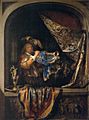
Trumpet-Player in front of a Banquet, by Gerrit Dou, around 1660–1665
-
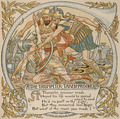
An illustration for The Trumpeter Taken Captive from an 1887 children's book
-

A statue of Louis Armstrong in Algiers, New Orleans
-

A statue of Miles Davis in Kielce, Poland


See Also
 In Spanish: Trompeta para niños
- Herald and Trumpet contest
- Birch trumpet
- Muted trumpet
- Wind controller
