
Wet Tropics of Queensland facts for kids
| UNESCO World Heritage Site | |
|---|---|

Forest near Daintree, Queensland
|
|
| Location | Queensland, Australia |
| Includes |
components:
|
| Criteria | Natural: (vii), (viii), (ix), (x) |
| Inscription | 1988 (12th Session) |
| Area | 893,453 ha (3,449.64 sq mi) |
The Wet Tropics of Queensland is an amazing natural area in Queensland, Australia. It's a special place recognized by UNESCO as a World Heritage Site. This means it's so important and unique that it's protected for everyone in the world to enjoy and learn from. The Wet Tropics covers about 8,940 square kilometers of very wet forests along the coast and mountains of tropical Queensland. It was declared a World Heritage Site in 1988 and added to the Australian National Heritage List on 21 May 2007.
These tropical forests are home to some of the oldest and most unique plants and animals on Earth. They have the highest number of primitive flowering plant families in the world. Imagine plants that look very similar to their ancient ancestors from millions of years ago! This area is a true biodiversity hotspot, meaning it has an incredible variety of life. Even though it's only a tiny part of Australia (0.1%), it contains half of all the nation's species. Many of these plants and animals are found nowhere else in the world.
Discovering the Wet Tropics of Queensland
A Home for Ancient Cultures
The Wet Tropics is also very important for its human history. On 9 November 2012, the Australian Government recognized the special heritage of the Indigenous people here. The Aboriginal Rainforest People have lived in these rainforests for at least 5,000 years. This makes it the only place in Australia where Aboriginal people have lived permanently in a tropical rainforest. They have a deep connection to this land.
Exploring the Landscape
The Wet Tropics of Queensland stretches along the coast from Townsville to Cooktown. It runs right next to the Great Barrier Reef, which is another famous World Heritage Site! The land here is very rugged and mountainous. You'll find the Great Dividing Range and many smaller mountain ranges, highlands, and plateaus.
The site includes the northern part of Queensland's tropical rainforests. This includes the famous Daintree Rainforest. Scientists have found 16 different kinds of rainforest structures here. The area is also home to Wallaman Falls, Australia's highest waterfall. Many important rivers flow through this region. These include the Annan, Bloomfield, Daintree, Barron, and Tully Rivers. You can also find dams like Copperlode Falls Dam here.
Protecting Special Places
A large part of the Wet Tropics, about 15%, is protected as national parks. Some of these parks are:
- Barron Gorge National Park
- Daintree National Park
- Girringun National Park
- Wooroonooran National Park
There are also over 700 other protected areas, even some on private land.
To help manage this special place, the Wet Tropics Management Authority was created in 1983. Their job is to make sure the area is protected. They follow rules set by the World Heritage Convention. This group works with both the Queensland and Australian governments.
Amazing Plant Life: Flora of the Tropics
The Wet Tropics is a plant paradise! It has over 390 rare plant species. About 74 of these are considered threatened. At least 85 plant species are endemic here, meaning they grow nowhere else. You can find 13 different kinds of rainforest and 29 species of mangroves. That's more mangroves than anywhere else in Australia!
This area is incredibly important for understanding plant evolution. Out of 19 families of very old, primitive flowering plants in the world, 12 are found here. Two of these families are found only in the Wet Tropics. This includes at least 50 unique species.
You can also discover 90 different kinds of beautiful orchids. Look out for the rare Stockwellia tree, also called Vic Stockwell's Puzzle. These trees are like living fossils! They are very similar to the ancient ancestors of today's Eucalypts from the supercontinent Gondwana. The Wet Tropics also protects 65% of Australia's fern species. This includes all seven species of ancient ferns.
Unique Animals: Fauna of the Tropics
The Wet Tropics is buzzing with amazing animals!
| Animal Type | Species | Endemic Species |
|---|---|---|
| Bird | 370 | 11 |
| Mammal | 107 | 11 |
| Reptile | 113 | 24 |
| Amphibian | 51 | 22 |
| Butterfly | 225 | 6 |
Over 370 types of birds live here, and 11 of them are found nowhere else. Keep an eye out for the large, colorful southern cassowary, which is a threatened species. The rare spotted-tailed quoll also calls this rainforest home.
The musky rat-kangaroo is a very special animal. It's one of 50 animal species found only in this area. This small creature is important because it shows us an early step in how kangaroos evolved. Other rare mammals include yellow-bellied gliders and brush-tailed bettongs. In total, 107 mammal species have been identified here. You might even find Australia's rarest mammal, the tiny insect-eating Flores tube-nosed bat. A quarter of all Australia's rodent species live in the Wet Tropics.
The area is also home to 113 species of reptiles, with 24 unique to this region. There are 51 types of amphibians, and 22 of these are found only here. This high number of unique species is because the landscape is so varied. Different mountains and areas have created "habitat islands" where animals have evolved differently.
About 225 species of beautiful butterflies flutter through the rainforest. Six of these species and 14 subspecies are found only in the Wet Tropics. This means over half of all Australian butterflies live here!
Understanding the Tropical Climate
The Wet Tropics gets a lot of rain, but how much depends on where you are. Mountains and how the coast faces the ocean play a big role. On average, the area gets between 1,200 and over 8,000 millimeters of rain each year. That's a huge amount!
The highest mountains, especially between Cairns and Tully, get the most rain. This happens because of something called orographic precipitation. When wet air hits the mountains, it's forced upwards, cools, and drops its moisture as rain. Mount Bellenden Ker is one of the wettest places here. Most of the rain falls from November to April. Sometimes, tropical cyclones can also bring heavy rain and strong winds to the area.
Caring for the Rainforest: Environmental Challenges
Protecting the Wet Tropics is very important, but there are some challenges. One big concern is the growth of sugarcane farms in the lowlands. This can harm some endangered ecosystems. Some natural areas are becoming fragmented, meaning they are broken into smaller pieces. Roads and power lines can also cut through the forest.
Another problem is invasive species. These are plants or animals that are not native to the area and can harm the local wildlife. Some tiny insects and mites are especially worrying because they are hard to spot. To protect the plants, some areas are closed to visitors. This helps prevent the spread of diseases like Phytophthora. Sadly, the southern cassowary is sometimes hit by cars. Feral cats also hunt native animals and compete with species like the spotted-tailed quoll for food. Everyone needs to help protect this amazing rainforest!
Gallery
-
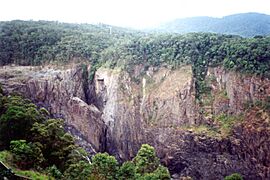
Barron Gorge in Barron Gorge National Park
-
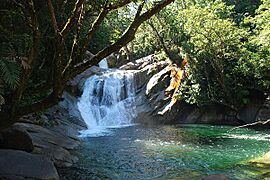
Josephine Falls, 2008
-
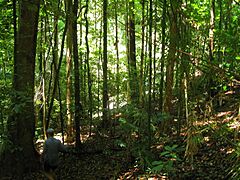
Daintree Rainforest, 2011
-
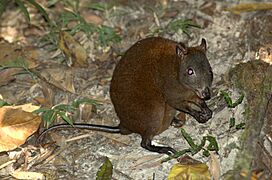
The musky rat-kangaroo is a marsupial species only found in the Wet Tropics ecoregion.
-
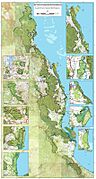
Map of the region, 2012


See also
 In Spanish: Trópicos húmedos de Queensland para niños
- Environment of Australia
- Forests of Australia
- List of World Heritage Sites in Asia and Australasia
