
William H. Seward facts for kids
Quick facts for kids
William H. Seward
|
|
|---|---|

Seward in 1859
|
|
| 24th United States Secretary of State | |
| In office March 5, 1861 – March 4, 1869 |
|
| President | |
| Preceded by | Jeremiah S. Black |
| Succeeded by | Elihu B. Washburne |
| United States Senator from New York |
|
| In office March 4, 1849 – March 3, 1861 |
|
| Preceded by | John Adams Dix |
| Succeeded by | Ira Harris |
| 12th Governor of New York | |
| In office January 1, 1839 – December 31, 1842 |
|
| Lieutenant | Luther Bradish |
| Preceded by | William L. Marcy |
| Succeeded by | William C. Bouck |
| Member of the New York State Senate from the 7th district |
|
| In office January 1, 1831 – December 31, 1834 |
|
| Preceded by | Multi-member district |
| Succeeded by | Multi-member district |
| Personal details | |
| Born |
William Henry Seward
May 16, 1801 Florida, New York, U.S. |
| Died | October 10, 1872 (aged 71) Auburn, New York, U.S. |
| Political party |
|
| Spouse | |
| Children | 6, including Augustus, Frederick, William, Fanny, and Olive (adopted) |
| Education | Union College (BA) |
| Signature |  |
| Nickname | The Sage of Auburn |
William Henry Seward (born May 16, 1801 – died October 10, 1872) was an important American politician. He served as the United States Secretary of State from 1861 to 1869. Before that, he was the Governor of New York and a United States senator. Seward strongly opposed the spread of slavery before the American Civil War. He was a key leader in the early Republican Party. As Secretary of State during the Civil War, he worked hard to keep the Union together. He is also famous for arranging the purchase of Alaska for the United States.
Contents
Early Life and Education
William Seward was born in 1801 in Florida, New York. His father was a wealthy farmer. Slavery was still allowed in New York at that time. William was a very bright student and loved learning.
At 15, he went to Union College. He was an excellent student. During his final year, he briefly left college and traveled to Georgia. There, he worked as a principal at a new school. In Georgia, he saw how slaves were treated, which made him oppose slavery even more. He returned to New York, finished his law studies, and graduated from Union College with top honors in 1820.
Starting a Political Career
After becoming a lawyer, Seward moved to Auburn, New York. He married Frances Miller in 1824. He soon met Thurlow Weed, a newspaper publisher. They became close friends and political allies. They both believed the government should improve things like roads and canals.
Seward quickly became involved in politics. He joined the Anti-Masonic Party. Later, he joined the Whig Party. In 1830, he was elected to the New York State Senate. As a state senator, he worked on prison reform.
In 1834, he ran for governor of New York but lost. However, he was elected governor in 1838 and served two terms.
Governor of New York: Championing Rights
As governor, William Seward had many ideas for improving New York. He believed that new immigrants should be welcomed and given full citizenship. He also wanted to improve education for all children, including those from Catholic immigrant families.
Seward signed laws that helped black residents. These laws gave fugitive slaves the right to a jury trial in New York. They also protected people who worked to end slavery. He even helped free black people who had been illegally enslaved in the Southern states.
During his time as governor, he also handled a diplomatic issue with Britain. This experience helped him prepare for his future role as Secretary of State.
Becoming a U.S. Senator
After being governor, Seward returned to his law practice. He continued to be interested in politics, especially the issue of slavery. In 1849, the state legislature elected Seward to the U.S. Senate. His strong views against slavery made him unpopular in the Southern states.
Fighting Against Slavery's Expansion
As a U.S. Senator, Seward became a leading voice against slavery. In 1850, he gave a famous speech where he spoke of a "higher law than the Constitution." This meant that moral laws against slavery were more important than laws that allowed it. This speech made him a prominent anti-slavery leader.
His wife, Frances, was also a dedicated abolitionist. Their home in Auburn became a safe place for runaway slaves on the Underground Railroad.
In 1854, Senator Stephen A. Douglas proposed the Kansas–Nebraska Act. This law would let new territories decide if they wanted slavery. Seward strongly opposed this bill. Even though the bill passed, it brought many Northerners together to fight against slavery.
Seward joined the new Republican Party in 1855. This party was formed to oppose the spread of slavery. He quickly became one of its most important figures. He predicted that the United States would eventually become either entirely free or entirely slave-holding. He called this an "irrepressible conflict."
The 1860 Presidential Election
As the 1860 presidential election approached, many people thought Seward would be the Republican candidate. However, some worried that his strong anti-slavery views and support for immigrants might make it hard for him to win. At the Republican convention, Abraham Lincoln was chosen instead.
Seward was disappointed but still campaigned for Lincoln. He traveled across the Midwest, giving speeches to large crowds. He emphasized the importance of keeping the Union together. Lincoln won the election, and then asked Seward to be his Secretary of State.
Lincoln Administration: Guiding the Nation Through War
War Begins and Diplomacy Efforts
When Lincoln became president, several Southern states had already left the Union. Seward tried to find a compromise to prevent more states from leaving. However, his efforts were unsuccessful, and the American Civil War began with the attack on Fort Sumter.
As Secretary of State, Seward's main job was to prevent other countries from getting involved in the war. He worked hard to keep Great Britain and France from supporting the Confederacy. If these powerful nations had helped the South, the Union might have lost the war.
One famous event was the Trent affair in 1861. An American ship stopped a British ship and took two Confederate diplomats prisoner. This caused a big problem with Britain. Seward helped calm the situation, and Lincoln eventually released the diplomats to avoid a conflict with Britain. This showed Seward's skill in handling difficult international situations.
Working with President Lincoln
Seward initially had some doubts about Lincoln's abilities. However, he soon grew to admire Lincoln's leadership. They developed a close working relationship and friendship. Lincoln often sought Seward's advice on many matters, not just foreign policy.
Seward also played a role in the Emancipation Proclamation. He advised Lincoln to wait for a Union victory before announcing it. This was to ensure that the proclamation would be seen as a strong move by a winning side.
Assassination Attempt on Seward
On April 14, 1865, the same night President Lincoln was assassinated, William Seward was also attacked. A conspirator named Lewis Powell broke into Seward's home. Seward was recovering from a carriage accident and was in bed. Powell attacked Seward with a knife, seriously wounding him in the face and neck.
Seward's sons and a soldier guarding him fought off the attacker. All five people injured in the house that night survived. Powell was later captured and executed for his role in the assassination plot. Seward's wife, Frances, was deeply affected by the attack and passed away a few weeks later.
Johnson Administration: Reconstruction and Expansion
Reconstruction and Political Battles
Seward continued as Secretary of State under President Andrew Johnson after Lincoln's death. This was a difficult time known as Reconstruction, as the country tried to rebuild after the war. Seward generally supported Johnson's plans for bringing the Southern states back into the Union.
However, Johnson often disagreed with Congress. Seward tried to advise Johnson, but the president often made his own decisions. Congress eventually tried to impeach President Johnson, but he was found not guilty. Seward supported Johnson during this challenging time.
Foreign Policy: Mexico and Alaska
Seward continued his active foreign policy. He strongly pushed for France to remove its troops from Mexico. French Emperor Napoleon III had placed an Austrian prince, Maximilian, on the Mexican throne. Seward saw this as a threat to American influence. With the Civil War over, the U.S. could now firmly demand that France leave. Eventually, the French troops withdrew in 1867, and Maximilian was overthrown.
Seward was also a strong believer in expanding the United States. He wanted the U.S. to acquire more territory, especially for naval bases and trade. His most famous achievement in this area was the Alaska Purchase in 1867. He negotiated with Russia to buy the vast territory of Alaska for $7.2 million. Many people at the time thought this was a foolish idea and called it "Seward's Folly." However, it turned out to be a very wise decision, as Alaska later proved to be rich in natural resources.
Retirement and Legacy
William Seward retired from public life in 1869. He then embarked on several long trips, including a journey across North America and a trip around the world. He enjoyed seeing new places and meeting people.
Seward passed away on October 10, 1872, at his home in Auburn, New York. He is buried in Fort Hill Cemetery.
Historians generally praise Seward for his work as Secretary of State. He skillfully managed foreign affairs during the Civil War, preventing other nations from interfering. His vision for American expansion, especially the purchase of Alaska, showed great foresight. While Lincoln's fame grew after his assassination, Seward's contributions were also vital to the nation's history. He helped shape America's future, believing in a strong, expanding, and commercially active nation.
Images for kids
-
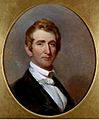
Portrait of Seward by Henry Inman, 1844
-
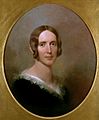
Portrait of his wife Frances Adeline Miller by Henry Inman, 1844
-
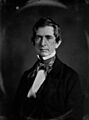
Daguerreotype of Seward around 1848
-
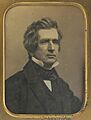
Daguerreotype of Seward around 1852
-
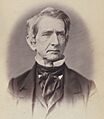
Photograph of Seward by Julian Vannerson, 1859
-
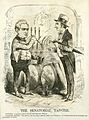
In this March 1860 cartoon, Seward serves "mild beer" in his February 29, 1860, address to position himself as a moderate after the "irrepressible conflict" speech.
-
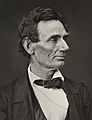
Abraham Lincoln in 1860
-
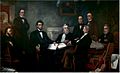
Lincoln meeting with his Cabinet for the first reading of the Emancipation Proclamation draft on July 22, 1862. Seward is seated at mid-right. Painting by Francis Carpenter.
-
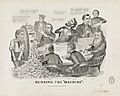
Running The "Machine"
An 1864 cartoon mocking Lincoln's cabinet depicts Seward, William Fessenden, Lincoln, Edwin Stanton, Gideon Welles and other members -
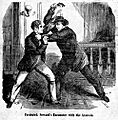
Lewis Powell attacking Frederick Seward after attempting to shoot him
-
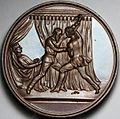
Medal presented to George F. Robinson for saving Seward's life
-
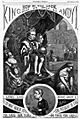
Thomas Nast cartoon from before the 1866 midterm elections. Seward is depicted as Johnson's grand vizier, motioning for the execution of Thaddeus Stevens, and is seen again in the inset, scars from the assassination attempt visible.
-
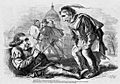
Johnson, as Mercutio, wishes a plague on both their Houses (of Congress) as Seward (as Romeo, right) leans over him. Alfred Waud cartoon from 1868.
-
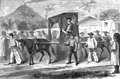
"Hon. William H. Seward traveling in Mexico," engraving published 1870.
-
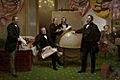
Signing the Alaska Purchase. Seward is seated at center.
-
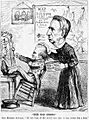
Thomas Nast cartoon on Alaska, 1867. Seward hopes that the purchase will help cool Johnson's fevered political situation.
-
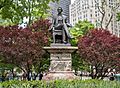
Statue of Seward by Randolph Rogers in Madison Square Park, New York City


.jpg)

.jpg)


.jpg)
See also
 In Spanish: William H. Seward para niños
- Sites and works regarding William H. Seward
