
Airbus A320 family facts for kids
Quick facts for kids Airbus A320 familyA318/A319/A320/A321 |
|
|---|---|
 |
|

An A320 in the Airbus corporate livery in 2012
|
|
| General information | |
| Role | Narrow-body jet airliner |
| National origin | Multi-national |
| Manufacturer | Airbus |
| Status | In service |
| Primary users | American Airlines
|
| Number built | 12,487 as of January 2026[update] |
| History | |
| Manufactured | 1986–present |
| Introduction date | 18 April 1988 with Air France |
| First flight | 22 February 1987 |
| Variants | |
| Developed into | Airbus A320neo family |
The Airbus A320 family is a group of popular passenger airplanes made by Airbus. These planes are known as "narrow-body" airliners. They are the best-selling airliners ever built! The first A320 took its first flight on February 22, 1987. It started carrying passengers in April 1988 with Air France.
This family of aircraft includes different sizes: the longer A321, the shorter A319, and the shortest, the A318. These planes are put together in several places around the world. These include Toulouse in France, Hamburg in Germany, Tianjin in China, and Mobile, Alabama in the United States.
The A320 family was the first to use advanced digital controls called "fly-by-wire." This system helps pilots fly the plane using a small side-stick, similar to a video game controller. These planes can carry many passengers over long distances.
In December 2010, Airbus announced an improved version called the A320neo. "Neo" means "new engine option." It has more efficient engines and special wingtips called "sharklets." These changes make it use about 15% less fuel. The older version is now called the A320ceo, or "current engine option."
As of January 2026, over 12,400 A320 family aircraft have been delivered to airlines worldwide. It became the most-delivered jet aircraft in September 2025. This shows how popular and successful these planes are!
Contents
How the A320 Family Was Developed
Early Ideas for a New Plane

When Airbus first designed the A300 airplane, they dreamed of making a whole family of different airliners. They wanted to compete with big airplane makers like Boeing. Airbus engineers started thinking about smaller planes that could carry fewer passengers.
They focused on planes with a single aisle, a market where the Boeing 737 was very popular. Many European companies worked together on ideas for a new 150-seat plane. This project was first called "JET2" and later became the A320.
Designing the A320
In 1977, a new project called "Joint European Transport" (JET) began. It brought together companies from the UK, France, and Germany. This project was the start of the Airbus A320. The team looked at different sizes for planes, from 125 to 180 seats. These ideas later became the A319, A320, and A321.
By 1981, the project was officially named A320. Airbus worked with Delta Air Lines to design a 150-seat aircraft. They decided to make the A320's cabin wider than its competitors. This made it more comfortable for passengers, even though it made the plane a bit heavier.
Launching the A320 Program
_FAB_SEP88_(13753510323).jpg)
The A320 program officially started on March 2, 1984. Many airlines quickly showed interest. Air France was the first customer, ordering 25 A320s. Later, Northwest Airlines placed a large order for 100 A320s.
The A320 could use two types of powerful turbofan engines: the CFM56-5-A1 or the IAE V2500. These engines provide the thrust needed to fly the plane.
The A320 Takes Flight
_F-GFKQ_-_MSN_002_(10655931213).jpg)
The first A320 was shown to the public on February 14, 1987. It made its first flight just a few days later, on February 22, 1987. After many test flights, it was approved for service in February 1988.
Air France received the very first A320 on March 28, 1988. It began carrying passengers on April 8, flying between Paris and Berlin.
Making the A320 Family Bigger and Smaller
The Longer A321
_D-AIRB_-_MSN_468_-_Named_Baden-Baden_(3526963624).jpg)
Airbus soon decided to make a longer version of the A320, called the Airbus A321. This plane was designed to carry more passengers. It was made longer by adding sections to the fuselage, both in front and behind the wings. The wings were also slightly changed to help with the extra weight.
The first A321 flew on March 11, 1993. Lufthansa was the first airline to receive this stretched version in January 1994.
The Shorter A319
.jpg)
Next, Airbus created a shorter version, the Airbus A319. This plane was designed to carry fewer passengers but fly longer distances. It was made shorter by removing sections from the fuselage. The A319 uses similar engines to the A320, but they are adjusted for its smaller size.
The A319 first flew on August 25, 1995. Swissair received the first A319 in April 1996. This model became very popular with airlines that offer lower fares, like EasyJet.
The Smallest A318

The Airbus A318 is the smallest plane in the A320 family. It was designed to carry around 100 passengers. The A318 was launched in April 1999.
The first A318 flew on January 15, 2002. Frontier Airlines received the first A318 in July 2003. The A318 is also special because it can land at airports with very steep approaches, like London City Airport.
Where A320 Planes Are Built
.jpg)
Airbus builds its A320 family planes in several locations around the world. A320s are assembled in Toulouse, France. A318s, A319s, and A321s are built in Hamburg, Germany. There are also assembly lines in Tianjin, China, and Mobile, Alabama, in the United States.
Many parts for these planes come from different countries. For example, the middle part of the fuselage is made in Germany, and the tail is made in Spain. Airbus aims to build many planes each month to meet the high demand.
Making the A320 Even Better
In 2006, Airbus started a program to make the A320 more efficient. They aimed to improve fuel use by 4-5%. This included adding special wingtips and making the cabin more comfortable.
Sharklets


One important improvement was adding "sharklets." These are tall, blended wingtips that help the plane fly more smoothly. They reduce drag and save about 3.5% on fuel for longer flights. This saves a lot of money and reduces carbon dioxide emissions. The first A320 with sharklets was delivered in December 2012.
Improved Cabin
In 2007, Airbus introduced a new, quieter cabin for the A320. It had better places to store luggage and a more modern look. They also added new air filters to remove smells and LED lights for mood lighting. These changes made flights more pleasant for passengers.
The New Generation: A320neo

The A320neo is a major upgrade to the A320. "Neo" stands for "new engine option." It was launched in December 2010. The A320neo uses new, more fuel-efficient engines from CFM International or Pratt & Whitney. It also has the sharklets.
These improvements make the A320neo about 15% more fuel-efficient than the older A320ceo models. The first A320neo started flying with Lufthansa in January 2016. Many airlines have ordered these new planes because they save a lot of fuel. As of July 2024, IndiGo is the largest operator of the A320neo.
How the A320 is Designed

The Airbus A320 family planes are "narrow-body" aircraft. This means they have a single aisle in the cabin. They have two powerful turbofan engines under their wings. After the oil price increases in the 1970s, Airbus wanted to make the A320 very fuel-efficient.
The A320 uses special lightweight materials called composites in its structure. This helps save weight and makes the plane easier to maintain. Its tail is almost entirely made of these composites. The A320 also has a wider cabin than some other planes, making it more comfortable for passengers.
The High-Tech Cockpit

The A320's cockpit is called a "glass cockpit." This means it uses digital screens instead of many traditional dials and gauges. Pilots control the plane using side-sticks, which are small joysticks on the side. This is different from the traditional control column in front of the pilot.
The plane also has a system called Electronic Centralised Aircraft Monitor (ECAM). This system gives pilots important information about all the plane's systems. Since 2003, newer A320s use modern liquid crystal display (LCD) screens in the cockpit.
Fly-by-Wire Technology
The A320 was the first passenger airliner in the world to use a digital "fly-by-wire" flight control system. This means that when pilots move the side-stick, their commands go to computers. These computers then tell the plane's control surfaces (like the wings and tail) how to move. This system helps the plane fly very smoothly and safely.
This technology was a big step forward in aviation. All future Airbus planes have used similar systems. This makes it easier for pilots to learn to fly different Airbus models.
Engines for the A320 Family
The A320 family uses powerful turbofan engines. The A320ceo (current engine option) models use engines from CFM International (CFM56) or International Aero Engines (V2500). The smallest A318 can also use Pratt & Whitney PW6000 engines.
-
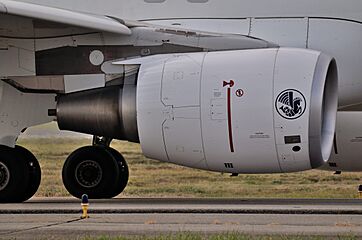
The CFM56 engine is available on all A320 family planes.
-
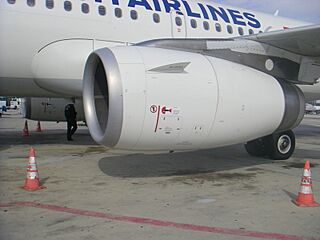
The IAE V2500 engine equips the larger A320 family planes.
-
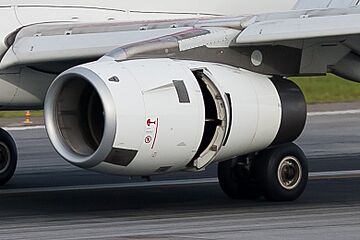
The PW6000 engine is available on the smallest A318.


_landed_at_Congonhas-S%C3%A3o_Paulo_International_Airport_(1)_(cropped).jpg)
The newer A320neo (new engine option) models use even more advanced engines. These are the CFM International LEAP-1A or Pratt & Whitney PW1000G engines. These new engines help the A320neo save a lot of fuel.
A320 Family in Action
The A320 family quickly became very popular after it started flying in April 1988. Airbus rapidly introduced the different sizes: the A321 in 1994, the A319 in 1996, and the A318 in 2003.
The A320 fleet has shown excellent reliability, with a 99.7% operational rate in recent years. This means the planes are almost always ready to fly when needed.
In October 2025, a rare technical issue caused by space weather affected flight data on some A320 family aircraft. Airbus and aviation authorities quickly issued a safety notice. Most planes only needed a software update, which was completed quickly. This showed how quickly safety measures can be put in place.
Competing with Other Planes
.jpg)
The A320 family was designed to compete with other popular planes like the Boeing 737 and McDonnell Douglas MD-80. Over the years, it has continued to compete with newer versions of these planes.
The A320 family has been very successful. It has sold well to many airlines, including new low-cost carriers. In October 2019, the A320 family became the highest-selling airliner family ever. In September 2025, it also became the most-delivered jet aircraft.
Different Types of A320 Family Planes

The A320 family includes four main types of aircraft. They all share a similar design and cockpit. This means pilots can fly any of them with minimal extra training. These planes can carry between 100 and 220 passengers.
A318: The Smallest Member
.jpg)
The Airbus A318 is the smallest plane in the A320 family. It can carry up to 132 passengers. It has a maximum range of about 3,100 nautical miles (5,740 km). The A318 is special because it is certified to operate at airports with steep approaches. This makes it useful for airports like London City Airport.
A319: The Compact Choice
_landing_at_Manchester_Airport_(1).jpg)
The Airbus A319 is shorter than the A320. It can carry around 124 to 156 passengers. Because it carries fewer passengers but has similar fuel capacity to the A320, it can fly longer distances. Its range can be up to 3,700 nautical miles (6,850 km) with sharklets. The A319 is a popular choice for airlines that need a plane for medium-range flights.
ACJ319: A Business Jet Version
.jpg)
The ACJ319 is a special version of the A319 designed as a corporate or business jet. It has extra fuel tanks to fly even longer distances. It can carry fewer passengers, usually around 8 to 39, in a luxurious cabin. Many governments use the ACJ319 for transporting officials.
A320: The Original Model
_F-GFKQ_-_MSN_002_(10655935863).jpg)
The A320 is the original and most common model in the family. It can carry between 150 and 186 passengers. The A320-200, which is the most common version, has wingtip fences and more fuel capacity for longer range. Its typical range with 150 passengers is about 3,300 nautical miles (6,100 km).
A321: The Longest Member
.jpg)
The Airbus A321 is the longest plane in the A320 family. It is stretched to carry more passengers, typically 185 to 230. The A321-100 was the first version, but the A321-200 was developed to have a longer range. This was achieved by adding more powerful engines and extra fuel tanks. The A321 is often used for busy routes where many passengers need to fly.
Converting A320 Planes for Other Uses
Passenger-to-Freighter (P2F)
_Melbourne_International_Airport_(MEL_YMML)_(51814068661).jpg)
Some A320 and A321 passenger planes can be changed into cargo planes. This process is called "passenger-to-freighter" (P2F) conversion. The windows and passenger doors are removed, and a large cargo door is added. These converted planes can carry many containers and pallets of goods. The first A321P2F was delivered to Qantas Airways in October 2020.
Military Versions
The A320 family can also be adapted for military uses. For example, the Indian Defence Ministry has plans to modify some A320s into "Netra Mk2" aircraft. These planes would be used for airborne early warning and control, helping to detect and track other aircraft. The DRDO (Defence Research and Development Organisation) is also working on A319 or A321 planes for gathering intelligence and jamming communications.
Who Flies the A320 Family Planes
_-_Quintin_Soloviev.jpg)
As of January 2026, there are over 11,400 A320 family aircraft flying with more than 375 airlines around the world. The five largest airlines that operate these planes are American Airlines, China Eastern Airlines, IndiGo, easyJet, and China Southern Airlines.
American Airlines is the largest operator, with 489 aircraft in its fleet. Many airlines use these planes because they are reliable and efficient. In December 2022, over 10,000 A320 family aircraft were in service, having completed more than 158 million flights.
Orders and Deliveries
The A320 family has been incredibly popular. It was the fastest-selling airliner for many years. Its newer version, the A320neo family, has also received thousands of orders.
In November 2013, the A320 family reached a milestone of 10,000 orders. By 2017, there were more A320 family aircraft in service than any other airliner. In October 2019, it became the highest-selling airliner family ever, surpassing the Boeing 737.
In August 2021, the A320 family passed the 10,000 delivery mark. In September 2025, it officially became the most-delivered jet aircraft in history. As of January 2026, a total of 12,487 A320 family aircraft have been delivered. The A320 family continues to be a top choice for airlines worldwide.
Aircraft on Display
You can see some famous A320 aircraft on display:
| Photograph | Registration number | Model | Operator | Location | Notes |
|---|---|---|---|---|---|
 |
F-WWAI | Airbus A320-100 | Airbus | Aeroscopia in Blagnac, France | This was the very first A320 ever built. |
 |
N106US | Airbus A320-214 | US Airways | Sullenberger Aviation Museum in Charlotte, North Carolina | This is the aircraft that made the famous "Miracle on the Hudson" landing. |
See also
 In Spanish: Familia Airbus A320 para niños
- Competition between Airbus and Boeing
- Aircraft related to this one
- Similar aircraft
- Airbus A220
- Boeing 717
- Boeing 737 Classic
- Boeing 737 Next Generation
- Boeing 757
- Comac C919
- Embraer 195
- Irkut MC-21
- McDonnell Douglas MD-80
- McDonnell Douglas MD-90
- Tupolev Tu-204
- Lists related to this aircraft
- List of aircraft
- List of jet airliners
