
C/2023 A3 (Tsuchinshan–ATLAS) facts for kids

Comet C/2023 A3 (Tsuchinshan–ATLAS) on 2 October 2024
|
|
| Discovery | |
|---|---|
| Discovered by | Purple Mountain Observatory ATLAS South Africa |
| Discovery date | 9 January 2023 |
| Designations | |
| C/2023 A3 | |
| A10SVYR | |
| Orbital characteristics | |
| Observation arc | 1.37 years (502 days) |
| Earliest precovery date | 9 April 2022 |
| Number of observations |
2060 |
| Aphelion | ≈ 270,000 AU (inbound) ≈ 3,800 AU (outbound) |
| Perihelion | 0.3914 AU (58.6 million km) |
| Eccentricity | 0.9999985 (epoch 1800) 0.9998981 (epoch 2200) |
| Orbital period | ≈ 1.4 billion years (inbound) ≈ 235,000 years (outbound) |
| Max. orbital speed | 67.33 km/s @ perihelion |
| Inclination | 139.1° |
| 21.56° | |
| Argument of periapsis |
308.5° |
| Last perihelion | 27 September 2024 18:00 ± 20 minutes (3-sigma) |
| Earth MOID | 0.275 AU (41.1 million km; 107 LD) |
| Physical characteristics | |
|
Mean diameter
|
~3.2 km |
| Comet total magnitude (M1) |
4.3 ± 0.3 |
| Comet nuclear magnitude (M2) |
9.2 ± 0.3 |
Comet C/2023 A3 (Tsuchinshan–ATLAS), also known as Comet Tsuchinshan–ATLAS or Comet A3, is a special space rock from the Oort cloud. This is a huge, icy cloud far beyond our Solar System. It was first spotted by the Purple Mountain Observatory in China on January 9, 2023. Later, the ATLAS in South Africa also found it on February 22, 2023.
This comet made its closest pass to the Sun, called perihelion, on September 27, 2024. It was about 58.6 million kilometers (36.4 million miles) away from the Sun. Around this time, it became bright enough to be seen without a telescope, just using your naked eye. The comet was at its brightest on October 9, 2024, shining with a magnitude of −4.9. This made it one of the brightest comets seen in the last 100 years!
Contents
How We Found and Watched the Comet
Finding the Comet

Scientists using the Asteroid Terrestrial-impact Last Alert System (ATLAS) found a faint object in their images on February 22, 2023. It looked like an asteroid and had a brightness (called magnitude) of 18.1. This was when the comet was about 7.3 AU (1.1 billion kilometers or 680 million miles) from the Sun.
After checking its path, they realized it was the same object that the Purple Mountain Observatory in China had reported earlier. The Chinese observatory had seen it on January 9, 2023. It was even fainter then, with a magnitude of 18.7. The comet was named after both observatories: Tsuchinshan (the traditional name for Purple Mountain) and ATLAS.
Scientists also looked at older pictures and found the comet in images from the Zwicky Transient Facility (ZTF) taken on December 22, 2022. These pictures showed that the object had a small, fuzzy cloud around it, called a coma, and a short tail. This proved it was a comet, not just an asteroid.
Getting Closer to the Sun

By January 2024, the comet had gotten brighter, reaching a magnitude of 13.6. People could see it with large telescopes. It was moving through the constellations of Libra and Virgo. By the end of April, it was even brighter, around magnitude 10, and could be seen with smaller telescopes. It also had a short tail.
In May and June, the comet's brightening slowed down. It stayed around magnitudes 10 to 11. Scientists saw a dusty tail that looked like a teardrop. Some astronomers thought this might mean the comet's main icy body (its nucleus) was breaking apart.
In mid-June, the comet moved into the Leo constellation. In early July, a faint "ion tail" (made of gas particles) was seen in photos. After mid-July, the comet became hard to see because it was too close to the Sun's bright glare. But in August, the STEREO spacecraft, which watches the Sun, saw the comet getting steadily brighter.
The Closest Pass to the Sun and Earth

The comet was seen again in the morning sky on September 11, 2024. It was in the Sextans constellation and had a magnitude of 5.5. Astronauts on the ISS even saw and photographed it on September 20. The first time someone on Earth saw it with their naked eye was on September 23. It had a magnitude of 3.3, and its tail looked about 2.5 degrees long through binoculars.
During the last week of September, the comet was best seen from the Southern Hemisphere. It was expected to get even brighter. Its closest approach to the Sun (perihelion) happened on September 27. By October 1, the comet was magnitude 2, and its tail was estimated to be 10–12 degrees long.
From October 7 to 11, the comet was visible to the SOHO spacecraft, which has a special camera to block out the Sun's brightness. On October 8, one astronomer even managed to photograph the comet in broad daylight! On October 9, the comet was very close to the Sun and became incredibly bright, reaching magnitude −4.9. This made it one of the brightest comets seen by SOHO since 1995.
The comet was seen again in the evening sky on October 10. It made its closest approach to Earth on October 12, at a distance of about 71 million kilometers (44 million miles). After this, the comet started to get dimmer as it moved away from both Earth and the Sun. On October 14, Earth crossed the comet's orbital path, and a rare "antitail" was seen. This is a tail that seems to point towards the Sun, opposite the main tail.
How Bright Was It Expected to Be?
When Comet C/2023 A3 was first found, scientists tried to guess how bright it would get. They thought it might reach a magnitude of +3 when it was closest to the Sun. They also predicted it would be easier to see about three weeks after passing the Sun, in mid-October.
Later, in June 2024, new calculations suggested it would get to about magnitude 2.2. However, scientists also knew about something called "forward scattering." This is when sunlight bounces off dust particles in the comet's tail and makes it look much brighter when viewed from a certain angle. This effect was expected to make the comet several times brighter, especially around October 9, 2024. And it did! On that day, the comet brightened by almost 6 magnitudes, becoming extremely bright due to this effect.
Comet's Journey in Space

Comet C/2023 A3 travels in a retrograde orbit. This means it goes around the Sun in the opposite direction compared to Earth and most other planets. Its path is tilted quite a bit, at an angle of 139 degrees.
The comet passed its closest point to the Sun (perihelion) on September 27, 2024. It was about 0.391 AU (58.6 million kilometers) from the Sun. Its closest approach to Earth happened on October 12, 2024, at a distance of about 0.47 AU (70.6 million kilometers).
This comet doesn't get very close to the giant planets like Jupiter. Its path around the Sun is very long. Because of the gravitational pull from planets, its path will change a bit after it leaves the inner Solar System. This means its next trip around the Sun will be much shorter than its last one.
Images for kids
-
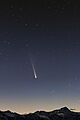
On September 25 at 05:24 from Chile
-
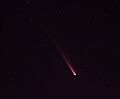
On September 25 at 06:14 from the ISS
-

On September 28 at 06:39 from Gran Canaria, Spain
-
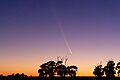
On October 2 at 05:00 from Victoria, Australia
-

On October 12 at 20:11 over the Grand Canyon
-

On October 13 at 19:31 in the Santa Cruz Mountains above Pacifica, California
-
C/2023 A3 (Tsuchinshan–ATLAS) seen in El Paso Tx
On October 13 at 19:51 from El Paso, Texas
-

On October 13 at 19:32 from Greeley, Colorado
-
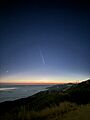
On October 14 at 19:25 from Santa Barbara, California
-
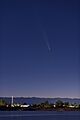
On October 14 at 19:35 from Mountain View, California
-
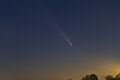
On October 14 at 20:23 from Groningen, Netherlands
-

On October 14 at 19:51 from Copper Mountain, Colorado
-
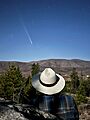
On October 15 at 19:39 from Grand Lake, Colorado
-

On October 15 at 19:31 from Mandal, Norway
-

On October 15 at 19:44 from Drøbak, Norway
-
On October 14 at 19:28 from Northern New Jersey
-
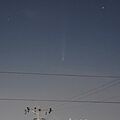
On Philippine Time October 16 at 19:03 from Mabalacat, Pampanga
-
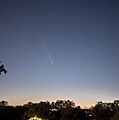
On October 15 at 19:26 from Northwestern Illinois
-
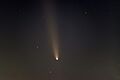
On October 14 at 19:50 from Covington, Georgia
_from_Chile_(IMG_4135-CC).jpg)
_(Rotated).jpg)
.jpg)


_from_Santa_Ynez_Mountains,_Santa_Barbara,_CA_(Oct_15,_2024).jpg)


.jpg)


_from_Kuching_Sarawak.jpg)
_seen_in_Mabalacat_Philippines.jpg)

_on_10-14-2024_seen_from_Covington,_GA.jpg)
See also
 In Spanish: C/2023 A3 (Tsuchinshan–ATLAS) para niños
