
Cetus (constellation) facts for kids
| Constellation | |

List of stars in Cetus
|
|
| Abbreviation | Cet |
|---|---|
| Genitive | Ceti |
| Pronunciation | SEE-təss, genitive SEE-tye |
| Symbolism | the Whale, Shark, or Sea Monster |
| Right ascension | 00h 26m 22.2486s–03h 23m 47.1487s |
| Declination | 10.5143948°–-24.8725095° |
| Area | 1231 sq. deg. (4th) |
| Main stars | 14 |
| Bayer/Flamsteed stars |
88 |
| Stars brighter than 3.00m | 2 |
| Stars within 10.00 pc (32.62 ly) | 9 |
| Brightest star | Diphda (2.02m) |
| Messier objects | 1 |
| Meteor showers | October Cetids Eta Cetids Omicron Cetids |
| Bordering constellations |
Aries Pisces Aquarius Sculptor Fornax Eridanus Taurus |
| Visible at latitudes between +65° and −79°. Best visible at 21:00 (9 p.m.) during the month of November. Note: †Mira (ο Cet) is magnitude 2.0 at its brightest. |
|
Cetus (pronounced SEE-təss) is a large constellation in the night sky. It is often called 'the whale' or 'the sea monster'. In ancient Greek mythology, Cetus was a huge sea creature. The heroes Perseus and Heracles both had to face this monster.
Cetus is located in a part of the sky with other constellations linked to water. These include Aquarius (the Water Bearer), Pisces (the Fish), and Eridanus (the River).
Contents
Exploring the Cetus Constellation
What Makes Cetus Special?
Cetus and the Ecliptic Path
Cetus is not one of the 12 main zodiac constellations. However, the ecliptic path passes very close to it. The ecliptic is the path the Sun seems to follow across the sky. It's also where the Moon and planets usually travel.
This means that the Moon and planets sometimes appear in Cetus. They briefly pass in front of its stars. The Sun's southern edge also appears in Cetus for about 14 hours each year. This happens around March 27th to 28th.
Bright Stars of Cetus
Cetus has many interesting stars. One of the most famous is Mira, also known as Omicron Ceti. Its name means "wonderful" because it was the first variable star ever discovered. Mira changes its brightness a lot over 332 days. At its brightest, you can see it without a telescope. At its dimmest, it disappears from view. Mira is about 420 light-years from Earth.
Diphda is the brightest star in Cetus. It is an orange-colored giant star. Diphda is about 96 light-years away from us. Its traditional name means "the whale's tail."
Menkar is another bright star. It is a red giant star, about 220 light-years from Earth. Menkar means "the nose" in Arabic. It is part of a double star system.
Kaffaljidhma means "head of the whale." It is a close double star system. The main star is blue and about 82 light-years away.
Tau Ceti is a very special star. It is similar to our Sun and is relatively close, at 11.9 light-years away. It is a yellow star, much like our own.
There are also AA Ceti and UV Ceti. AA Ceti is a triple star system. UV Ceti is a binary system of two red dwarf stars. One of them is a flare star. This means it can suddenly get much brighter for a few minutes!

Amazing Deep-Sky Objects
Cetus is far from the main part of our Milky Way galaxy. This means we can see many distant galaxies clearly. They are not hidden by dust from our own galaxy.
Messier 77 (also called NGC 1068) is the brightest of these. It is a beautiful spiral galaxy that looks like a swirling pinwheel. It is about 50 million light-years away. M77 is also a Seyfert galaxy, which means its center is very bright.

Scientists recently confirmed that JKCS 041 is the most distant cluster of galaxies ever found. Imagine how far away that is! The Pisces–Cetus Supercluster Complex is an even bigger structure. It is one of the largest known groups of galaxies in the universe. Our own Milky Way galaxy is part of this huge complex.
Other galaxies in Cetus include Holmberg 15A, NGC 1042, NGC 1052, and NGC 1052-DF2.
IC 1613 is a small, irregular dwarf galaxy. It is a member of our Local Group of galaxies.
NGC 246 is a planetary nebula. It is sometimes called the "Cetus Ring" or even the "Pac-Man Nebula." This is because of how its central stars and surrounding gas look. It is about 1600 light-years from Earth.
The Wolf–Lundmark–Melotte (WLM) is another irregular galaxy. It was discovered in 1909. It sits on the very edges of our Local Group.
In 2026, scientists proposed that MoM-BH*-1 is a black hole star. This object is classified as a "little red dot."
UGC 1646 is a spiral galaxy about 150 million light-years away. You can find it near the star TYC 43-234-1.
.jpg)
Stories and History of Cetus
Ancient Myths and Legends
Cetus has a rich history in stories and myths. It was often seen as a whale or a fearsome sea monster. In Greek myths, Cetus was sent by the sea god Poseidon to punish Queen Cassiopeia. Her daughter, Princess Andromeda, was to be sacrificed to the monster. But the hero Perseus arrived and bravely defeated Cetus, saving Andromeda.
Cetus is part of a group of constellations called "The Sea." These constellations are all related to water. Other members include Eridanus (the River), Pisces (the Fish), and Aquarius (the Water Bearer).


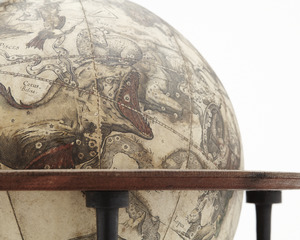
Throughout history, artists have drawn Cetus in many ways. In the 1600s, some showed it as a "dragon fish." Others drew it as a creature that looked like a whale. Sometimes, it even had animal heads on a fish-like body.
Cetus in Different Cultures
In Chinese astronomy, the stars of Cetus are part of two larger areas. These are the Black Tortoise of the North and the White Tiger of the West.
The Tukano and Kobeua people of the Amazon rainforest saw a jaguar in the stars of Cetus. This jaguar represented a god of storms. Different stars formed its head, body, legs, and tail.
In Hawaii, the constellation was known as Na Kuhi. The star Mira (Omicron Ceti) might have been called Kane.
Namesakes
The USS Cetus (AK-77) was a cargo ship in the United States Navy. It was named after this constellation.
See also
- Cetus (Chinese astronomy)
- Book of Jonah
