
D-Day facts for kids
Quick facts for kids Normandy landings |
|||||||||
|---|---|---|---|---|---|---|---|---|---|
| Part of Operation Overlord and the Western Front of the Second World War | |||||||||
 Into the Jaws of Death: men of the 16th Infantry Regiment wade ashore on Omaha Beach |
|||||||||
|
|||||||||
| Belligerents | |||||||||
Allies:
|
 Germany Germany |
||||||||
| Commanders and leaders | |||||||||
|
|
||||||||
| Units involved | |||||||||
 1st Army 1st ArmyOmaha Beach:
Utah Beach:
 2nd Army 2nd ArmyGold Beach:
Juno Beach:
Sword Beach:
|
5th Panzer Army South of Caen:
7th ArmyOmaha Beach:
Utah Beach:
Gold, Juno, and Sword Beaches:
|
||||||||
| Strength | |||||||||
| 156,000 soldiers 195,700 naval personnel |
50,350+ 170 coastal artillery guns |
||||||||
| Casualties and losses | |||||||||
| 10,000+ casualties; 4,414 confirmed killed 185 M4 Sherman tanks |
4,000–9,000 killed, wounded, missing, or captured | ||||||||


The Normandy landings were a huge military operation during World War II on June 6, 1944. This day is often called D-Day. It was the largest invasion by sea in history. Allied forces, including soldiers from the United States, United Kingdom, and Canada, landed on the beaches of Normandy, France. This event marked the beginning of the liberation of France from German control. It was a crucial step towards winning the war on the Western Front.
Planning for D-Day started in 1943. The Allies used clever tricks, called Operation Bodyguard, to make the Germans think the invasion would happen somewhere else. The weather on the planned day was bad, so the invasion was delayed by 24 hours. German leader Adolf Hitler put Erwin Rommel in charge of defending the French coast. US General Dwight D. Eisenhower led the Allied forces.
The invasion began early on June 6 with bombs from planes and ships. Then, 24,000 American, British, and Canadian paratroopers landed behind enemy lines. Soon after, Allied soldiers landed on five beaches: Utah, Omaha, Gold, Juno, and Sword. Strong winds pushed some landing craft off course, especially at Utah and Omaha.
Soldiers faced heavy gunfire from German positions on the cliffs. The beaches were full of mines and obstacles like wooden stakes and barbed wire. This made it very dangerous for the teams trying to clear the way. Omaha Beach saw the most losses due to its high cliffs. At other beaches, soldiers fought their way through towns. Special tanks helped to destroy German gun positions.
By the end of the first day, the Allies had secured a foothold on all five beaches. However, important towns like Carentan, Saint-Lô, and Bayeux were still held by the Germans. Caen, a major target, was not captured until July 21. It took several days for all the beach landings to connect. On D-Day, about 4,000 to 9,000 German soldiers were lost. The Allies had at least 10,000 soldiers lost, with 4,414 confirmed deaths.
Contents
- The Story of D-Day: Normandy Landings
- Why the Allies Invaded Normandy
- Choosing the Landing Spot
- Planning the Big Day
- The Overall Plan: Operation Overlord
- Tricking the Enemy: Operation Bodyguard
- Goals for D-Day
- Clever Tricks to Fool the Germans
- Confusing German Radar
- The Importance of Weather
- A Risky Decision
- German Miscalculations
- German Defenses in France
- Key German Commanders
- Building the Atlantic Wall
- Rommel's Defensive Efforts
- German Tank Reserves
- Allied Forces Ready for Battle
- French Resistance Support
- Naval Power for the Invasion
- Bombing the German Defenses
- Airborne Operations: Landing Behind Enemy Lines
- The Beach Landings: A Fierce Fight
- Aftermath of D-Day: A Turning Point
- Visiting D-Day Memorials Today
- Interesting Facts About D-Day
- D-Day in Popular Culture
- Related pages
- Images for kids
The Story of D-Day: Normandy Landings
Why the Allies Invaded Normandy
After Germany invaded the Soviet Union in 1941, the Soviet leader Joseph Stalin asked his allies to open a "second front" in Western Europe. This would force Germany to fight on two sides, making the war easier for the Soviets. At first, the Allies, mainly the United Kingdom and United States, didn't have enough soldiers and equipment for such a huge invasion.
Instead, they fought in North Africa and Italy. By late 1943, they decided it was time to plan a major invasion of France. This decision was made at a meeting in Washington.
Choosing the Landing Spot
The Allies looked at a few places in France for the invasion. They chose Normandy because it was less heavily defended than other areas like Pas-de-Calais. Normandy also offered more space to expand the invasion once soldiers landed. This would allow them to attack important ports like Cherbourg and move towards Paris.
A big challenge in Normandy was the lack of large ports. To solve this, the Allies planned to build special artificial harbors called Mulberry harbours. They also developed unique tanks, nicknamed Hobart's Funnies, to help clear mines and overcome obstacles on the beaches.
Planning the Big Day
General Dwight D. Eisenhower was chosen to lead all Allied forces for the invasion. General Bernard Montgomery was in charge of the ground troops. The first plan involved three divisions landing on a 25-mile front. But Eisenhower and Montgomery wanted a bigger attack. They decided to use five divisions for the beach landings and three more airborne divisions. This meant the invasion would cover a wider 50-mile front and help capture Cherbourg faster. Because of this bigger plan, they needed more landing craft, so the invasion was delayed until June 1944.

The Overall Plan: Operation Overlord
The entire plan to establish a strong presence in France was called Operation Overlord. The first part of this, the actual beach landings, was codenamed Operation Neptune. To make sure the invasion succeeded, the Allies first launched a massive bombing campaign. This campaign targeted German aircraft factories, fuel supplies, and airfields. This helped the Allies gain control of the skies.
Tricking the Enemy: Operation Bodyguard
Before the invasion, the Allies carried out a complex plan called Operation Bodyguard. This was designed to trick the Germans about where and when the real invasion would happen. This deception was very important for the success of D-Day.
Goals for D-Day
The invasion started with paratroopers landing behind enemy lines. Their job was to capture key bridges and road crossings.
- American forces landing at Utah and Omaha aimed to capture towns like Carentan and Saint-Lô. They also wanted to cut off the Cotentin Peninsula and seize the port of Cherbourg.
- British and Canadian forces landing at Sword, Gold, and Juno Beach were to protect the American side. They also aimed to capture airfields near Caen.
The main goal was to connect all the landing areas and create a strong foothold. This would allow more troops and supplies to arrive, preparing for the push further into France.
Clever Tricks to Fool the Germans
The Allies used many clever tricks to mislead the Germans about D-Day. This was part of the larger Operation Bodyguard.
- Operation Fortitude was a big part of this. It made the Germans believe the main attack would happen in Norway (Fortitude North) or at Calais, France (Fortitude South).
- For Fortitude South, they created a fake army group led by General George S. Patton. They used fake radio messages and even inflatable tanks to make it look like a huge force was gathering in southeast England. This kept many German troops waiting at Calais, far from Normandy.

Confusing German Radar
On the night before the invasion, Allied planes dropped strips of metal foil, called "window," into the air. This created false signals on German radar screens, making it look like large naval convoys were heading towards other parts of the French coast. Small boats towing balloons also helped create this illusion.
- Special forces also dropped dummy paratroopers in other areas. This made the Germans think there were more airborne landings happening elsewhere.
The Importance of Weather
Planning D-Day meant finding the perfect weather conditions. The Allies needed:
- A full moon for light for aircraft.
- Specific tides to help landing craft and expose beach obstacles.
- A time just before dawn.
These conditions only happened a few days each month. General Eisenhower first chose June 5, 1944. However, on June 4, the weather was terrible with high winds and heavy seas. This made it impossible to launch landing craft or for planes to fly.

A Risky Decision
A British weather expert, Group Captain James Stagg, told Eisenhower that the weather would improve just enough for June 6. Delaying the invasion further would mean waiting at least two more weeks. This would risk the Germans discovering the plans. After much discussion, Eisenhower made the brave decision to go ahead on June 6. It turned out to be the right choice, as a major storm hit Normandy from June 19-22, which would have made landings impossible.
German Miscalculations
The Allies controlled the Atlantic, giving them better weather information. German weather forecasters predicted two weeks of bad weather. Because of this, many German commanders left their posts. Field Marshal Erwin Rommel even went to Germany for his wife's birthday. This meant key German leaders were not in position when the invasion began.
German Defenses in France
Germany had about 50 divisions in France and the Netherlands. However, many of these units were not at full strength. Years of fighting, especially on the Eastern Front against the Soviet Union, had weakened the German army. Many soldiers were older, and some units were made up of conscripts from other countries, often with older, less reliable equipment.
Key German Commanders
- The overall German commander in the West was Field Marshal Gerd von Rundstedt.
- Field Marshal Erwin Rommel was in charge of defending the French coast, including Normandy.
- The German 7th Army was responsible for the Normandy area.
- The 21st Panzer Division, a tank unit, was stationed south of Caen.
Building the Atlantic Wall
After earlier Allied raids, Adolf Hitler ordered a massive line of defenses built along the Atlantic coast. This was called the Atlantic Wall. It stretched from Spain all the way to Norway. His goal was to stop any Allied invasion. However, due to shortages of materials and workers, many parts of this wall were never finished.


Rommel's Defensive Efforts
Field Marshal Erwin Rommel was put in charge of improving these defenses. He believed the invasion had to be stopped right on the beaches. He ordered many obstacles placed on the beaches, including:
- Wooden stakes
- Metal tripods
- Land mines
- Barbed wire
These were meant to damage landing craft and slow down tanks. He also ordered many of these obstacles to be placed at the high tide mark. This was because he expected the Allies to land at high tide.
Rommel also knew that the German air force, the Luftwaffe, was much weaker than the Allied air forces. So, he couldn't count on air support. He even had booby-trapped stakes, called Rommelspargel, placed in fields to stop paratroopers from landing.
German Tank Reserves
Rommel wanted to keep Germany's tanks close to the coast to fight the invasion immediately. However, other German commanders disagreed. They thought the tanks should be held back and used only after the main Allied landing spot was clear. Adolf Hitler made the final decision. He kept some tank divisions under his direct control, meaning they couldn't be used without his specific order. This complicated the German response.
Allied Forces Ready for Battle
General Dwight D. Eisenhower was the Supreme Commander of all Allied forces. General Bernard Montgomery led the ground forces.
American Forces
Lieutenant General Omar Bradley commanded the American First Army. About 73,000 American soldiers took part in the initial landings. This included 15,600 paratroopers.
- Utah Beach: The VII Corps landed here, including the 4th Infantry Division and airborne divisions like the 82nd Airborne Division and 101st Airborne Division.
- Omaha Beach: The V Corps landed here, including the 1st Infantry Division and 29th Infantry Division.
British and Canadian Forces
Lieutenant General Sir Miles Dempsey commanded the British Second Army. This force included about 83,115 soldiers, with 61,715 being British. Many other Allied nations also contributed to the air and naval support.
- Gold Beach: The British XXX Corps landed here, including the 50th Infantry Division.
- Juno Beach: The British I Corps landed here, including the 3rd Canadian Infantry Division.
- Sword Beach: The British I Corps also landed here, including the 3rd Infantry Division and the 6th Airborne Division.

French Resistance Support
The French Resistance played a vital role in helping the D-Day invasion. They worked with the British Special Operations Executive to carry out sabotage missions.
- Plan Vert aimed to damage the German rail system.
- Plan Bleu focused on destroying electrical facilities.
- Plan Tortue was designed to slow down German forces trying to reinforce Normandy.
- Plan Violet involved cutting underground telephone and telegraph cables.

The Resistance was alerted to act through special messages broadcast on the BBC's French service. These messages, often disguised as poetry or random sentences, signaled when to begin their operations. German intelligence noticed an increase in these messages on June 5, but many units ignored the warnings due to previous false alarms.
The Resistance's efforts were very successful. In the southeast, 52 locomotives were destroyed on June 6. Railway lines were cut in over 500 places. By June 7, Normandy was largely cut off, making it hard for German reinforcements to arrive.
Naval operations for D-Day were a huge undertaking, involving 6,939 vessels from eight different navies. British Admiral Sir Bertram Ramsay was in overall command. The fleet included:
- 1,213 warships
- 4,126 landing craft
- 736 support craft
- 864 merchant ships
Most of the fleet was provided by the United Kingdom. In total, 195,700 naval personnel were involved.


Early on D-Day, German torpedo boats attacked the Eastern Task Force. They sank the Norwegian destroyer HNoMS Svenner but missed British battleships. Allied ships also faced dangers from German mines. The American destroyer USS Corry was sunk by a mine off Utah Beach.
Bombing the German Defenses
Around midnight on June 6, over 2,200 British, Canadian, and US bombers attacked targets along the coast and inland. However, low clouds made it hard for bombers to hit targets accurately at Omaha Beach. Many bombers delayed their attacks to avoid hitting their own troops, which meant some beach defenses remained intact.
German forces had far fewer aircraft, with only 815 planes over Normandy compared to the Allies' 9,543.
Minesweepers cleared paths for the invasion fleet just after midnight. Naval bombardment of areas behind the beaches began at 5:45 AM. Battleships, cruisers, and destroyers fired at German positions. At Utah and Omaha beaches, troops landed at 6:30 AM, meaning these areas received only about 40 minutes of naval shelling before the assault began.

Airborne Operations: Landing Behind Enemy Lines
The success of the beach landings depended on quickly securing areas behind the coast. Airborne forces were crucial for this. They aimed to:
- Capture key bridges and road crossings.
- Destroy German coastal defense batteries.
- Help the beach forces move inland faster.
Allied aircraft also bombed roads, railroads, and bridges further inland to stop German reinforcements.
American Paratroopers
The US 82nd and 101st Airborne Divisions landed west of Utah Beach. Their mission was to control causeways through flooded areas and destroy bridges. Thick clouds made navigation difficult, and many paratroopers landed far from their targets. Some drowned in flooded fields.

Despite the confusion, some units quickly captured important areas like Sainte-Mère-Église. Reinforcements arrived by glider later in the day, bringing more troops and heavy equipment. By the end of the first day, only about a third of the American paratroopers were with their units. However, their widespread landings confused the Germans, making their response slower.
British and Canadian Paratroopers
The first Allied action of D-Day was the capture of two bridges over the Caen Canal and Orne River by British glider troops at 00:16. These bridges, later renamed Pegasus Bridge and Horsa Bridge, were quickly secured. Other paratroopers destroyed bridges over the Dives River.

Another important mission was to destroy the Merville Gun Battery overlooking Sword Beach. Only a small group of the 9th Battalion reached the battery, but they managed to disable the guns using explosives. This prevented the battery from firing on the invasion fleet.
British and Canadian airborne forces were reinforced by commandos and more glider troops throughout the day.
The Beach Landings: A Fierce Fight

Special Tanks Lead the Way
Some landing craft were modified to provide fire support. Special amphibious tanks, called Duplex-Drive tanks, were designed to land just before the infantry. Their job was to provide covering fire. However, many of these tanks sank before reaching the shore, especially at Omaha Beach. Other specialist tanks helped clear beach obstacles.
Utah Beach: A Smoother Landing

American soldiers of the 8th Infantry Regiment landed on Utah Beach at 6:30 AM. Strong currents pushed them south of their planned landing zone. This turned out to be a lucky mistake. The new spot had fewer defenses, and Allied bombers had caused more damage there. Brigadier General Theodore Roosevelt Jr., the first senior officer ashore, decided to "start the war from right here."
Engineers quickly cleared obstacles and mines. By 9:00 AM, combat teams began moving off the beach. They faced some resistance from German soldiers armed with anti-tank guns. The 4th Infantry Division landed 21,000 troops with only 197 losses, making Utah Beach the most successful landing.
Pointe du Hoc: A Cliffhanger

Between Utah and Omaha beaches was Pointe du Hoc, a high cliff with a German gun battery. Two hundred men of the 2nd Ranger Battalion had the dangerous task of scaling the 100-foot cliffs. They used grappling hooks, ropes, and ladders while under fire. When they reached the top, they found the guns had been moved. They quickly found the weapons in an orchard nearby and destroyed them with explosives.
The Rangers then fought off many German counter-attacks. They were isolated for days, running low on ammunition. By the time relief arrived, many Rangers had been lost.
Omaha Beach: The Toughest Fight

Omaha Beach was the most heavily defended. The American 1st and 29th Infantry Divisions faced a strong German division. Strong currents pushed many landing craft off course. US bombers also failed to hit most of the beach obstacles. Many landing craft got stuck on sandbars, forcing soldiers to wade through deep water under heavy fire.
Most of the special DD tanks sank before reaching shore, leaving infantry without vital cover. Casualties were high, around 2,000 soldiers lost. Exiting the beach was difficult due to heavily defended ravines. Destroyers arrived to provide fire support, helping the landings to continue. By noon, Americans began clearing paths and ravines. The beachhead was slowly expanded, and Omaha's objectives were met by June 9.
Gold Beach: Breaking Through Defenses

British troops landed on Gold Beach at 7:25 AM. High winds made conditions tough, and DD tanks landed closer to shore than planned. Naval bombardment had disabled most of the large guns at the Longues-sur-Mer battery. However, a strong German position at Le Hamel continued to fire until a special tank destroyed it in the afternoon.
Infantry cleared fortified houses and moved inland. The No. 47 (Royal Marine) Commando captured the port of Port-en-Bessin the next day. Company Sergeant Major Stanley Hollis earned the only Victoria Cross awarded on D-Day for his bravery. By nightfall, the Gold beachhead was linked with the Canadian forces at Juno.
Juno Beach: Canadian Courage

The landing at Juno Beach was delayed by rough seas. Canadian soldiers arrived ahead of their supporting tanks, leading to many losses. Most of the offshore bombardment had missed German defenses. The beach quickly became crowded with traffic, making it hard to move inland.
Major German strongpoints in towns like Courseulles-sur-Mer had to be cleared in fierce house-to-house fighting. Elements of the 9th Canadian Infantry Brigade advanced close to the Carpiquet airfield but had to dig in for the night due to low ammunition. The airfield was not captured until a month later. By nightfall, the Juno and Gold beachheads were connected, covering a wide area. Casualties at Juno were 961 men.
Sword Beach: British Advance

On Sword Beach, 21 of 25 DD tanks successfully landed, providing cover for the infantry who disembarked at 7:30 AM. The beach was heavily mined and full of obstacles, making it dangerous for clearing teams. The tide came in quickly, making tank movement difficult.
Brigadier Simon Fraser, 15th Lord Lovat and his 1st Special Service Brigade arrived in the second wave, famously piped ashore by Private Bill Millin. French soldiers, led by Commander Philippe Kieffer, attacked and cleared a strong German position at Riva Bella.
A large German defensive complex, the 'Hillman' strongpoint, was essentially undamaged by the morning's bombing. It was not captured until 8:15 PM. British troops advanced towards Caen but had to withdraw without tank support. In the afternoon, the German 21st Panzer Division launched a counter-attack but was stopped by the British 3rd Division. Estimates of Allied losses on Sword Beach were as high as 1,000.
Aftermath of D-Day: A Turning Point
The Normandy landings were the largest seaborne invasion ever. Nearly 5,000 landing craft and 289 escort vessels took part. Almost 160,000 troops crossed the English Channel on D-Day. By the end of June, 875,000 men had landed. Allied losses on the first day were at least 10,000, with 4,414 confirmed deaths. German losses were estimated at 4,000–9,000. Germany never achieved its goal of "throwing the Allies back into the sea."

Achieving and Missing Goals
The Allies successfully built up troops and established a secure foothold, with fewer losses than expected. However, they did not capture all their first-day objectives. Towns like Carentan, Saint-Lô, Caen, and Bayeux remained in German hands. The five beachheads were not connected until June 12. Caen, a major target, was not fully captured until July 21.
Reasons for Allied Success
Several factors led to the Allied victory in Normandy:
- German defenses along the Atlantic Wall were incomplete.
- The Allied deception plans (Operation Fortitude) successfully fooled the Germans.
- Key German commanders, like Rommel, were not present on D-Day.
- The Allies had complete control of the skies, preventing German observations and air attacks.
- French transport infrastructure was severely damaged by Allied bombing and the French Resistance. This made it hard for German reinforcements to arrive.
- Specialized Allied tanks worked well, providing crucial support on the beaches.
- German command was often slow and complicated, hindering their response.
German forces retreated east across the Seine River by August 30, 1944, marking the end of Operation Overlord.
Visiting D-Day Memorials Today
Many places in Normandy today honor the events of D-Day.
- At Omaha Beach, parts of the artificial Mulberry harbours are still visible. The Normandy American Cemetery and Memorial is nearby, overlooking the beach.
- Pointe du Hoc looks much like it did in 1944, with bomb craters and bunkers still in place.
- A museum about the Utah landings is in Sainte-Marie-du-Mont.
- Pegasus Bridge, captured by British airborne troops, was replaced in 1994. The original bridge is now part of a museum.
- Sections of Mulberry Harbour B can still be seen in the sea at Arromanches. The well-preserved Longues-sur-Mer battery is also nearby.
- The Juno Beach Centre, opened in 2003, tells the story of the Canadian landings.
- The British Normandy Memorial above Gold Beach opened in 2021.
Interesting Facts About D-Day
- The 'D' in D-Day simply stands for 'Day'. It was a term used for the day of any important military operation.
- D-Day was just the start of a campaign that lasted about 12 weeks.
- The Normandy landings were the largest invasion by sea in history.
- Thousands of paratroopers landed first, but only 15% landed in the right place.
- Adolf Hitler was asleep when the Allied forces landed.
- There were five beaches where the landings happened: Sword, Juno, Gold, Omaha, and Utah.
- Before D-Day, the BBC ran a fake competition. People were asked to send in French beach holiday photos. These were secretly sent to the War Office to help plan the landings.
D-Day in Popular Culture
Books About D-Day
- The Longest Day by Cornelius Ryan (1959)
- D-Day: The Battle for Normandy by Antony Beevor (2009)
Films and TV Shows About D-Day
- The Longest Day (1962 film)
- Saving Private Ryan (1998 film)
- Band of Brothers (2001 miniseries)
Related pages
Images for kids
-
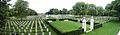
The Bény-sur-Mer Canadian War Cemetery
-
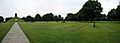
The La Cambe German war cemetery, near Bayeux
-
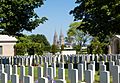
The Bayeux Commonwealth war cemetery
-
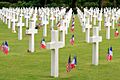
The Normandy American Cemetery and Memorial, overlooking Omaha Beach


