
Franklin D. Roosevelt facts for kids
Quick facts for kids
Franklin D. Roosevelt
|
|
|---|---|
.jpg)
1944 portrait
|
|
| 32nd President of the United States | |
| In office March 4, 1933 – April 12, 1945 |
|
| Vice President |
|
| Preceded by | Herbert Hoover |
| Succeeded by | Harry S. Truman |
| 44th Governor of New York | |
| In office January 1, 1929 – December 31, 1932 |
|
| Lieutenant | Herbert H. Lehman |
| Preceded by | Al Smith |
| Succeeded by | Herbert H. Lehman |
| Assistant Secretary of the Navy | |
| In office March 17, 1913 – August 26, 1920 |
|
| President | Woodrow Wilson |
| Preceded by | Beekman Winthrop |
| Succeeded by | Gordon Woodbury |
| Member of the New York State Senate from the 26th district |
|
| In office January 1, 1911 – March 17, 1913 |
|
| Preceded by | John F. Schlosser |
| Succeeded by | James E. Towner |
| Personal details | |
| Born | January 30, 1882 Hyde Park, New York, U.S. |
| Died | April 12, 1945 (aged 63) Warm Springs, Georgia, U.S. |
| Resting place | Springwood Estate |
| Political party | Democratic |
| Spouse | |
| Relatives |
|
| Education | Harvard University (AB) |
| Signature |  |
Franklin Delano Roosevelt (January 30, 1882 – April 12, 1945), often called FDR, was the 32nd President of the United States. He served from 1933 until his death in 1945. He holds the record as the longest-serving U.S. president, having served more than two terms. His first two terms focused on helping the country recover from the Great Depression. His later terms were dedicated to leading the U.S. during World War II.
A member of the Democratic Party, Roosevelt was born into important families in Hyde Park, New York. He studied at Harvard University and later became a state senator and the Governor of New York. In 1921, a serious illness, polio, permanently paralyzed his legs. Despite this challenge, he returned to public life with the support of his wife, Eleanor Roosevelt.
As president, FDR introduced the "New Deal" programs. These programs aimed to provide relief, help the economy recover, and reform financial systems. He was reelected multiple times, showing strong public support. After the Japanese attack on Pearl Harbor in 1941, Roosevelt led the U.S. into World War II. He worked closely with other world leaders to guide the Allies to victory. He also helped create the United Nations, an organization designed to promote world peace.
Roosevelt passed away in 1945, shortly before the end of the war. While some of his actions, like the internment of Japanese Americans, have faced criticism, historians generally rank him among the greatest American presidents.
Contents
Early Life and Education
Growing Up in Hyde Park
Franklin Delano Roosevelt was born on January 30, 1882, in Hyde Park, New York. His parents were James Roosevelt I and Sara Ann Delano. They belonged to the wealthy Roosevelt and Delano families. Franklin grew up on a large family estate called Springwood.
As a child, Franklin learned many skills like riding horses, shooting, and sailing. He often traveled to Europe, which helped him learn German and French. He was taught at home by tutors until he was 14. Then, he attended Groton School, a boarding school in Massachusetts. The headmaster there taught students the importance of public service and helping others.
College Years and Early Career Path
Like many of his classmates, Roosevelt went to Harvard College. He was active in college life, even becoming the editor-in-chief of the student newspaper, The Harvard Crimson. This role showed his ambition and ability to lead. After Harvard, he studied at Columbia Law School. He passed the New York bar exam in 1907 and began working at a law firm.

Franklin's father passed away in 1900. The next year, his cousin, Theodore Roosevelt, became U.S. president. Theodore's strong leadership inspired Franklin. Franklin was also a passionate stamp collector from a young age. He continued this hobby throughout his life, even as president.


.jpg)
Early Steps in Politics (1910–1920)
Serving as a New York State Senator

Franklin Roosevelt wasn't very interested in practicing law. He told friends he wanted to enter politics. In 1910, he ran for a seat in the New York State Senate. This district was usually Republican, but Roosevelt campaigned aggressively. He traveled by car, which was unusual at the time, and won a surprising victory.
As a state senator, Roosevelt quickly became a leader. He opposed the powerful Tammany Hall political group in New York. He also supported Woodrow Wilson for president in 1912. Roosevelt was re-elected in 1912 and worked on important bills related to farming and labor. These experiences helped shape his later policies.

In 1913, President Wilson appointed Roosevelt as Assistant Secretary of the Navy. Roosevelt loved the Navy and wanted a strong, efficient force. He helped improve the Navy's operations and gained valuable experience in management and logistics.
When World War I began in Europe in 1914, Roosevelt supported building up the U.S. Navy. After the U.S. entered the war in 1917, he helped coordinate the Navy's expansion. He even traveled to Europe to inspect naval bases and meet with leaders like King George V.
Running for Vice President

In 1920, Roosevelt was chosen as the running mate for presidential candidate James M. Cox. They ran on the Democratic ticket for president and vice president. Roosevelt campaigned across the country, defending the Wilson administration and supporting the League of Nations.
However, they lost the election to Republicans Warren G. Harding and Calvin Coolidge. Despite the loss, Roosevelt gained important connections and experience. This would prove very helpful in his future political career.
Overcoming Illness and Political Return (1921–1928)
.jpg)
In August 1921, while on vacation, Roosevelt became very ill. He was diagnosed with polio, which left his legs permanently paralyzed. His mother wanted him to retire from public life. However, Roosevelt, his wife Eleanor, and his friend Louis Howe were determined that he would continue his political journey.
Roosevelt worked hard to regain strength. He taught himself to walk short distances using leg braces. He was careful not to be seen in his wheelchair in public. He wanted people to focus on his abilities, not his disability.
He spent much time at Warm Springs, Georgia, where he found that warm water therapy helped him. In 1926, he even established a rehabilitation center there. Later, in 1938, he founded the National Foundation for Infantile Paralysis, which helped develop polio vaccines.

Roosevelt remained active in New York politics. He gave speeches at the Democratic National Conventions in 1924 and 1928. These speeches marked his return to public life after his illness.
Governor of New York (1929–1932)

In 1928, Al Smith, the Democratic presidential nominee, asked Roosevelt to run for Governor of New York. Roosevelt was hesitant at first, but party leaders convinced him he was the best candidate. He won the election by a small margin, becoming a strong contender for the next presidential election.
As governor, Roosevelt focused on important issues like building hydroelectric power plants and helping farmers. He also started holding "fireside chats" on the radio. These informal talks helped him connect directly with the people of New York.
When the Wall Street Crash of 1929 happened, leading to the Great Depression, Roosevelt understood the seriousness of the situation. He created a state employment commission and supported the idea of unemployment insurance. He was re-elected for a second term in 1930. He then proposed economic relief programs, like the Temporary Emergency Relief Administration, to help New Yorkers struggling during the Depression.
1932 Presidential Election Victory

As the 1932 presidential election approached, Roosevelt became the leading candidate for the Democratic nomination. He promised a "new deal" for the American people. This meant new government actions to address the Great Depression.
Roosevelt won the Democratic nomination and then flew from New York to Chicago to accept it in person. This was a first for a major party candidate. It was important for him to show his strength and energy despite his physical disability.
Roosevelt ran against President Herbert Hoover. He promised to regulate banks, help farmers, and create public works jobs. He also supported ending Prohibition. Roosevelt won a landslide victory, carrying all but six states. This election marked a major shift in American politics, creating the "New Deal coalition" of voters.

During the transition period before he took office, Roosevelt chose his key advisors. Frances Perkins became the first woman appointed to a cabinet position as Secretary of Labor. In February 1933, Roosevelt survived an assassination attempt in Miami.
Presidency (1933–1945)
Leading the Nation Through Crisis
When Roosevelt became president on March 4, 1933, the U.S. was in the worst part of the Great Depression. Many people were unemployed, farmers faced huge losses, and banks were closing. Roosevelt's plan focused on "relief, recovery, and reform." He aimed to help the unemployed, boost the economy, and fix the financial system. He used his "fireside chats" to explain his plans directly to the American public. His optimism helped renew the nation's spirit.
The New Deal: Helping America Recover
One of Roosevelt's first actions was to declare a four-day national "bank holiday." This stopped people from withdrawing all their money and helped stabilize the banking system. Congress quickly passed the Emergency Banking Act. When banks reopened, confidence returned. Roosevelt also signed the Cullen–Harrison Act, which ended Prohibition.

The "Hundred Days Congress" saw many new laws passed. Key New Deal agencies included:
- The Civilian Conservation Corps (CCC), which hired young men for environmental projects.
- The Public Works Administration (PWA), which built large public works like dams and bridges.
- The Federal Deposit Insurance Corporation (FDIC), which protected people's savings in banks.
- The Agricultural Adjustment Administration (AAA), which helped farmers by managing crop prices.
In 1935, Roosevelt launched the "Second New Deal." A major part of this was the Social Security Act. This law created a system of economic security for the elderly, the poor, and the sick. It was funded by payroll taxes, giving people a right to their benefits. Another important program was the Works Progress Administration (WPA), which employed millions of people on construction projects and in the arts. The National Labor Relations Act also gave workers the right to form unions and bargain for better conditions.
Conservation and the Environment
Roosevelt cared deeply about the environment. As governor, he started programs to plant trees and fight soil erosion. As president, he greatly expanded the National Park and National Forest systems. The CCC, his favorite New Deal agency, played a huge role in these efforts. They built trails, planted billions of trees, and improved parks across the country.
Preparing for World War II
.jpg)
In the 1930s, the U.S. generally favored staying out of world conflicts. Roosevelt, however, saw the growing threats from Nazi Germany and Fascist Italy in Europe, and Japan in Asia. He worked to strengthen the U.S. military.
When World War II began in Europe in September 1939, Roosevelt wanted to help Britain and France. He convinced Congress to allow the sale of arms to these countries on a "cash-and-carry" basis. He also began a secret correspondence with British Prime Minister Winston Churchill, forming a close friendship.

In 1940, Roosevelt decided to run for an unprecedented third term as president. He believed he was the best person to lead the nation through the growing global crisis. He won the election, promising to keep the country out of war while preparing for defense. He introduced the Lend-Lease program, which provided massive military aid to Britain and China, making the U.S. the "Arsenal of Democracy."
World War II Begins

Relations with Japan worsened after its invasion of China. Roosevelt cut off oil sales to Japan, which greatly impacted their war efforts. On December 7, 1941, Japan launched a surprise attack on Pearl Harbor in Hawaii. This attack severely damaged the U.S. Pacific Fleet.
Roosevelt called for war in his famous "Infamy Speech" to Congress. He declared December 7, 1941, "a date which will live in infamy." Congress quickly declared war on Japan. A few days later, Germany and Italy also declared war on the United States, and the U.S. responded in kind. The U.S. was now fully engaged in World War II.
-
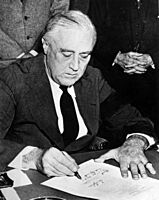
Roosevelt signing the declaration of war against Japan on December 8, 1941
-
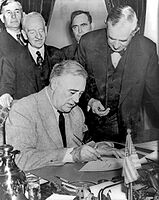
Roosevelt signing the declaration of war against Germany on December 11, 1941
-
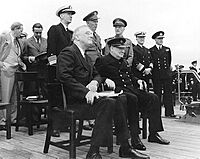
Roosevelt and Winston Churchill aboard HMS Prince of Wales for 1941 Atlantic Charter meeting


Leading the Allies to Victory

Roosevelt and Churchill met in December 1941 and agreed on a "Europe first" strategy. This meant defeating Germany before focusing completely on Japan. The U.S. and Britain worked together closely to coordinate military plans. On January 1, 1942, the United States and other Allied Powers signed the Declaration by United Nations, pledging to defeat the Axis powers.
Roosevelt, Churchill, and Soviet leader Joseph Stalin became known as the "Big Three." They met at several important conferences to plan strategy and discuss the post-war world. At the Tehran Conference in 1943, they committed to opening a second front against Germany.

_(B%26W).jpg)
Roosevelt was a strong supporter of creating the United Nations. He believed this new organization would help prevent future wars. At the Yalta Conference in February 1945, the Big Three leaders agreed on the structure of the United Nations and discussed plans for Germany after the war.
The Allies successfully invaded French North Africa in 1942 and then Sicily and Italy in 1943. In June 1944, General Dwight D. Eisenhower led the massive Operation Overlord (D-Day) invasion of France. Allied forces then pushed into Germany. In the Pacific, U.S. and Australian forces used an "island hopping" strategy to defeat Japan.

The Home Front During Wartime
World War II brought huge changes to the U.S. home front. The military buildup created millions of new jobs, ending the Great Depression's unemployment. Factories produced massive amounts of trucks, aircraft, tanks, and ammunition. The U.S. became the world's leading producer of war materials.
To pay for the war, the government increased taxes. Many people moved to cities to work in defense industries. In 1944, Roosevelt proposed the G.I. Bill. This program provided benefits for returning soldiers, including money for education, medical care, and low-cost loans for homes and businesses. It helped millions of veterans after the war.
Fourth Term and the End of the War

Roosevelt was re-elected for a fourth term in 1944, with Harry S. Truman as his new vice president. He campaigned on the idea of not "changing horses in mid-stream" during wartime. His victory showed strong support for his leadership and for the nation's role in the international community.
During his last months in office, Roosevelt oversaw the secret Manhattan Project. This project was developing the first atomic bomb. Scientists like Albert Einstein had warned Roosevelt about the possibility of Germany developing such a weapon. Roosevelt authorized the research, fearing the consequences if the U.S. did not have it. The atomic bomb was developed to help end the war, though Roosevelt passed away before it was used.
Health and Passing


Roosevelt's health had been declining since 1940. He had several serious health conditions, including heart problems. His personal doctor tried to ensure he got enough rest, but Roosevelt continued to work tirelessly. He knew his health was poor and even considered resigning after the war.
After returning from the Yalta Conference in February 1945, Roosevelt looked very tired and frail. On March 29, he traveled to his retreat in Warm Springs, Georgia, to rest. On April 12, 1945, while having his portrait painted, he suffered a massive intracerebral hemorrhage and passed away. He was 63 years old.


Roosevelt's death shocked and saddened people around the world. His body was transported by train to Washington, D.C., and then to his home in Hyde Park, New York. On April 15, he was buried in the rose garden of his Springwood estate, as he wished.

Germany surrendered just weeks after his death. President Harry Truman dedicated Victory in Europe Day to Roosevelt's memory. World War II officially ended with Japan's surrender in September 1945.
Roosevelt's Lasting Legacy

Franklin D. Roosevelt is remembered as one of America's most important presidents. He led the country through two of its greatest challenges: the Great Depression and World War II. His New Deal programs changed the role of government in American life, providing a safety net for many citizens. His leadership during the war helped secure victory for the Allies and laid the foundation for global peace organizations.
Memorials and Commemorations
Many places and symbols honor Franklin D. Roosevelt:
- His childhood home in Hyde Park is now a National Historic Site and home to his Presidential library.
- In Washington, D.C., the large Franklin Delano Roosevelt Memorial was dedicated in 1997. It features engravings of his Four Freedoms speech.
- He is honored on the American dime coin, partly because of his work with the March of Dimes to fight polio.
- Several U.S. Postage stamps feature his image.
- The aircraft carrier USS Franklin D. Roosevelt was named after him.
- In Paris, a Métro station was renamed in his honor in 1946.
- London's Westminster Abbey has a stone tablet memorial to him.
- Roosevelt Island in New York City was renamed after him in 1973, and the Franklin D. Roosevelt Four Freedoms Park was built there. In 2025, artist Ai Weiwei designed a conceptual pavilion to further honor the Four Freedoms memorial site.
Franklin D. Roosevelt Quotes
- "My friends, judge me by the enemies I have made."
- "The Nation that destroys its soil destroys itself."
- "Let us not be afraid to help each other — let us never forget that government is ourselves and not an alien power over us. The ultimate rulers of our democracy are not a President and Senators and Congressmen and Government officials but the voters of this country."
- "Happiness lies not in the mere possession of money; it lies in the joy of achievement, in the thrill of creative effort."
- "The only thing we have to fear is fear itself."
- "No man can occupy the office of President without realizing that he is President of all the people."
- "There can be no constitutional democracy in any community which denies to the individual his freedom to speak and worship as he wishes."
- "We must be the great arsenal of Democracy."
See also
 In Spanish: Franklin D. Roosevelt para niños
