
Fremantle Football Club facts for kids
Quick facts for kids Fremantle Football Club |
||||
|---|---|---|---|---|
 |
||||
| Names | ||||
| Full name | Fremantle Football Club Limited | |||
| Nickname(s) | Dockers, Freo Indigenous rounds: Walyalup |
|||
| Motto | Forever Freo | |||
| 2026 season | ||||
| After finals | AFL: 2nd | |||
| Home-and-away season | AFL: 1st | |||
| Leading goalkicker | AFL: Jye Amiss (64 goals) | |||
| Doig Medal | AFL: TBA | |||
| Club details | ||||
| Founded | 21 July 1994 | |||
| Colours | AFL: Purple White AFLW: Purple White Crimson |
|||
| Competition | AFL: Men AFLW: Women |
|||
| President | Chris Sutherland | |||
| Coach | AFL: Justin Longmuir AFLW: Lisa Webb |
|||
| Captain(s) | AFL: Alex Pearce AFLW: Ange Stannett |
|||
| Premierships | 0 | |||
| Ground(s) | AFL: Perth Stadium 2018-present (capacity: 61,266) | |||
| AFLW: Cockburn ARC Oval 2026–present (capacity: 3,000-4,000) | ||||
| Former ground(s) | WACA Ground (1995–2000) Subiaco Oval (1995–2017) |
|||
| Training ground(s) | Cockburn ARC (2017–present) Fremantle Oval (1995–2017) |
|||
| Uniforms | ||||
|
||||









 Current season
The Fremantle Football Club is a professional Australian rules football team. People usually call them the Dockers or simply Freo. They play in the Australian Football League, which is also called the AFL. This league is the highest level of Australian football in the country. The team comes from the sunny port city of Fremantle. Fremantle is located in the state of Western Australia. The Dockers joined the national competition in 1994 and began playing games in 1995. They were the second club from their state to join after the West Coast Eagles.
Both Fremantle and the West Coast Eagles belong to a group called WA Football. A special board of directors helps run the Fremantle club every single day. Fremantle has played in many exciting AFL finals matches over several decades. They have won two minor premierships by finishing first during regular seasons. Those great regular seasons happened in the 2015 AFL season and the 2026 AFL season. They also reached two big AFL Grand Final games in 2013 and 2026.
Many famous stars have played football for the purple and white team. These include Australian Football Hall of Fame heroes like Matthew Pavlich and Peter Bell. Another great legend is Nat Fyfe, who won two Brownlow Medal awards. Today, former player Justin Longmuir teaches the squad as the head coach. Tough defender Alex Pearce leads the boys on the field as captain.
The club trains at a modern sports centre called Cockburn ARC in Cockburn Central. On game days, they run out in front of huge crowds at Perth Stadium. Fremantle also has an amazing women's team in the elite AFL Women's competition. Coach Lisa Webb and captain Ange Stannett lead the women's squad. In the 2020 AFL Women's season, the team went completely undefeated in an unforgettable run.
Contents
- Understanding Fremantle Football Club History
- Season-by-Season Performance and Match Records
- Club Culture, Nicknames, and Traditions
- Passionate Rivalries with Other AFL Teams
- Player Development and Partner Teams
- Fremantle AFL Women's Team
- Club Awards and Individual Football Honours
- Supporters and Notable Fans
- Images for kids
- See also
Understanding Fremantle Football Club History
Background of Football in Fremantle
| 1979 WANFL Grand Final | G | B | Total |
| East Fremantle | 21 | 19 | 145 |
| South Fremantle | 16 | 16 | 112 |
| Venue: Subiaco Oval | crowd: 52,781 | ||
The seaside city of Fremantle has loved football for well over a century. The very first organised game of Australian rules football in Western Australia happened there in 1881. Early local teams were very strong and won lots of early premiership trophies. These champion pioneer clubs were the Fremantle Football Club (1882–1886) and Fremantle Football Club (1882–1899). Another powerhouse was the famous East Fremantle Football Club, nicknamed the Sharks. Together, these three clubs won 24 out of the first 34 league titles.
For more than one hundred years, Fremantle Oval was the city's main sports ground. Local fans loved watching matches between East Fremantle and their neighbours, South Fremantle Football Club. People called these fun local games the famous Fremantle Derby. In the 1979 WANFL Grand Final, these two rivals played in front of 52,781 people. That giant crowd at Subiaco Oval was a state football record for many years. It showed everyone how much the local community cared about their favourite sport.
Many legendary stars from the port city later entered the Australian Football Hall of Fame. Famous heroes from old local leagues included great players like Steve Marsh. Goal kickers like Bernie Naylor and George Doig scored hundreds of amazing goals. Tough players such as Jack Sheedy and William Truscott became legends too. Brilliant coach John Todd inspired generations of young athletes with his great leadership.
Early Years in the AFL (1993–2006)

The national league was originally named the Victorian Football League. When it expanded across Australia, it only added the West Coast Eagles in 1987. Local Fremantle clubs wanted to join together to make a brand new team. However, special legal rules stopped another Western Australian team from joining right away. The state commission called the West Australian Football Commission also had different ideas. Everyone had to wait several years before another team could get a licence.
On 14 December 1993, the AFL finally approved a brand new club for Fremantle. The team planned to start playing against other Australian cities in 1995. Officials first thought about calling the team the Fremantle Sharks during early planning stages. On 21 July 1994, leaders revealed the official name as the Fremantle Football Club. They also introduced the nickname "Dockers" and chose purple, red, green, and white colours. The new players held their very first training session at Fremantle Oval in October 1994.
The first few seasons were quite challenging for the brand new football club. They worked hard, but often finished near the bottom of the league ladder. Everything changed in 2003 when Fremantle won 14 games and reached fifth spot. They qualified for their first ever finals game against powerful club Essendon Football Club. Even though Essendon won the match at Subiaco Oval, Fremantle showed big improvement. Fans were thrilled to see their team finally competing against the best teams.
During the 2006 AFL season, the Dockers played their best football yet. They won nine games in a row near the end of the year. That strong streak helped them finish third on the ladder with 15 wins. They lost a close qualifying match against the Adelaide Football Club at Football Park. The next week, Fremantle beat Melbourne Football Club at home for their first finals win. They travelled to Stadium Australia in Sydney, but lost to the Sydney Swans.
Grand Final Journey and Ross Lyon Era (2007–2019)

In 2007, former champion Mark Harvey took over as the club's new senior coach. The team had some ups and downs while rebuilding with young new players. In 2009, they suffered a difficult loss against Adelaide, scoring only 13 total points. However, the young squad learned important lessons and bounced back very quickly. In 2010, Fremantle surprised everyone by beating Hawthorn Football Club in a home final. Luke McPharlin played great defence against Lance Franklin, while Adam McPhee stopped Luke Hodge.
Near the end of 2011, the club hired a new coach named Ross Lyon. Coach Lyon was famous for teaching teams how to play very tough defence. In 2012, Fremantle travelled to the huge MCG and defeated the strong Geelong Football Club. Champion forward Matthew Pavlich kicked six goals to lead his team to victory. The Dockers were learning how to win tough games away from their home state. Everyone could tell that the team was building something truly special.
The 2013 season turned out to be one of the most exciting years ever. Fremantle won 16 games during the home-and-away season and finished in third place. They defeated Geelong in an away final and then hosted the Sydney Swans. In front of a roaring home crowd, the Dockers won by 25 points. That giant win sent Fremantle into their very first AFL Grand Final. In the 2013 AFL Grand Final, Fremantle battled hard against Hawthorn, but lost by 15.

In 2014, Fremantle played in finals again and star player Nat Fyfe shined brightly. He won the Leigh Matthews Trophy as the league's most valuable player. The next year was even better, as Fremantle won the 2015 McClelland Trophy. That trophy meant they finished on top of the ladder as minor premiers. Nat Fyfe became the first Docker to win the prestigious 2015 Brownlow Medal. After several successful years, Ross Lyon finished coaching the club near late 2019.
Modern Era Under Justin Longmuir (2020–present)
Former Fremantle player Justin Longmuir became the new head coach before the 2020 AFL season. That season was shortened because of the global COVID-19 pandemic health emergency. Longmuir taught the players a smart game style built on teamwork and ball control. In the 2022 AFL season, Fremantle returned to finals after finishing fifth on the ladder. They played the Western Bulldogs at home in a dramatic elimination final. After falling behind by 41 points, Fremantle roared back to win by 13.
The next week, Fremantle played Collingwood Football Club at the Melbourne Cricket Ground. Over 90,000 cheering fans watched the exciting contest, where Fremantle battled bravely. In the 2023 AFL season, Fremantle scored a big win over West Coast in the Western Derby. They also defeated both 2022 AFL Grand Final teams during that same competitive season. During the 2024 AFL season, the club stayed in finals contention for most rounds. Unfortunately, late injuries to forward Josh Treacy and ruckman Sean Darcy hurt their chances.
In the 2025 AFL season, Fremantle won 12 of their last 14 regular matches. They qualified for finals again before losing a thriller to the Gold Coast Suns. That tight game marked the end of the legendary career of Nat Fyfe. The 2026 AFL season brought even greater joy and success to the purple army. Fremantle won all 12 home matches and secured their second ever minor premiership. They won 14 straight matches and marched into the 2026 AFL Grand Final.
In that huge Grand Final battle, Fremantle faced off against the mighty Brisbane Lions. Fremantle fought with tremendous heart and led the game late in the final quarter. Brisbane kicked late goals to take the win, 96 to 89 points. Fremantle superstar Shai Bolton won the Norm Smith Medal as best player on ground. Fans celebrated the team's incredible effort and sportsmanship throughout the entire season.
Season-by-Season Performance and Match Records

Fremantle has played hundreds of exciting matches since joining the elite AFL competition. They have built an overall winning percentage of more than 47 percent over time. They have reached ten separate finals series through decades of determination and hard work. Fans are very proud that their team has claimed two regular-season minor premierships. The table below shows the complete record for every season the men's team played.
Complete Year-by-Year Results Table
| Year | P | W | D | L | % | Ladder | Finals P | Finals W | Finals L | Final Rank | Coach |
| 2026 | 23 | 19 | 0 | 4 | 137.2 | 1st | 4 | 2 | 2 | 2nd | Justin Longmuir |
| 2025 | 23 | 16 | 0 | 7 | 109.0 | 6th | 1 | 0 | 1 | 8th | Justin Longmuir |
| 2024 | 23 | 12 | 1 | 10 | 111.9 | 10th | 0 | 0 | 0 | 10th | Justin Longmuir |
| 2023 | 23 | 10 | 0 | 13 | 96.7 | 14th | 0 | 0 | 0 | 14th | Justin Longmuir |
| 2022 | 22 | 15 | 1 | 6 | 117.0 | 5th | 2 | 1 | 1 | 6th | Justin Longmuir |
| 2021 | 22 | 10 | 0 | 12 | 86.5 | 11th | 0 | 0 | 0 | 11th | Justin Longmuir |
| 2020 | 17 | 7 | 0 | 10 | 93.7 | 12th | 0 | 0 | 0 | 12th | Justin Longmuir |
| 2019 | 22 | 9 | 0 | 13 | 91.9 | 13th | 0 | 0 | 0 | 13th | Ross Lyon / David Hale |
| 2018 | 22 | 8 | 0 | 14 | 76.2 | 14th | 0 | 0 | 0 | 14th | Ross Lyon |
| 2017 | 22 | 8 | 0 | 14 | 74.4 | 14th | 0 | 0 | 0 | 14th | Ross Lyon |
| 2016 | 22 | 4 | 0 | 18 | 74.3 | 16th | 0 | 0 | 0 | 16th | Ross Lyon |
| 2015 | 22 | 17 | 0 | 5 | 118.7 | 1st | 2 | 1 | 1 | 3rd | Ross Lyon |
| 2014 | 22 | 16 | 0 | 6 | 130.4 | 4th | 2 | 0 | 2 | 6th | Ross Lyon |
| 2013 | 22 | 16 | 1 | 5 | 134.1 | 3rd | 3 | 2 | 1 | 2nd | Ross Lyon |
| 2012 | 22 | 14 | 0 | 8 | 115.7 | 7th | 2 | 1 | 1 | 6th | Ross Lyon |
| 2011 | 22 | 9 | 0 | 13 | 83.1 | 11th | 0 | 0 | 0 | 11th | Mark Harvey |
| 2010 | 22 | 13 | 0 | 9 | 103.9 | 6th | 2 | 1 | 1 | 6th | Mark Harvey |
| 2009 | 22 | 6 | 0 | 16 | 77.3 | 14th | 0 | 0 | 0 | 14th | Mark Harvey |
| 2008 | 22 | 6 | 0 | 16 | 93.7 | 14th | 0 | 0 | 0 | 14th | Mark Harvey |
| 2007 | 22 | 10 | 0 | 12 | 102.6 | 11th | 0 | 0 | 0 | 11th | Chris Connolly / Mark Harvey |
| 2006 | 22 | 15 | 0 | 7 | 109.8 | 3rd | 3 | 1 | 2 | 3rd | Chris Connolly |
| 2005 | 22 | 11 | 0 | 11 | 100.2 | 10th | 0 | 0 | 0 | 10th | Chris Connolly |
| 2004 | 22 | 11 | 0 | 11 | 100.6 | 9th | 0 | 0 | 0 | 9th | Chris Connolly |
| 2003 | 22 | 14 | 0 | 8 | 103.1 | 5th | 1 | 0 | 1 | 7th | Chris Connolly |
| 2002 | 22 | 9 | 0 | 13 | 88.3 | 13th | 0 | 0 | 0 | 13th | Chris Connolly |
| 2001 | 22 | 2 | 0 | 20 | 72.0 | 16th | 0 | 0 | 0 | 16th | Damian Drum / Ben Allan |
| 2000 | 22 | 8 | 0 | 14 | 72.0 | 12th | 0 | 0 | 0 | 12th | Damian Drum |
| 1999 | 22 | 5 | 0 | 17 | 82.4 | 15th | 0 | 0 | 0 | 15th | Damian Drum |
| 1998 | 22 | 7 | 0 | 15 | 76.4 | 15th | 0 | 0 | 0 | 15th | Gerard Neesham |
| 1997 | 22 | 10 | 0 | 12 | 91.9 | 12th | 0 | 0 | 0 | 12th | Gerard Neesham |
| 1996 | 22 | 7 | 0 | 15 | 92.3 | 13th | 0 | 0 | 0 | 13th | Gerard Neesham |
| 1995 | 22 | 8 | 0 | 14 | 92.9 | 13th | 0 | 0 | 0 | 13th | Gerard Neesham |
Club Culture, Nicknames, and Traditions
How the Dockers Got Their Name

The nickname "Dockers" honours the hard-working people who load ships at the port. In 1994, a famous clothing company named Levi Strauss & Co. made pants called Dockers. Because of legal naming rules, Fremantle stopped putting the word Dockers on shirts. However, cheering fans and sports commentators never stopped using the popular name anyway. By 2010, the club made a friendly agreement with the clothing brand. That special deal let the team use the Dockers name on everything again.
A funny story also surrounds the early choice of the club's famous nickname. Leaders once joked that the name came from the cool sea breeze in town. That famous afternoon coastal wind is widely known as the Fremantle Doctor. During special celebrations, supporters sometimes like to invent fun nicknames for their favourite team. For example, fans chanted the silly name "Flagmantle" when dreaming of winning flags. In football, fans use the word "flag" to talk about winning a premiership trophy.
Fremantle also proudly celebrates Australian Indigenous culture during special league football rounds each season. During the Sir Doug Nicholls Round, the club adopts the special name Walyalup. Walyalup is the traditional Noongar word for the Fremantle area. It translates directly to English as the "place of the woylie". A woylie is a tiny, adorable marsupial native to southwest Western Australia. The team wears stunning jerseys painted with traditional Aboriginal art for these special games.
Team Mottos and the Famous Wharfie Time
The official club motto known by every Fremantle fan is "Forever Freo". During Indigenous rounds, the team proudly writes this motto in the Noongar language. In Noongar, the phrase translates directly to the powerful words "Kalyakoorl Walyalup". Players and supporters love these slogans because they inspire teamwork, loyalty, and pride. You can see these inspiring words printed across club banners, scarves, and flags.
Fremantle fans also love a very famous football phrase called "Wharfie Time". A wharfie is an Australian word for someone who works on the docks. In a close 2009 match, television microphones picked up captain Matthew Pavlich speaking. He cheered his teammates by saying: "Put on your Superman capes, boys. It's wharfie time." The phrase meant that the players needed to roll up their sleeves and work. Whenever a game gets close at Perth Stadium, stadium bells ring from AC/DC's "Hells Bells".
Uniforms and Guernsey Evolution
.jpg)

When Fremantle started playing in 1995, their guernsey featured a large white anchor. The front was split into red and green panels across the chest. In nautical sailing, red and green represent port and starboard navigation lights on ships. Red, green, and white also honoured the large local Italian Australian community. Many Italian families in Fremantle worked as skilled fishermen over several generations. The team wore purple shorts and purple socks to finish their colourful look.
In 2011, the club redesigned their uniform to make it simpler and cleaner. The new home guernsey is deep purple with three bold white V-shapes called chevrons. This modern look was based on an old design worn back in 1885. When playing away games against teams with dark jumpers, Fremantle wears a white guernsey. The away guernsey features purple chevrons so players can easily spot their teammates.
Every year, Fremantle hosts a very special charity match called the Purple Haze game. The club partners with the Starlight Children's Foundation to help very sick children in hospitals. Fans wear bright purple clothes and buy yellow stars to raise charity money. The players run onto the ground wearing a small yellow star on their guernseys. This fun event has raised millions of dollars to help kids across Australia.
Stadiums, Training Grounds, and Headquarters

Between 1995 and 2017, Fremantle conducted all daily training sessions at historic Fremantle Oval. In 2017, the club moved into a wonderful new sports centre at Cockburn ARC. This massive facility cost over one hundred million dollars to build for athletes. It features giant swimming pools, modern gyms, recovery baths, and a full-size football oval. Local community members can also visit the facility to swim, exercise, and play sports.
For home games, the men's team plays at the world-class Perth Stadium in Burswood. This huge stadium can hold more than 60,000 cheering fans for big football games. It features giant video screens, comfortable seats, and bright lights that change colours. Before moving there in 2018, Fremantle played games at Subiaco Oval and the WACA Ground. Cheering fans create a loud purple wall of noise during big home victories.
Team Songs and Club Mascots

The official victory song sung by players after winning is "Freo Way to Go". It was adapted from an earlier club song composed by musician Ken Walther. Unlike traditional football fight songs, Fremantle's song has a modern rock and roll drum beat. An early version featured music inspired by composer Igor Stravinsky and his "The Volga Boatmen's Song". Award-winning author Tim Winton once joked that Fremantle's song has a cool backbeat. Other songs like "Knees Up Mother Brown" sound very old compared to Fremantle's rock song.
Famous Australian rock musicians who support the club have also written special songs. The popular group Pond recorded a rock cover of the team song in 2013. Rock star Kevin Parker from the band Tame Impala wrote the pump-up song "Go Freo". That song is played at three-quarter time during home games to energise the crowd. The music draws inspiration from the hard-rocking classic sound of singer Bon Scott.
Kids love meeting the fun, costumed mascots who entertain families at home games:
- Grinder (1995–1999): A tough cartoon dock worker who looked similar to the cartoon character Popeye.
- The Doc (2000–2003): A mascot with long blonde hair like players Clive Waterhouse and Shaun McManus.
- Johnny "The Doc" Docker (2003–present): A blonde surfer carrying a cool surfboard under his arm.
- Jenny Docker (2012–present): Johnny's sporty younger sister who loves cheering for the Dockers.
- Dokka the Quokka (2022–present): A smiling quokka, a famous native animal found on Rottnest Island.
Passionate Rivalries with Other AFL Teams
The Fierce Western Derby Against the Eagles

Fremantle's biggest football rival is their cross-town neighbour, the West Coast Eagles. Twice every year, these two local teams play against each other in the Western Derby. Western Australians pronounce the match name as "Derby" with a hard "er" sound. The winner of the game earns bragging rights across schools, playgrounds, and offices statewide. The very best player on the field receives the prestigious Glendinning-Allan Medal.
In the early years, the older West Coast team won the first nine derby matches. Fremantle finally broke the losing streak with an amazing win in late 1999. In 2000, the teams played in an unforgettable game nicknamed the Demolition Derby. Fremantle fell behind by 42 points before launching a heroic comeback to win by one. The match was famous for tough tackling, huge collisions, and incredible competitive spirit. Today, both clubs have won many exciting derbies, making it a very even contest.
Classic Clashes with the St Kilda Saints
Fremantle also shares a very interesting and dramatic history with the St Kilda Football Club. In 2006, they played a match in Launceston at a stadium called York Park. At the end of the game, the ground siren was not loud enough. The field umpires could not hear it over the screaming crowd, so play continued. St Kilda kicked a behind to level the scores, causing the famous "Sirengate" controversy. A few days later, league officials checked the clock and officially awarded Fremantle the win.
A few years later in 2011, Fremantle hired coach Ross Lyon away from St Kilda. Saints fans were very upset that their successful head coach moved to Fremantle. When the two teams played in the 2012 AFL season, fans booed loudly throughout. Fremantle won that tense Friday night game at Docklands Stadium by 13 points. Matches between these two passionate clubs remain very entertaining for supporters to watch.
Player Development and Partner Teams
Working Together with Peel Thunder
In Australian rules football, not every player on a team's roster plays AFL each week. Senior teams only pick their top 23 players for each weekend game. The extra players need to play competitive matches so they stay match-fit and sharp. In the early days, Fremantle players were shared across different West Australian Football League clubs. That system meant teammates often played against each other in the local state league.
Since 2014, Fremantle has worked in a close partnership with the Peel Thunder Football Club. Peel Thunder plays in the WAFL and is based in the coastal city of Mandurah. Fremantle players who miss out on AFL selection put on the Peel Thunder guernsey instead. This great system helps younger players learn how to play alongside experienced professionals. The partnership has been super successful, helping Peel Thunder win WAFL premierships in 2016, 2017, 2024, and 2026.
Fremantle AFL Women's Team
Inspiring New Generations of Female Athletes

In 2016, the AFL decided to create the first national league for female footballers. Fremantle worked very hard to win a licence to enter the brand new AFL Women's competition. They partnered with Curtin University to offer players great education and career support. The AFL officially awarded Fremantle their women's licence on 15 June 2016. Passionate coach Michelle Cowan was chosen as the team's first head coach.
Tough midfielder Kiara Bowers and skilled leader Kara Antonio were the club's first marquee signings. In their early seasons, the team played their home matches at historic Fremantle Oval. The team worked hard to learn the professional game while balancing work and study. In 2018, Fremantle played in the very first football match ever held at Perth Stadium. Over 41,000 cheering fans watched them beat Collingwood on that historic summer evening.
The 2019 AFL Women's season was a huge breakthrough under new coach Trent Cooper. The team won six out of seven regular season matches to make their first finals. Midfielder Kiara Bowers tackled opponents relentlessly, while Gemma Houghton kicked spectacular goals. Both stars earned spots in the prestigious AFL Women's All-Australian team. Teammate Ashley Sharp won the Goal of the Year award for an amazing running goal.
In the 2020 AFL Women's season, Fremantle had one of the best seasons ever seen. They won every single game they played, finishing first with an unbeaten record. Young forward Sabreena Duffy kicked four goals in a huge win against Brisbane. In their home final at Fremantle Oval, they smashed the Gold Coast Suns by 70 points. Sadly, the rest of finals was stopped due to the COVID-19 pandemic health emergency. Even without a trophy awarded, fans know that 2020 team was truly special.
Today, former Docker player Lisa Webb leads the team as the head coach. Tough defender Ange Stannett guides the squad on the ground as the team captain. Star ruck Mim Strom dominates hit-outs, while Irish athlete Aisling McCarthy wins key clearances. The AFLW Dockers continue to inspire thousands of young girls across Australia to play football.
Club Awards and Individual Football Honours
The Doig Medal and Special Trophies
The Doig Medal is Fremantle's most prestigious annual award for its best and fairest player. It is named after George Doig, an East Fremantle legend who kicked 1,077 goals. After every AFL game, the coaching staff grades each player on a five-point scale. At the end of the year, the club counts all votes at a gala dinner. The player with the highest total votes receives the shiny medal and big applause.
The club also gives out several other special trophies at the awards night:
- Beacon Award: Given to the most outstanding first-year rookie player on the squad.
- Best Clubman Award: Given to the player who shows the greatest unselfish team spirit.
- Players' Award: Voted on by the teammates for the player who lives team values best.
- Leading Goalkicker: Awarded to the sharp-shooting forward who kicks the most goals all year.
Complete Doig Medal and Award Winners
| Season | Doig Medal Winner | Beacon Award (Best Rookie) | Leading Goalkicker |
|---|---|---|---|
| 1995 | Peter Mann | Scott Chisholm | Peter Mann (33) |
| 1996 | Stephen O'Reilly | Gavin Mitchell | Kingsley Hunter (33) |
| 1997 | Dale Kickett | Mark Gale | Kingsley Hunter (32) |
| 1998 | Jason Norrish | Brad Dodd | Clive Waterhouse (30) |
| 1999 | Adrian Fletcher | Clem Michael | Tony Modra (71) |
| 2000 | Troy Cook | Paul Hasleby | Clive Waterhouse (53) |
| 2001 | Peter Bell | Dion Woods | Justin Longmuir & Matthew Pavlich (28) |
| 2002 | Matthew Pavlich | Paul Medhurst | Trent Croad (42) |
| 2003 | Peter Bell | Graham Polak | Paul Medhurst (50) |
| 2004 | Peter Bell | Andrew Browne | Paul Medhurst (41) |
| 2005 | Matthew Pavlich | David Mundy | Matthew Pavlich (61) |
| 2006 | Matthew Pavlich | Marcus Drum | Matthew Pavlich (71) |
| 2007 | Matthew Pavlich | Robert Warnock | Matthew Pavlich (72) |
| 2008 | Matthew Pavlich | Rhys Palmer | Matthew Pavlich (67) |
| 2009 | Aaron Sandilands | Stephen Hill | Matthew Pavlich (28) |
| 2010 | David Mundy | Michael Barlow | Matthew Pavlich (61) |
| 2011 | Matthew Pavlich | Tendai Mzungu | Chris Mayne & Kepler Bradley (25) |
| 2012 | Ryan Crowley | Lee Spurr | Matthew Pavlich (69) |
| 2013 | Nat Fyfe | Cam Sutcliffe | Michael Walters (46) |
| 2014 | Nat Fyfe | Matt Taberner | Hayden Ballantyne (49) |
| 2015 | Aaron Sandilands | Alex Pearce | Michael Walters (44) |
| 2016 | Lachie Neale | Lachie Weller | Michael Walters (36) |
| 2017 | Bradley Hill | Luke Ryan | Cam McCarthy (25) |
| 2018 | Lachie Neale | Brennan Cox | Michael Walters (22) |
| 2019 | Nat Fyfe | Sam Switkowski | Michael Walters (40) |
| 2020 | Luke Ryan | Caleb Serong | Matt Taberner (29) |
| 2021 | Sean Darcy | Hayden Young | Matt Taberner (37) |
| 2022 | Andrew Brayshaw | Brandon Walker | Rory Lobb (36) |
| 2023 | Caleb Serong | Jye Amiss | Jye Amiss (41) |
| 2024 | Caleb Serong | Josh Draper | Josh Treacy (45) |
| 2025 | Caleb Serong | Murphy Reid | Josh Treacy (44) |
Hall of Fame Heroes and National Superstars
.jpg)
Many Fremantle players have earned the highest honours available in Australian rules football. Midfielder Nat Fyfe won the prestigious Brownlow Medal twice, in 2015 and 2019. This award honours the best and fairest player across the entire national competition. In 2021, star tackler Kiara Bowers won the AFL Women's best and fairest award. Dynamic forward Shai Bolton won the famous Norm Smith Medal in the 2026 Grand Final.
Several young Dockers have won the prestigious AFL Rising Star award as top rookie:
- Paul Hasleby won the award in 2000 with his great ball-winning skills.
- Rhys Palmer claimed the trophy in 2008 with his speedy running in midfield.
- Caleb Serong took home the prize in 2020 with his tough tackling performances.
- Murphy Reid won the honour in 2025 after an amazing debut season.
Fremantle champions have also taken home the exciting Mark and Goal of the Year awards. In 2000, high-flying forward Tony Modra took the Mark of the Year with an unbelievable leap. Defender Luke McPharlin followed him by winning Mark of the Year in 2005. For unbelievable goals, Winston Abraham won Goal of the Year in 1996. Small forward Hayden Ballantyne won in 2011, and Caleb Serong won in 2021.
Club Games and Goal Records

- Most Games Played: David Mundy, who played an astonishing 376 games in purple.
- Most Goals Kicked: Matthew Pavlich, who kicked 700 career goals for the Dockers.
- Most Goals in One Game: Tony Modra, who booted 10 goals against Melbourne in 1999.
- Most Goals in a Season: Matthew Pavlich, who booted 72 goals during the 2007 season.
- Highest Team Score: 180 points against Collingwood Football Club on 8 May 2005.
- Biggest Winning Margin: 124 points against North Melbourne at Hands Oval in 2026.
- Longest Winning Streak: 14 matches in a row during the historic 2026 season.
Supporters and Notable Fans
Famous Fans and Number-One Ticket Holders
_(cropped).jpg)
Every AFL team selects an extra special person to be their number-one ticket holder. In the beginning, the club gave this role to former premier Carmen Lawrence. Later, the club chose famous actors, athletes, and artists who truly love the team. Funny comedian Rove McManus held the role, as did basketball giant Luc Longley. In 2021, famous rock star Kevin Parker of Tame Impala received the title. Indigenous artist and musician Richard Walley has also served as an honoured patron.
Other famous fans love showing off their purple pride at games and on television:
- Western Australia's state leaders Roger Cook, Mark McGowan, and Alan Carpenter.
- Musician and comedian Tim Minchin, who loves cheering for the purple army.
- Famous international tennis star John Isner from the United States.
- Talented sports journalists and television presenters Neroli Meadows and Dixie Marshall.
- Professional champion golfer Min Woo Lee, who often wears Freo gear.
The Passionate Purple Army Fan Base
Fremantle fans are famous for being some of the loudest supporters in Australian sport. Even when the team faced tough rebuilding seasons, loyal members kept buying game memberships. In 2004, the club had the fastest-growing membership base across the entire AFL. In 2023, the Dockers broke a huge milestone by passing 60,000 official club members. By 2025, that impressive number climbed even higher to more than 66,000 passionate members.
Cheering crowds pack into Perth Stadium every second weekend to sing and support the team. Fans wear purple beanies, wave large anchor flags, and chant for their favourite players. Whenever the team wins, the whole stadium erupts in purple light and loud music. The Dockers are a huge part of the community and culture of Western Australia.
Images for kids
-
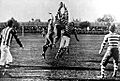
Marking contest from a Fremantle Derby between South Fremantle and East Fremantle, c. 1910
-
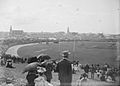
A view over Fremantle Oval and the surrounding buildings, c. 1895
-
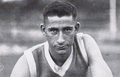
East Fremantle legend George Doig, namesake of Fremantle's Doig Medal
-
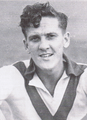
South Fremantle legend Bernie Naylor
-
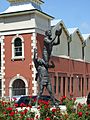
Statue of John Gerovich's mark over Ray French
-
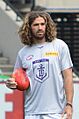
Alex Pearce has captained the club since 2023
-

Justin Longmuir, former Fremantle player and current coach
-
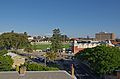
The AFLW squad formerly played its home matches at Fremantle Oval
-
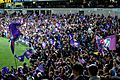
Supporters cheer on the Dockers


See also
 In Spanish: Fremantle Football Club para niños
- List of Fremantle Dockers league players
- Australian rules football in Western Australia
- Fremantle Football Club drafting and trading history
- Sport in Australia
- Sport in Western Australia
