
Heat facts for kids
Quick facts for kids Heat |
|
|---|---|

A glowing-hot metal bar showing incandescence, the emission of light due to its temperature, is often recognized as a source of heat.
|
|
|
Common symbols
|
 |
| SI unit | joule |
|
Other units
|
British thermal unit, calorie |
| In SI base units | kg⋅m2⋅s−2 |
| Dimension | Lua error in Module:Wd at line 1575: attempt to index field 'wikibase' (a nil value). |
Heat is the flow of thermal energy from something warm to something colder. In thermodynamics, scientists say heat is energy moving between objects. Objects do not hold heat inside them. Instead, they have internal energy, which turns into heat only when it moves somewhere else!
Contents
What Is Heat and How Does It Travel?

Whenever two things touch or interact, heat naturally moves toward the colder area. This energy transfer can happen in three main ways.
The first way is conduction, where heat moves directly through solid touch. For instance, a metal spoon in hot soup warms up fast. The second way is convection, where warm liquids or gases rise and cool ones sink. The third way is radiation, where energy travels through invisible waves, just like sunlight reaching Earth.
Scientists measure heat in a unit called the joule (J), named after James Prescott Joule. You might also hear of other units like the calorie or the British thermal unit. When engineers measure how fast heat moves per second, they use the watt. In science formulas, heat is written with the letter Q.
History of How We Discovered Heat

People did not always understand heat. Early thinkers once imagined heat was an invisible fluid called caloric. Over time, clever scientists proved that heat is actually caused by tiny particles moving around.
In the 1600s, thinkers like Francis Bacon and Galileo Galilei noticed that heating things made their tiny parts move faster. Robert Boyle and Robert Hooke agreed that matter is made of moving pieces. Later, John Locke pointed out that friction creates heat, like when you rub two sticks together. In 1850, Rudolf Clausius showed that work and friction create heat directly.
.jpg)
During the 1700s, Scottish scientist Joseph Black realized that temperature and heat are not the exact same thing. Temperature tells us how hot something feels, while heat is the amount of energy passing through. Black discovered latent heat, which is the energy needed to change a solid into a liquid, like melting ice, without changing its temperature. He also studied specific heat capacity, which explains why water takes longer to warm up than metal.
Scientists soon built tools called calorimeters to measure thermal energy. In the 1780s, Antoine Lavoisier and Pierre-Simon Laplace used an ice calorimeter to see how chemical reactions melted ice.
Everyday Machines That Move Heat
.jpg)
Engineers use their knowledge of heat to build amazing machines that help our daily lives.
A heat engine takes heat from a hot place and turns it into useful movement, called mechanical work. Cars and power plants use this basic idea to run. On the other hand, a heat pump or refrigerator does the opposite. It uses electricity to push heat backward from a cold fridge box out into the warm room, keeping your food fresh and cool!
Amazing Facts About Heat
- Your body is like a little furnace. You generate heat by burning the food you eat. This is called metabolism. Your body works hard to keep your internal temperature at about 37 degrees Celsius (98.6 degrees Fahrenheit), no matter if it is freezing outside or very hot.
- The center of our sun reaches temperatures of about 15 million degrees Celsius (27 million degrees Fahrenheit). That is enough heat to power the entire solar system!
- Deep inside the Earth, it is so hot that rock actually melts into a thick, gooey liquid called magma. When this magma erupts from a volcano, it is called lava. Lava can reach temperatures of over 1,200 degrees Celsius (2,200 degrees Fahrenheit).
- Our atmosphere acts like a blanket for the Earth. It traps some of the heat from the sun, which keeps our planet at a temperature where life can thrive. Without this "greenhouse effect," the Earth would be a frozen, lifeless rock.
- Most things expand when they get hot. This is because the molecules start moving faster and need more space to bounce around. This is why bridges have special gaps in them—so they have room to grow in the summer heat without buckling!
Images for kids
-

John Locke wrote about friction making objects hot.
-

Brook Taylor studied temperatures of mixed liquids.
-
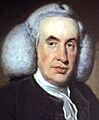
William Cullen experimented with early cooling methods.
-
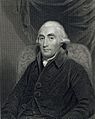
Joseph Black helped explain sensible and latent heat.
-
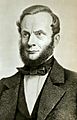
Rudolf Clausius helped define entropy and laws of heat.
.jpg)
.jpg)
.jpg)


See also
 In Spanish: Calor para niños
