
Hoverfly facts for kids
Quick facts for kids Syrphidae |
|
|---|---|
 |
|
| Sixteen different species of hoverflies | |
Scientific classification  |
|
| Kingdom: | Animalia |
| Phylum: | Arthropoda |
| Class: | Insecta |
| Order: | Diptera |
| Section: | Aschiza |
| Superfamily: | Syrphoidea |
| Family: | Syrphidae Latreille, 1802 |
| Subfamilies | |
|
|
Hoverflies are amazing insects. They are also known as flower flies or syrphids. These flies belong to the insect family called Syrphidae. You often see them hovering in the air, like tiny helicopters. They also visit flowers to drink nectar and collect pollen. Adult hoverflies mostly eat nectar and pollen. Their young, called larvae or maggots, have different diets. Some larvae eat decaying plants and animals. Others are helpful predators. They eat tiny pests like aphids that harm plants.
Aphids are small insects that can damage crops. So, hoverfly larvae are very important. They help farmers by eating these pests. Adult hoverflies also help plants by spreading pollen. This makes them great pollinators, just like bees! There are about 6,000 types of hoverflies. You can find them almost everywhere in the world, except Antarctica. Hoverflies are harmless to people. Many look like stinging wasps or bees. This trick helps them scare away predators.
Hoverflies hover in the air for different reasons. Males often hover to show off their territory. They are looking for females. Females hover to find good places to lay their eggs.
- Adult hoverflies often hover over the plants they visit
-
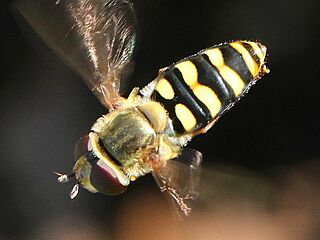
Eupeodes fumipennis
-
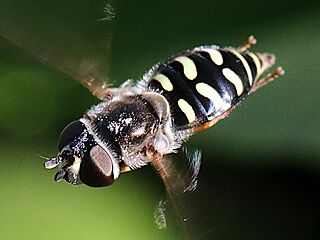
Eupeodes volucris
-
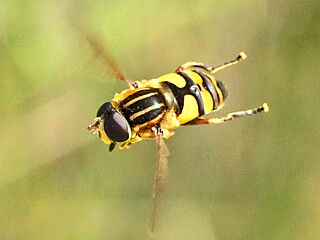
Helophilus fasciatus
-
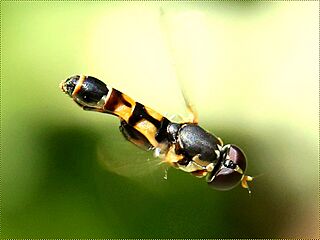
Syritta pipiens


Contents
Discovering Hoverflies: What They Look Like
Hoverflies come in many sizes. Some are tiny, only about 3 to 5 millimeters long. Others are much bigger, growing up to 20 millimeters. Some hoverflies are long and thin. Others are large, hairy, and have bright yellow and black stripes.
Like all true flies, hoverflies have only one pair of working wings. Their back wings are tiny balancing organs. Many hoverflies have bright colors. They often have yellow or brown spots, stripes, and bands. Because of these colors, birds and people often mistake them for wasps or bees. This clever trick is called Batesian mimicry. It helps them avoid being eaten. But remember, hoverflies are completely harmless to humans! For example, drone flies look a lot like honeybees.
Most hoverflies have a special "false vein" in their wings. This helps scientists tell them apart from other flies. Adult hoverflies love to eat nectar and pollen. Many species also hover around flowers. This is how they got their common name.
Some other flies, called bee flies, also look like bees and hover near flowers. It can be tricky to tell them apart! But you can spot hoverflies by a few clues. Their legs and mouthparts are usually not very long or thin. Their faces often have bumps or nose-like shapes. Their wings are usually clear or have soft colors. The veins in their wings create a "false edge" at the back. Also, their bodies often look shiny. Their colors come from their skin, not just their hairs.

Hoverfly Reproduction and Life Cycle
Hoverfly larvae, or maggots, eat many different things. Some larvae are decomposers. They help clean up by eating decaying plants or animals. Other larvae are predators. They eat small insects like aphids and thrips. These pests suck juices from plants.
Predatory hoverfly larvae are very helpful to farmers and gardeners. Aphids can destroy crops. So, hoverfly maggots are often used to control pests naturally. One common hoverfly, Episyrphus balteatus, has larvae that eat aphids.


A famous hoverfly larva is the "rat-tailed maggot." This is the young of the drone fly. It has a long breathing tube at its rear end. This tube looks like a rat's tail! These maggots live in still water, like ponds or even sewage. They can help filter and clean the water. Sometimes, these maggots are even used as bait for ice fishing.
The Ancient History of Hoverflies
The oldest known hoverfly fossils are from a time called the Eocene epoch. These fossils were found in places like the Florissant Formation and Baltic amber. Scientists have also found an even older hoverfly ancestor. This ancient relative, called Prosyrphus, lived during the Late Cretaceous period. It was found in amber from Myanmar. These fossils help us understand how hoverflies have changed over millions of years.
Where Do Hoverflies Live?
Hoverflies live almost everywhere in the world. They are found in most natural areas, called biomes. You won't find them in extreme deserts, very cold places near the North and South Poles, or Antarctica. Some species are more common in certain regions. For example, the American hoverfly, Eupeodes americanus, is often seen in the Nearctic realm. The common hoverfly, Melangyna viridiceps, is found in the Australasian realm. There are about 6,000 different kinds of hoverflies in 200 groups, called genera.
Some hoverfly larvae live in water, often in stagnant water. Other larvae, especially those that eat aphids, live on plant leaves. Adult hoverflies are usually found near flowers. This is because flowers provide their main food: nectar and pollen. Some hoverflies have unique homes. For instance, some Volucella hoverflies live in bumblebee nests. Others, like Microdon species, live in ant or termite nests. You can also find some in decomposing plants.
Hoverflies: Amazing Pollinators
Hoverflies are very important pollinators for many flowering plants. They help plants grow seeds and fruits all over the world. These flies visit many different wild plants and farm crops. They are often considered the second most important group of pollinators, right after wild bees.
Scientists have studied bees more than flies. Bees might carry more pollen on their bodies. But flies can visit many more flowers. This helps them spread just as much pollen.
Some hoverflies visit many different types of plants. They are called "generalists." Others are "specialists" and only visit a few specific plants. Even though many hoverflies are generalists, some are very picky. For example, one type of hoverfly, Cheilosia albitarsis, is thought to only visit buttercup plants.
Hoverflies often prefer white and yellow flowers. But they also use smells to find flowers, especially those that aren't yellow. Many hoverflies have short mouthparts. This means they like open flowers where nectar and pollen are easy to reach.
Some orchids have special ways to attract hoverflies. The Epipactis veratrifolia orchid, for example, smells like aphid alarm signals. This smell attracts hoverflies, which then pollinate the orchid. Another plant, the slipper orchid in southwest China, also uses its bright yellow color to trick hoverflies into pollinating it.

_(3).jpg)
Systematics
How Hoverflies Help Us
Hoverflies are very useful insects! Adult hoverflies are excellent pollinators. They help many plants, including those we eat, produce fruits and seeds.
The larvae of many hoverfly species are natural pest controllers. They eat harmful insects like aphids and leafhoppers. These pests can spread plant diseases. So, hoverflies are a natural way to keep gardens and farms healthy. Gardeners sometimes plant special "companion plants" to attract hoverflies. These plants include Alyssum species, Iberis umbellata, statice, buckwheat, chamomile, parsley, and yarrow. Some chemicals that plants release when attacked by pests can also attract hoverflies. These chemicals can be used to bring hoverflies to farms for pest control.
Some hoverfly larvae, especially those in the Eristalinae group, live in water. They can be found in places like manure and compost. These larvae help filter and clean the water.
People are fascinated by hoverflies! For example, a writer named Fredrik Sjöberg wrote a book about his love for hoverflies. He studied them on an island in the Baltic Sea. This island is a special place for many insects, including hoverflies.

See also
 In Spanish: Sírfidos para niños
