
Lucy (hominid) facts for kids
 |
|
| Catalog no. | AL 288-1 |
|---|---|
| Common name | Lucy |
| Species | Australopithecus afarensis |
| Age | 3.2 million years |
| Place discovered | Hadar, Ethiopia |
| Date discovered | November 24, 1974 |
| Discovered by |
|
Lucy, also known as AL 288-1 or Dinkinesh, is a famous collection of fossilized bones. These bones make up about 40 percent of the skeleton of a female Australopithecus afarensis. This species is an early type of hominin, which means she was an ancient relative of humans. Her name "Dinkinesh" comes from the Amharic language and means "you are marvelous."
Lucy's skeleton was found in 1974 in Ethiopia, at a place called Hadar. Donald Johanson, a scientist who studies ancient humans, led the team that found her. Lucy lived about 3.2 million years ago. Her skeleton shows that she had a small head, much like an ape. But she also walked upright on two legs, similar to how humans walk today. This discovery helped scientists understand that walking upright came before brains grew much larger in human evolution. Some studies from 2016 suggest that Lucy's species might have also spent some time living in trees.
The team named her Lucy after the popular 1967 song "Lucy in the Sky with Diamonds" by the Beatles. They played the song often at their camp after finding her. Lucy quickly became famous around the world. Her story helped many people learn about human origins.
Lucy's story of discovery and how her skeleton was put together was even shared in a book. From 2007 to 2013, her actual fossil bones traveled around the United States for an exhibition called Lucy's Legacy: The Hidden Treasures of Ethiopia. Many museums worried about the fragile bones getting damaged. Because of this, other exhibitions have mostly shown casts, which are copies, of Lucy's skeleton. The original fossils were returned to Ethiopia in 2013.
In 2024, after many more years of research, scientists learned even more about Lucy's species. They found that her species was not the very first member of the human family. Also, they now believe Lucy's species lived in grassy woodlands, not just open grasslands. They adapted to different environments over a very long time. Scientists also know that Lucy was not the only type of early human relative living at that time.
Contents
How Lucy Was Found
Planning the Search
In 1970, a French geologist named Maurice Taieb found the Hadar area in Ethiopia. He realized it was a great place to look for ancient human fossils. Taieb then created a team called the International Afar Research Expedition (IARE). He invited other important scientists to join him. These included Donald Johanson from the United States and Yves Coppens from France. In 1973, their team began searching for signs of early humans around Hadar.
.jpg)
The First Clues
In November 1973, near the end of their first field season, Donald Johanson found a fossilized shinbone. Nearby, he found a thigh bone. When he put them together, the angle of the knee joint showed that this ancient creature walked upright. This fossil, called AL 129-1, was over three million years old. It was much older than other human-like fossils known at that time.
Finding Lucy's Bones
The team returned to Hadar the next year. On November 24, 1974, Johanson and his student Tom Gray went searching near the Awash River. Johanson decided to check a small ditch that others had already looked at. As they were about to leave, Johanson spotted a bone fragment. It was part of an arm bone. Then they saw a piece of a small skull. A few feet away, they found part of a thigh bone.
As they looked more closely, they found many more bones on the slope. These included parts of a pelvis, ribs, and pieces of a jaw. They marked the spot and rushed back to camp, very excited. They believed they had found many bones from a single early human.
That afternoon, the whole team returned to carefully dig up the site. This work took three weeks. That first evening, they celebrated at camp. They named the fossil AL 288-1 "Lucy" because the Beatles' song "Lucy in the Sky with Diamonds" was playing loudly.
Over the next three weeks, the team found hundreds of bone pieces. There were no duplicate bones, meaning they all came from one individual. They recovered an amazing 40 percent of a single skeleton. Johanson believed Lucy was female because of the shape of her pelvic bone.
Putting Lucy Together
Lucy was about 1.1 meters (3 feet 7 inches) tall and weighed around 29 kilograms (64 pounds). After being put back together, she looked a bit like a chimpanzee. She had a small brain, similar to a chimpanzee's. However, her pelvis and leg bones were very much like those of modern humans. This proved that Lucy's species walked upright on two legs.
With permission from Ethiopia, Johanson brought Lucy's bones to the Cleveland Museum of Natural History in Ohio. There, they were carefully put back together by Owen Lovejoy. Lucy became very famous. About nine years later, her skeleton was returned to Ethiopia.
Later Discoveries
More fossils of A. afarensis were found in the years after Lucy. These helped scientists understand more about this species. In 1992, an even older human relative called "Ardi" (Ardipithecus) was found in the same Awash Valley. Ardi lived about 4.4 million years ago, much earlier than Lucy.
How Old is Lucy?
Scientists used special methods to figure out Lucy's age. In the 1970s, they tried to use a method called potassium-argon dating. This method looks at how certain elements in volcanic rocks decay over time. It was hard to use at first because the rocks around Lucy's bones had changed.
Later, in the 1990s, scientists used a more advanced method called argon-argon technology. They found two layers of volcanic ash near Lucy's bones. One layer was about 18 meters below her fossil, and another was just one meter below. By dating these ash layers, scientists determined that Lucy's bones are about 3.18 to 3.22 million years old.
What Lucy Tells Us About Early Humans
Walking Upright
One of the most important things about Lucy's skeleton is her knee joint. It shows that she normally walked upright on two legs. Her thigh bone has features that are both ancient and human-like. Her pelvis also shows that she walked upright. She even had a curve in her lower spine, which is another sign of walking on two legs. Lucy's feet were likely flat, which is normal for her species.
- Mounted skeleton reconstructions
-
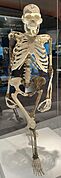
Lucy skeleton reconstruction at the Cleveland Museum of Natural History, front view
-
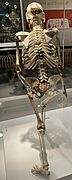
Lucy skeleton reconstruction at the Cleveland Museum of Natural History, rear view


Her Pelvis and Spine
Scientists found Lucy's left hip bone and her sacrum, which is part of the lower spine. The sacrum was very well preserved. The shape of her pelvis showed that she had a wide opening, similar to modern human females. This shape is important for walking upright.
Lucy's sacrum was thought to have five fused bones. However, newer studies suggest it might have only had four. This idea is still being discussed by scientists. Lucy's spine was not complete, but the parts found also support the idea that she walked upright.
Her Skull and Brain
The bones from Lucy's head are more ape-like than human-like. Her braincase was small, holding about 375 to 500 cubic centimeters of brain. This is similar to the size of a chimpanzee's brain. Her canine teeth were also more spatulate (spoon-shaped) than those of other apes.
What She Ate
Australopithecus afarensis likely had a rib cage shaped like a cone. This is similar to modern great apes like chimpanzees and gorillas. This shape allows for a large stomach and long intestines. These are needed to digest a lot of plant material. Eating a plant-based diet requires a lot of energy for digestion. This might have limited how much energy was available for brain development.
What Happened to Lucy?
Scientists have not been able to figure out exactly how Lucy died. Her wisdom teeth were fully grown and slightly worn. This means she was a mature but still young adult when she passed away.
In 2016, some researchers suggested that Lucy might have died from falling out of a tall tree. However, other scientists, including Donald Johanson, disagreed with this idea.
Where Can You See Lucy?
The original Lucy skeleton is kept safe at the National Museum of Ethiopia in Addis Ababa. Instead of the real bones, a plaster copy is shown to the public there. You can also see a cast of Lucy's skeleton at the Cleveland Museum of Natural History. The American Museum of Natural History in New York City has a display showing Lucy's species and other early human relatives. The Field Museum in Chicago also displays a cast and a reconstruction of Lucy.
Lucy's Journey Around the World
From 2007 to 2013, Lucy's actual fossil bones went on a six-year tour in the United States. The exhibition was called Lucy's Legacy: The Hidden Treasures of Ethiopia. It also included over 100 other ancient artifacts. The Houston Museum of Natural Science organized this tour. Part of the money earned from the tour helped to improve museums in Ethiopia.
Some experts were worried that the fragile fossils might get damaged during the tour. Because of these concerns, some museums chose not to host the exhibition. However, Donald Johanson believed the tour would help more people learn about human origins.
During the tour, in September 2008, Lucy's skeleton was taken to the University of Texas at Austin. There, scientists used special CT scans to get detailed images of the fossils.
Lucy was also shown at the Discovery Times Square Exposition in New York City in 2009. She was also exhibited in Mexico at the Mexico Museum of Anthropology before returning to Ethiopia in May 2013.
In August 2025, Lucy and another hominid fossil named Selam were transported to the Czech Republic. They were part of a two-month exhibition at the Czech National Museum in Prague.
See also
 In Spanish: Lucy para niños
- Ardi – a more complete skeleton of an even earlier human relative
- Dawn of Humanity – a 2015 documentary about human origins
- "Walking with Cavemen" – a 2003 documentary from the BBC
- List of human evolution fossils
- Prehistoric Autopsy – a 2012 documentary from the BBC
- Selam (Australopithecus) – a young female A. afarensis fossil from Ethiopia
- Lucy (spacecraft) – a NASA mission launched in 2021 to study asteroids
