
Timeline of human evolution facts for kids

This article tells the amazing story of how humans, called Homo sapiens, came to be. It's a journey through billions of years of life on Earth, showing the big steps that led to us. We'll explore how tiny, simple life forms slowly changed and grew into the complex animals we are today. This timeline follows the main ideas scientists have about how living things are related, like a giant family tree.
How Scientists Classify Living Things
Scientists organize all living things into groups, like a big family tree. This helps us understand how different species are related. Here are some of the main groups that lead to humans:
- Kingdom: Animals – We belong to the animal kingdom, which includes all creatures that move around and eat other organisms.
- Phylum: Chordates – This group includes animals with a notochord (a flexible rod supporting the body), like fish, birds, and mammals.
- Class: Mammals – Mammals are warm-blooded animals with hair or fur. Females produce milk to feed their babies.
- Order: Primates – Primates include monkeys, apes, and humans. They often have grasping hands and feet, and good eyesight.
- Family: Great Apes – This family includes humans, chimpanzees, gorillas, and orangutans.
- Genus: Homo – This group includes modern humans and our closest ancient relatives.
- Species: Homo sapiens – This is our species name, meaning "wise human."
Timeline
Orange labels: known ice ages.
Also see: Human timeline and Nature timeline
The Start of Life: Tiny Cells
Life on Earth began a very, very long time ago.
- Around 4.3 to 4.1 billion years ago, the first simple forms of life appeared. These were like tiny bags of chemicals that could copy themselves.
- About 4 to 3.8 billion years ago, Prokaryotic cells developed. These were simple cells without a nucleus, like bacteria. They used DNA to store their genetic information.
- By 3.5 billion years ago, cyanobacteria emerged. These amazing cells could make their own food using sunlight, a process called photosynthesis. This also released oxygen into the air for the first time!
- Between 2.5 and 2.2 billion years ago, some organisms learned to use this new oxygen. This led to a big change on Earth, as many older life forms that couldn't handle oxygen died out.
- Around 2.2 to 1.8 billion years ago, eukaryotic cells appeared. These were more complex cells with a nucleus and other specialized parts inside. This was a huge step in life's evolution.
- About 1.2 billion years ago, sexual reproduction began. This allowed living things to mix their genes, leading to faster changes and more variety in life.
- Between 1.2 and 0.8 billion years ago, the ancestors of animals started to develop. They began forming cell colonies, which was a step towards becoming multicellular.
The Rise of Animals
- Around 800 to 650 million years ago, the first animals started to appear. Some of the earliest fossils look like ancient sponges. These early animals were multicellular, meaning they were made of many cells working together.

- Between 650 and 600 million years ago, animals developed bilateral symmetry. This means they had a left and right side, like us! They also started to develop a head and a through-gut.

- From 600 to 540 million years ago, during a time called the Cambrian explosion, many new types of animals suddenly appeared in the oceans. This was a period of rapid evolution. Our ancestors in this time were called deuterostomes, which included early forms of starfish and acorn worms. They had pharyngeal slits, which were openings in their throat used for filter feeding.

Our Fishy Ancestors: Chordates
- About 540 to 520 million years ago, the first chordates evolved. These animals had a notochord (a flexible rod down their back), a tail, and gill slits. One famous early chordate was Pikaia.

- Between 520 and 480 million years ago, the first vertebrates appeared. These were jawless fish, like modern lampreys. They had a backbone made of cartilage and a simple brain. They also developed eyes and inner ears.

- From 460 to 430 million years ago, jawed fish evolved. Their jaws came from modified gill arches, allowing them to bite and become active hunters. They also developed bones and paired fins.

- Around 430 to 410 million years ago, bony fish appeared. They had strong bones, and some developed early lungs to help them breathe in shallow water. This group split into ray-finned fish and lobe-finned fish, which are important for our story.

Stepping Onto Land: Tetrapods
- Around 390 million years ago, some lobe-finned fish living in shallow, swampy waters started to develop stronger fins that could act like limbs. These "fishapods" were the ancestors of all tetrapods (animals with four limbs). Panderichthys is an example of such a fish.

- Between 375 and 350 million years ago, animals like Tiktaalik, Acanthostega, and Ichthyostega showed more features for life on land. They had limbs with digits (fingers and toes), but they still spent most of their time in water. They had both lungs and gills. Their bodies became stronger to support themselves out of water.


- About 350 to 330 million years ago, the first true amphibians appeared. They had five digits on their limbs and could live on land, but they still needed water to lay their eggs and for their young to develop. They developed tongues and three-chambered hearts.

- From 330 to 300 million years ago, the first amniotes evolved. These were like early reptiles, such as Hylonomus. The big breakthrough was the amniotic egg, which had a shell and could be laid on dry land. This meant these animals no longer needed to return to water to reproduce, allowing them to explore new environments. They also developed claws and a tougher skin.

The Age of Mammals
- Around 300 to 260 million years ago, two main branches of amniotes split off. One led to reptiles and birds, and the other led to synapsids, our ancestors. Synapsids, sometimes called "proto-mammals," started to show features like larger jaw muscles and a more upright posture.
- Between 260 and 230 million years ago, a group of synapsids called cynodonts became more mammal-like. They likely became warm-blooded and developed more complex lungs. Their jaws started to look like modern mammal jaws, and their teeth became specialized for different tasks.

- From 230 to 170 million years ago, the first true mammals appeared. These were small, shrew-like creatures, often active at night. They developed hair for warmth and milk glands to feed their young. Their brains also became more complex, with a new part called the neocortex. They had specialized teeth and a strong diaphragm for breathing.

- Around 170 to 120 million years ago, live birth evolved in most mammals. Early mammals like marsupials gave birth to undeveloped young that continued to grow in a pouch. Later, placental mammals evolved, where babies develop longer inside the mother's uterus with a placenta.

- About 100 to 90 million years ago, the common ancestor of many modern mammals, including rodents, rabbits, hoofed animals, carnivores, bats, and humans, lived.
Our Primate Relatives
- Between 90 and 66 million years ago, a group of small, tree-dwelling, insect-eating mammals called euarchonts began to evolve into primates, tree shrews, and flying lemurs. Early primates, like Plesiadapis, started spending more time in trees, eating fruits and leaves. They began to develop grasping digits (fingers and toes) instead of claws.


- From 66 to 56 million years ago, primates split into two main groups: wet-nosed primates (like lemurs) and dry-nosed primates (like tarsiers, monkeys, and apes). Their brains grew larger, and their eyes moved to the front of their heads, giving them better depth perception for life in the trees. They also developed nails instead of claws on most digits.
- Around 50 to 35 million years ago, simians (monkeys and apes) further split into New World monkeys (with prehensile tails) and Old World monkeys and apes. Our ancestors were part of the Old World group, which stayed in Africa. They developed color vision like ours.

- Between 35 and 20 million years ago, the Old World monkeys and apes separated. Early apes, like Proconsul, had a mix of monkey and ape features. They lacked tails and had slightly larger brains. Proconsul africanus is thought to be an ancestor of both great and lesser apes.

The Great Apes and Our Direct Ancestors
- From 20 to 15 million years ago, the great ape ancestors separated from the ancestors of lesser apes. They started to have smaller snouts.
- Between 16 and 12 million years ago, the ancestors of humans, chimpanzees, and gorillas separated from the ancestors of orangutans. Pierolapithecus catalaunicus is an important fossil from this time, showing adaptations for tree climbing similar to modern great apes.
- Around 12 million years ago, Danuvius guggenmosi lived. This ape could both hang in trees and walk on two legs, a unique way of moving that might have been shared by the last common ancestor of humans and other apes.
- From 12 to 8 million years ago, the group that includes humans and chimpanzees split from the ancestors of gorillas.
- Between 8 and 6 million years ago, the last common ancestor of humans and chimpanzees lived. This was a crucial time when our lineage, called hominins, began to separate. Early hominins like Sahelanthropus tchadensis and Orrorin tugenensis appeared.

- Ardipithecus, living about 5.6 to 4.4 million years ago, was an early hominin. It had a small brain, similar to a chimpanzee's. Ardipithecus likely lived in forests and could walk on two legs, though its feet were still good for grasping branches.

The Journey to Homo
- From 4 to 3.5 million years ago, Australopithecus afarensis lived. Famous for "Lucy", this species left human-like footprints, showing they walked upright all the time. They had smaller brains than us but were a key step in our evolution. They likely ate a varied diet, including scavenged meat.
- Between 3.5 and 3.0 million years ago, Kenyanthropus platyops, a possible ancestor of our genus Homo, emerged. Around this time, early stone tools were being made.
- About 3 million years ago, the australopithecines were common in African savannas. Around 3 to 2 million years ago, our ancestors started to lose most of their body hair, possibly as they became fully bipedal and their brains began to grow.
Our Own Genus: Homo
- From 2.8 to 2.0 million years ago, the first members of our genus, Homo, appeared in East Africa. This period marks the beginning of the Lower Paleolithic (Old Stone Age), defined by the use of stone tools. Homo habilis is one of the earliest species in our genus.
- Between 1.9 and 0.8 million years ago, Homo erectus evolved. This species was the first to develop control of fire and was also the first to migrate out of Africa, spreading across Eurasia. They were social and became skilled hunters. Their brains also started to expand.

- From 0.8 to 0.3 million years ago, the ancestors of Neanderthals and Denisovans diverged from our lineage. Homo heidelbergensis is a species from this time, and some scientists believe it was an ancestor to both Neanderthals and modern humans. Human brains continued to grow during this period, possibly due to changing environments and the need for more complex social lives.
Modern Humans: Homo sapiens
- Further information: Homo sapiens, Neanderthal, Interbreeding between archaic and modern humans, Recent human evolution, and Human genetic variation
- Between 300,000 and 130,000 years ago, the earliest evidence of anatomically modern Homo sapiens appeared in Africa. Fossils found in Morocco date back about 300,000 years.
- From 130,000 to 80,000 years ago, modern humans were present in Southern and West Africa.
- Between 80,000 and 50,000 years ago, modern humans began to migrate out of Africa, spreading across the world. During this time, there was some mixing between modern humans and other ancient human groups like Neanderthals and Denisovans.
- From 50,000 to 25,000 years ago, human behavior became more complex, with the development of art and advanced tools. During this period, other human species like Homo floresiensis and Neanderthals became extinct.
- After 25,000 years ago, humans continued to spread across the globe, including the Americas. As the climate changed and humans developed agriculture (the Neolithic Revolution), our bodies and genes continued to adapt to new diets and environments, such as the evolution of light skin in some populations and lactase persistence (the ability to digest milk).
Images for kids
-

Reconstruction of early Homo sapiens from Jebel Irhoud, Morocco c. 315 000 years BP
-
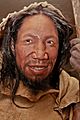
Reconstruction of Oase 2 (c. 40 ka)
-

Reconstruction of a Neolithic farmer from Europe, Science Museum in Trento
.jpg)
.jpg)

See also
- Evolution of human intelligence
- Human evolution
- Recent human evolution
- List of human evolution fossils
- Human history
- Natural history
- History of Earth
- Timeline of prehistory
- Timeline of the evolutionary history of life
- Chronology of the universe
- List of timelines
