
Mass in the Catholic Church facts for kids

The Mass is the main worship service of the Catholic Church. During this special gathering, Catholics come together to pray, listen to readings from the Bible, and celebrate the Eucharist. An ordained priest leads the service at an altar. In the Catholic faith, bread and wine are consecrated during the prayer. Catholics believe these gifts truly become the body and blood of Christ.
The Catholic Church calls the Mass the source and summit of Christian life. It helps believers remember the Last Supper that Jesus shared with his followers. Many major life celebrations happen inside a Mass, such as confirmation and holy matrimony. Other sacraments, including holy orders for new priests, also take place during Mass.
The word Mass comes from the Latin word Ite, missa est, which means "Go, you are sent." In the ancient Latin language, the word meant dismissal, but over time it came to mean a special mission. Today, Catholics around the world attend Mass every weekend to celebrate their faith together.
Contents
- What Is the Meaning of the Holy Mass?
- How the Mass Began and Changed Over History
- Books and Tools Used at the Altar
- The Four Main Parts of the Mass
- When Is Mass Celebrated?
- Images for kids
- See also
What Is the Meaning of the Holy Mass?
Catholics believe that the Mass is both a sacred meal and a holy sacrifice. It connects believers to Jesus and his loving self-offering on the cross at Calvary.
The Sacred Meal and Sacrifice
In Catholic belief, the Mass is an unbloody sacrifice. It recalls the sacrifice Jesus made long ago, bringing God's gifts of grace to the world. Through these blessings, the soul of each person is spiritually fed and helped.
The service connects the events of the Last Supper with the cross. It is celebrated to praise God, give thanks, ask for help, and seek forgiveness. Catholics believe Jesus is present in the priest, in the gathered people, in the Bible readings, and especially in the bread and wine.
Receiving the Holy Eucharist
To receive the Eucharist, a person must be a baptized Catholic who has made their first communion. Church rules teach that one must be in a state of grace, meaning they are free from serious misdeeds called mortal sin. Anyone who needs forgiveness can receive the sacrament of reconciliation from a priest first. Catholics believe receiving the host unites them closely with Jesus and with everyone else in the Church.
How the Mass Began and Changed Over History
The way Catholics worship has developed over thousands of years, starting with small gatherings in early Christian homes.

Early Christian Gatherings
Historians like Josef Andreas Jungmann have studied how the Mass grew from the earliest Christian meals. Early writers such as Justin Martyr, Ignatius of Antioch, and the Roman writer Pliny the Younger described these early services. Christians met on Sundays, listened to sacred writings, and shared bread and wine just as Jesus taught. Over time, these simple community meals separated from regular suppers to become dedicated worship services.
The Roman Empire and New Traditions
In the fourth century, the Roman Empire stopped persecuting Christians and allowed them to worship freely. Worship moved out of private houses and into grand stone basilicas. Ceremonies began to include beautiful vestments, candles, and sweet-smelling incense. Great church centers called an episcopal see developed their own customs and styles of prayer.
Different parts of the world created different ways of celebrating. While the Latin liturgical rites spread across Europe, other areas developed rich styles like the Byzantine Rite based on the Greek language. Other traditions include the Alexandrian Rite used by the Coptic Catholic Church, the Antiochene Rite used by the Maronite Church, the East Syriac Rite of the Chaldean Catholic Church, and the Armenian Rite used by the Armenian Catholic Church.
The Council of Trent and the Latin Mass
In the Middle Ages, King Charlemagne helped spread Roman worship patterns across Europe, where they picked up details from the Gallican Rite. Famous travelers and missionaries like Saint Boniface and Saint Augustine of Canterbury brought Roman prayers to places like Germany and England.
Later, church leaders met at the famous Council of Trent in the 1500s. In 1570, Pope Pius V printed a standard prayer book called the Roman Missal. This standard service, celebrated entirely in Latin, became known as the Tridentine Mass. It kept worship identical across countries for nearly four hundred years.
Modern Changes and the Second Vatican Council
During the 1960s, church leaders gathered for the Second Vatican Council. They wanted church members to participate more easily in the prayers and songs. Pope Paul VI introduced an updated version of the Mass in 1969, which allowed the service to be spoken in the local vernacular language of the people. This modern form became known as the Ordinary Form and was further revised by Pope John Paul II.
Later, Pope Benedict XVI wrote a letter called Summorum Pontificum that allowed greater use of the older 1962 Latin service, calling it the Extraordinary Form. More recently, Pope Francis issued Traditionis custodes, establishing that the modern books are the main standard for Catholic worship worldwide.
Books and Tools Used at the Altar
A Catholic priest uses several special books and sacred objects during the celebration of Mass.


Special Books for Prayer and Readings
The Roman Missal contains all the prayers, responses, and directions for the priest throughout the year. The directions printed inside the book are called rubrics, which tell the priest when to stand, sit, or raise his hands.
The readings from scripture are collected in a large book called the Lectionary. When reading the stories of Jesus, the Church often uses a decorated Gospel Book, also called an Evangeliary. When a bishop visits to celebrate Mass, helpers follow instructions found in the Ceremonial of Bishops. The Church even provides a special guide called the "Directory for Masses with Children" to help young people understand the liturgy.
Sacred Vessels on the Altar Table
The priest prepares several important items on the altar table before the prayers begin:
- The corporal, a square white linen cloth placed in the center of the altar.
- The paten, a shallow gold or silver plate that holds the sacramental bread.
- The chalice, a special cup used to hold the wine mixed with drops of water.
- A thurible, a metal container on chains used to burn fragrant incense during special parts of the service.
- A processional cross, carried high on a pole by an altar server called a crucifer.
The Four Main Parts of the Mass
The Mass is one single act of worship, but it is divided into four main sections that follow a clear order.
1. Introductory Rites: Gathering Together
The service begins as the community gathers to become one family in prayer.

The Procession and Greeting
The Mass starts with an entrance procession down the center aisle, called the nave. Altar servers carry candles and the cross, while a deacon or priest carries the holy book. The people sing a hymn, or recite an entrance antiphon.
When the ministers reach the sanctuary, they bow, and the priest kisses the altar to show reverence. The priest leads everyone in making the Sign of the Cross, saying, "In the name of the Father, and of the Son, and of the Holy Spirit." The congregation responds with "Amen," and the priest welcomes everyone using greetings taken from the Pauline epistles.
Asking for Mercy and Singing Praise
Next comes the Penitential Act, where the congregation quietly asks God for help and forgiveness. The people often pray the Confiteor, admitting their faults and asking Mary and the saints to pray for them. On some Sundays, the priest may bless the people with holy water using a rite called the Asperges.
After this, the people sing or recite the Kyrie, Eleison, an ancient Greek phrase meaning "Lord, have mercy." On joyful days and Sundays, everyone joins in singing the Gloria in Excelsis, an ancient hymn praising God. The Gloria is left out during quiet times like Advent and Lent, or at a funeral requiem Mass. Finally, the priest says the collect, a special opening prayer that gathers all the prayers of the people together.
2. Liturgy of the Word: Listening to God
During this part of the Mass, the faithful sit quietly to listen to stories and teachings from the Bible.

Readings from Scripture
On Sundays, there are usually three scripture readings:
- The first reading comes from the Old Testament, or from the Acts of the Apostles during the season of Eastertide.
- Next, a cantor or choir leads the singing of a Responsorial Psalm from the Book of Psalms.
- The second reading comes from the New Testament, usually from letters written by Saint Paul.
The Holy Gospel and the Homily
The most important reading is the Gospel, which tells about the words, miracles, and life of Jesus Christ. Everyone stands up out of respect, singing an joyful Alleluia. The priest or deacon announces the reading, and the people respond by making small signs of the cross on their forehead, lips, and chest.
After reading the Gospel, the priest kisses the sacred page and gives a talk called a homily or sermon. This speech explains what the readings mean and helps people live good lives during the coming week.
Stating the Faith and Praying for Others
After the sermon, the whole congregation stands to recite the Nicene Creed or the shorter Apostles' Creed. This prayer lists the central truths that Catholics believe about God, Jesus, and the Church. The Liturgy of the Word ends with the Universal Prayer, where the parish prays for world leaders, the sick, and people in need.
3. Liturgy of the Eucharist: The Sacred Meal
This is the heart of the Mass, where the gifts are brought forward, blessed, and shared.

Presenting the Gifts
Members of the parish carry bread and wine down the aisle to the altar. The priest takes the gifts, holds them up, and blesses God for providing them. He washes his hands at the side of the altar as a sign that he wants a pure heart. He then invites the people to stand and pray that the gifts will be pleasing to God.
The Great Eucharistic Prayer
The Eucharistic Prayer begins with a dialogue where the priest says, "Lift up your hearts," and the people reply, "We lift them up to the Lord." Everyone then sings the joyful Sanctus: "Holy, Holy, Holy Lord God of hosts." In many countries, such as the United States, people kneel down after this song.
The priest then speaks the Words of Institution, recalling what Jesus did at the Last Supper. As the priest repeats these words, Catholics believe the bread and wine become the actual body and blood of Christ, a change known as Transubstantiation. The priest lifts the host and chalice high so the congregation can see them, while altar servers may ring bells.

The priest also says the Epiclesis, asking the Holy Spirit to come down upon the gifts, and the Anamnesis, remembering Jesus' death and resurrection. He includes prayers for the Church, the Pope, and the souls resting in Purgatory. The prayer ends with a grand praise called a doxology, and everyone answers with an enthusiastic chant called the Great Amen.
The Communion Rite
To prepare to receive the sacrament, the church family recites the Lord's Prayer together. The priest expands the final line with a prayer called an embolism, asking for safety from distress. During these prayers, the priest extends his arms outward in an ancient prayer style called the orans posture.
Next, the people share the Sign of Peace, turning to shake hands or bow to people nearby. The priest breaks the host over the chalice in an action called the fraction, while the congregation sings the Lamb of God or Agnus Dei.
Holding up the host, the priest invites everyone to come forward. People line up reverently to receive communion, answering "Amen" when the minister says "The Body of Christ." Communion may be placed in the hand or on the tongue. Afterward, the priest cleans the sacred cups and says the final Prayer after Communion.
4. Concluding Rites: Going Forth on a Mission
The end of the Mass sends the people out to love and serve others.

The priest shares any brief announcements about parish events and activities. He raises his hand over the congregation to give God's final blessing. The deacon or priest then dismisses the faithful, saying phrases like "Go in peace, glorifying the Lord by your life." The people respond together, "Thanks be to God."
The priest and servers kiss the altar, join the procession, and exit while everyone sings a final recessional hymn. Some parishes may also sing a Marian antiphon in honor of Mary. People often stop to light small votive candles or speak quietly with friends outside the church doors.
When Is Mass Celebrated?
Catholics are expected to attend Mass every Sunday, as well as on special holy days called a Holy Day of Obligation.
Days and Times of Worship
Since the 1960s, Catholics can fulfill their Sunday obligation by attending Mass on Saturday evening. Priests are encouraged to celebrate Mass every day, but there are strict rules about how many times they may do so. Usually, a priest celebrates only one Mass per day, but bishops can allow them to celebrate two or three times if many people need to attend.
There are special exceptions throughout the year:
- On Christmas Day, priests have the privilege of celebrating three separate Masses: at midnight, at dawn, and during the daytime.
- On All Souls' Day, priests may also celebrate three Masses to pray for all people who have died.
- During the solemn Paschal Triduum, no regular Mass is celebrated on Good Friday.
- On Holy Saturday, the Church waits until after sundown to celebrate the grand Easter Vigil.
Special Occasions and Intentions
The Church offers special services called Ritual Masses for milestones in life. These include a Nuptial Mass for a couple celebrating matrimony, or Masses for Baptism and Anointing of the Sick. People can also ask a priest to offer a Mass for a specific need, such as for a sick family member or in memory of someone who died, often giving a small gift called a Mass stipend to support the church.
Images for kids
-

A person receiving Holy Communion reverently from a minister.
-
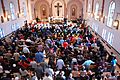
Parishioners holding hands in prayer during the Lord's Prayer in Oklahoma City.


See also
 In Spanish: Misa para niños
