
Mexican Border War facts for kids
Quick facts for kids Mexican Border War |
|||||||
|---|---|---|---|---|---|---|---|
| Part of the U.S. intervention in the Mexican Revolution, Banana Wars, and World War I | |||||||
_(14579944767).jpg) Mexico-US border marker in 1898 |
|||||||
|
|||||||
| Belligerents | |||||||
 Germany Germany |
 United States United States |
||||||
| Commanders and leaders | |||||||
 Álvaro Obregón Venustiano Carranza Pancho Villa Felipe Ángeles Aniceto Pizana Luis de la Rosca Álvaro Obregón Venustiano Carranza Pancho Villa Felipe Ángeles Aniceto Pizana Luis de la Rosca |
 Herbert J. Slocum John J. Pershing Frank Tompkins Frederick J. Herman Herbert J. Slocum John J. Pershing Frank Tompkins Frederick J. Herman |
||||||
| Casualties and losses | |||||||
| 867 soldiers, militia, and insurgents killed 400+ civilians killed |
123 soldiers killed Unknown number of Texas rangers killed |
||||||
The Mexican Border War, also known as the Border Campaign, was a series of military clashes. These conflicts happened between the United States Army and different groups in Mexico. They took place along the Mexican–American border during the Mexican Revolution.
The Mexican Revolution began in 1910. From that time, the U.S. Army was stationed along the border. They sometimes fought with Mexican rebels or federal troops. A major event happened in 1916. Revolutionary leader Pancho Villa attacked the American town of Columbus, New Mexico.
In response, the U.S. Army, led by General John J. Pershing, went into northern Mexico. Their goal was to find and capture Villa. They did not capture Villa, but they fought his rebels. Villa's top two leaders were killed. The American army returned to the U.S. in January 1917.
Fighting continued along the border. The U.S. launched smaller operations into Mexico. This lasted until the American victory in the Battle of Ambos Nogales in August 1918. This battle led to a permanent border wall being built. The conflict involved not only Villa's forces and Americans. Other Mexican groups and even Germans also fought with U.S. forces. The Bandit War in Texas was also part of this larger conflict.
The German Empire was a major trading partner with Mexico. Germany was also a rival of the United States. In 1914, the U.S. occupied Veracruz. This was to stop Germany from sending ammunition to Mexico at the start of World War I. In 1917, the British government found a secret German message. It offered Mexico money to help get back lands lost to the U.S. (like Texas). In return, Germany wanted Mexico's support if the U.S. joined the war in Europe. Mexico did not accept the offer. However, a small German military presence was seen in later border battles.
Contents
- Timeline: Key Events of the Border War
- 1910: Revolution Begins
- 1911: Early Clashes and Madero's Rise
- 1912: Border Security and New Rebellions
- 1913: Shifting Alliances and Fort Building
- 1914: U.S. Intervention and Long Sieges
- 1915: Raids and Villa's Setbacks
- 1916: Villa's Attack on Columbus and Pershing's Pursuit
- 1917: U.S. Withdrawal and the Zimmermann Telegram
- 1918: German Presence and Final Major Battle
- 1919: End of the Conflict
- Understanding the Borderlands
- The U.S. Occupation of Veracruz
- The Mexican Revolution: A Brief Overview
- Images for kids
- See Also
Timeline: Key Events of the Border War
1910: Revolution Begins
- Revolutionary activity started in Mexico.
- The U.S. Army moved to border towns. They aimed to protect American citizens and property. They also wanted to keep fighting on the Mexican side.
- Francisco Madero called for Mexicans to rise against President Porfirio Díaz. This call was made from San Antonio, Texas.
- Madero planned an attack on Ciudad Porfirio Diaz. He canceled it due to lack of support.
1911: Early Clashes and Madero's Rise
- Madero returned to Mexico on February 14.
- Rebels called Magonistas captured Mexicali and Tijuana in Baja California.
- The Mexican government fought back. The rebels surrendered to the U.S. Army.
- Madero led troops at the Battle of Casas Grandes in Chihuahua. His forces later controlled the area.
- Rebels bombed Mexican Army barracks in Ciudad Juárez. A large explosion was seen from El Paso, Texas.
- Maderista rebels fought federal troops at Agua Prieta, Sonora. U.S. troops in Douglas, Arizona, intervened.
- Madero's rebels, including Pancho Villa, fought at the Battle of Ciudad Juarez. U.S. soldiers in El Paso, Texas, exchanged fire with rebels.
- Porfirio Díaz was exiled. Francisco Madero became President of Mexico. He tried to end the fighting.
- However, fighting soon broke out between different rebel groups.
1912: Border Security and New Rebellions
- The U.S. Army continued to guard American border towns.
- El Paso, Texas, greatly reduced gun and ammunition exports to Mexico. This was due to increased security.
- This made it harder for rebels like Pascual Orozco to get supplies.
- General Pascual Orozco rebelled against President Madero in Chihuahua. Madero's army defeated Orozco.
- Pancho Villa also rebelled against Madero's government.
- The U.S. supported President Madero. This helped prevent Orozco's rebellion from growing.
- Mexican federal forces built Fort Tijuana to protect the border.
1913: Shifting Alliances and Fort Building
- Nogales, Sonora, was attacked by General Obregón's army.
- Federal forces surrendered to the U.S. Army in Nogales, Arizona.
- The Battle of Naco was fought. Obregón's rebels defeated federal troops. U.S. troops watched from across the border.
- American troops built Fort Naco in Arizona. This was one of 12 forts built along the border for protection.
- General John Pershing and Pancho Villa met at Fort Bliss, Texas. They met again in 1914.
1914: U.S. Intervention and Long Sieges
- The Tampico Affair caused problems between Mexico and the U.S.
- President Woodrow Wilson asked Congress to approve an invasion of Mexico.
- The U.S. Navy occupied the city of Veracruz. This followed a battle with Mexican defenders.
- The longest battle of the Mexican Revolution happened at Naco, Sonora. Pancho Villa's troops attacked General Obregón's forces.
- The siege lasted 119 days. Villa was defeated.
- U.S. Army Buffalo Soldiers in Naco, Arizona, were wounded by rebel gunfire. They showed great discipline by not returning fire.
- Pancho Villa and Emiliano Zapata briefly captured Mexico City. They were later forced to retreat.
1915: Raids and Villa's Setbacks
- A plan called the Plan de San Diego was discovered. It aimed for raids and rebellion in U.S. border states.
- Some raids did occur in Texas.
- Pancho Villa attacked General Obregón's forces at Nogales, Sonora. Villa was defeated due to lack of supplies.
- During the siege, Villa's rebels attacked U.S. soldiers in Nogales, Arizona. One American and several rebels were killed.
- Villa's forces fought again at Agua Prieta in November. Villa blamed his defeat on U.S. searchlights.
- This defeat led to another loss at the Battle of Hermosillo. Villa's forces looted the city instead of fighting.
1916: Villa's Attack on Columbus and Pershing's Pursuit
- In January, an attack near Santa Isabel, Chihuahua, occurred. Rebels stopped a train and killed American passengers.
- On March 9, Pancho Villa raided Columbus, New Mexico, for supplies.
- Villa's cavalrymen were defeated by U.S. infantry and cavalry. Columbus was damaged. Many rebels and some Americans died.
- President Wilson ordered General John J. Pershing to go into Mexico. His mission was to capture or kill Pancho Villa. This started the Pancho Villa Expedition.
- On May 5, Villa's rebels attacked Glenn Springs, Texas, and Boquillas, Texas. They sought supplies.
- U.S. soldiers resisted at Glenn Springs. Three U.S. troops and one American boy were killed.
- At Boquillas, Americans captured a rebel leader.
- American forces rescued two captives taken by the raiders.
- In May, President Wilson sent the National Guard to the border. About 117,000 guardsmen were stationed there.
- On April 12, U.S. forces and Carrancistas fought the Battle of Parral in Chihuahua.
- U.S. troops were attacked while leaving Parral. Many Mexicans and two Americans died. This was the deepest U.S. penetration into Mexico.
- In June, U.S. Buffalo Soldiers were defeated at the Battle of Carrizal. Mexican troops attacked them. Many on both sides were killed or wounded.
- Raids on U.S. border towns continued.
- Future General George S. Patton led an early armored vehicle assault. Three Mexicans were killed, including a rebel general.
1917: U.S. Withdrawal and the Zimmermann Telegram
- President Wilson ordered General Pershing to leave Mexico. The expedition ended.
- By January, most U.S. troops were back on border duty.
- Germany began sinking merchant ships. They worried the U.S. would join World War I.
- The Zimmermann Telegram was found by the British. Germany asked Mexico to join the war against the U.S.
- Germany promised to help Mexico regain lands lost to the U.S. Mexico did not accept.
1918: German Presence and Final Major Battle
- U.S. Army Intelligence found German military presence in Sonora. They prepared for possible conflict.
- Revolutionary Yaqui Native Americans had a weapons base in Arizona.
- U.S. Army troops attacked the Yaqui base. One Yaqui was killed, and nine were captured.
- In August, Lieutenant Colonel Frederick J. Herman learned of a possible attack on Nogales, Arizona. Mexican soldiers and German advisers were involved.
- On August 27, a dispute at the border escalated into the Battle of Ambos Nogales.
- Reinforcements arrived from both sides. U.S. soldiers attacked Mexican positions.
- Mexican troops and their German advisers were defeated. Many Mexicans, two Germans, and seven Americans died.
- German military activity in Sonora stopped after this battle. It was the last major battle of the Border War.
1919: End of the Conflict
- American and Mexican forces fought near El Paso, Texas, on June 16. This was the Battle of Ciudad Juárez.
- In this unique conflict, the Mexican and American armies joined forces. They fought against Pancho Villa's rebels.
- This was the second-largest battle involving the U.S. in the Mexican Revolution. It is seen as the last battle of the Border War.
- The Treaty of Versailles was signed on June 28. This treaty officially ended World War I. It established peace and war reparations.
Understanding the Borderlands
The 1910s saw increased tensions and conflicts between different groups in Texas. There were many instances of violence. This included actions by local law enforcement and citizen groups. This period of unrest was especially high from 1915 to 1919. It was partly in response to the Plan de San Diego, a plan for rebellion. This situation led to strong feelings against Mexican-Americans. Many lives were lost during these conflicts. Property was also destroyed.
The U.S. Occupation of Veracruz
The United States occupation of Veracruz happened from April 21 to November 23, 1914. This occurred during a time of difficult relations between Mexico and the United States. It was connected to the ongoing Mexican Revolution. Tensions grew after the Tampico Affair on April 9, 1914. Nine American sailors were briefly held after landing in a restricted area.
Another event was the "Ypiranga incident." The U.S. learned that a German ship, the SS Ypiranga, was bringing weapons to the Mexican government. This went against a U.S. ban on arms shipments to Mexico. Because of this, the U.S. military took control of the port. This began with the Battle of Veracruz and lasted for seven months.
The Mexican Revolution: A Brief Overview
The Mexican Border Wars happened during the Mexican Revolution. This was a period of major change and conflict in Mexico. It started in 1910 and lasted through the 1920s. Francisco I. Madero challenged Porfirio Díaz, who had been president for a long time. Díaz's rule had caused economic problems for many citizens.
Madero lost an unfair election. This led to uprisings across Mexico. Díaz lost control and was overthrown in 1911. After Madero became president, he faced challenges from other powerful leaders. These included Bernardo Reyes and Victoriano Huerta. They believed Madero was not leading correctly. They ended his leadership in 1913.
This led to more conflicts among regional leaders for the next seven years. In 1914, leaders like Venustiano Carranza and Pancho Villa overthrew Huerta's government. By 1917, Carranza created the Constitution of Mexico. He also promoted land reform in Mexico and strengthened the federal government.
Images for kids
-
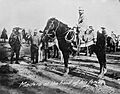
Mexican statesman and revolutionary Francisco Madero with his troops in 1910
-
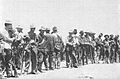
American Magonistas after the First Battle of Tijuana in 1911
-
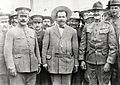
Front row, L-R: Mexican Generals Álvaro Obregón and Pancho Villa with American General John J. Pershing. Second row, far right: Pershing aide Lt. (future General) George S. Patton. At Fort Bliss, Texas, 1913.
-
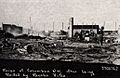
Columbus, New Mexico, after Pancho Villa's attack on the border town
-
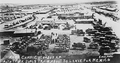
The expanded United States Army fort at Columbus, New Mexico, a staging area for the Pancho Villa Expedition
-
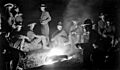
American troops of the 16th Infantry rest for the night on May 27, 1916
-
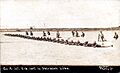
American infantry in a skirmish line near Deming, New Mexico, in 1916
-
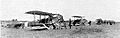
The 1st Aero Squadron in 1916, deployed during the expedition
-
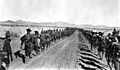
United States Army troops returning to the U.S. in January 1917
-
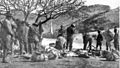
Yaqui prisoners and 10th Cavalry troops on January 9, 1918, after the skirmish in Bear Valley, Arizona
_crop.jpg)


See Also
 In Spanish: Guerra fronteriza para niños
- Bandit War
- Border War (disambiguation)
- List of border wars
- La Matanza (1910–1920)
- Mexican–American War
- Mexican Revolution
- Pancho Villa Expedition
- Roosevelt Reservation
- United States involvement in the Mexican Revolution
- World War I
- List of United States invasions of Latin American countries
