
Midas free-tailed bat facts for kids
Quick facts for kids Midas Free-Tailed Bat |
|
|---|---|
 |
|
| Conservation status | |
Scientific classification  |
|
| Kingdom: | Animalia |
| Phylum: | Chordata |
| Class: | Mammalia |
| Order: | Chiroptera |
| Family: | Molossidae |
| Genus: | Mops |
| Species: |
M. midas
|
| Binomial name | |
| Mops midas (Sundevall, 1843)
|
|
| Script error: The function "autoWithCaption" does not exist. | |

Script error: No such module "Check for conflicting parameters".
The Midas free-tailed bat (Mops midas) is a special kind of bat. Scientists group it with other bats in the Chiroptera order and the Molossidae family. These bats live in many places, from western Africa all the way to Saudi Arabia and even further south. You can find them in dry savannas, moist savannas, woodlands, and hot deserts. Some Midas free-tailed bats also live near big rivers or swamps.
Contents
Meet the Midas Free-Tailed Bat
The Midas free-tailed bat has wide ears. These ears are connected by a furry membrane that goes across its forehead. Its fur is dark brown with small white spots. The fur on the front part of its body is lighter. This bat has less hair on its neck, thighs, and legs. The Midas free-tailed bat is heavier than other bats in its family. This is because it has bigger feet, thumbs, and tail.
Where Do Midas Bats Live?
The Midas free-tailed bat lives in many countries across Africa and the Middle East. You can find them in Benin, Botswana, Burkina Faso, Burundi, Central African Republic, Chad, Democratic Republic of the Congo, Eritrea, Ethiopia, Gambia, Ghana, Kenya, Madagascar, Malawi, Mali, Mozambique, Namibia, Niger, Nigeria, Rwanda, Saudi Arabia, Senegal, South Africa, Sudan, Tanzania, Togo, Uganda, Zambia, and Zimbabwe.
How Midas Bats Behave
Midas free-tailed bats are nocturnal, which means they are active at night. They like to rest in places that are completely dark. People have seen these bats resting in trees, under bridges, and even inside houses.
- Social Life: These bats are very social. They often live in groups that can range from just two bats to hundreds. Female bats usually outnumber males by a lot, sometimes four females for every one male.
- Noisy Neighbors: Bat groups can be quite noisy. They push and shove each other to get the best spots. If humans get too close, they can become aggressive and might even bite.
- Night Flights: At sunset, groups of up to 20 bats leave their resting spots to find insects to eat. They return together when the sun rises.
- Foraging Journeys: Their flights can be short, less than 10 minutes, or long, over 50 minutes. They have been known to fly up to 10 kilometers (about 6 miles) from their roost to find food.
- Flying Style: Midas bats are not very agile flyers. They prefer to fly in open spaces, often as high as 40 meters (about 130 feet) in the air.
Midas Bats in Madagascar
Midas free-tailed bats are common across Africa and the Middle East. They also live on the island of Madagascar. Scientists have given different names to the bats from these two areas. African Midas bats are called M. m. midas, and those from Madagascar are called M. m. miarensis.
- Similarities and Differences: For a long time, it was hard to tell if they were different species because they look very much alike. However, there are some small differences. African male bats have longer limbs, while Malagasy males have slightly wider skulls and teeth.
- Color Phases: African Midas bats can be either dark or reddish in color. But the bats from Madagascar are always dark.
- Genetic Clues: After studying their genes, scientists found that the two groups are very similar genetically. The differences they do have might be due to different climates or diets in their habitats.
Midas Bat Reproduction
Female Midas free-tailed bats become pregnant between December and January. They usually give birth to one baby bat between February and March. At birth, a baby Midas bat can weigh up to 10 grams.
Images for kids
-
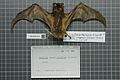
A Midas free-tailed bat specimen.
