
Aardvark facts for kids
Quick facts for kids Aardvark |
|
|---|---|
 |
|
| In the Bushveld, Limpopo | |
.jpg) |
|
| At Royal Burgers' Zoo, Arnhem, Netherlands | |
| Conservation status | |
Scientific classification  |
|
| Kingdom: | Animalia |
| Phylum: | Chordata |
| Class: | Mammalia |
| Order: | Tubulidentata |
| Family: | Orycteropodidae |
| Genus: | Orycteropus |
| Species: |
O. afer
|
| Binomial name | |
| Orycteropus afer (Pallas, 1766)
|
|
| Subspecies | |
|
See text |
|
 |
|
| Range | |
| Script error: The function "autoWithCaption" does not exist. | |

Script error: No such module "Check for conflicting parameters".
The aardvark (Orycteropus afer) is a unique mammal from Africa. It's known for its strong digging skills and for being active mostly at night. Aardvarks are the only living members of their special group of animals. They are related to other interesting animals like elephants, manatees, and hyraxes.
These amazing animals live in many parts of southern and central Africa. They prefer areas with soft soil for digging, like savannas and grasslands. Aardvarks mainly eat ants and termites. They use their powerful claws to dig into insect nests and their long snouts to sniff out food. They also dig burrows where they live and raise their young.
Contents
Discovering the Aardvark's Name and Family Tree
What's in a Name?
The aardvark is sometimes called the "African ant bear" or "Cape anteater." But don't confuse it with the South American anteaters!
The name "aardvark" comes from the Afrikaans language. It means 'earth pig' or 'ground pig.' This name fits perfectly because of how much they love to dig in the earth.
The scientific name Orycteropus means 'burrowing foot.' The word afer simply means 'from Africa.' Their order name, Tubulidentata, describes their unique teeth, which are shaped like tiny tubes.
Aardvark's Unique Family
The aardvark is not closely related to pigs, even though it looks a bit like one. It's the only living animal in its special group called Tubulidentata. This makes the aardvark very unique in the animal kingdom.
Despite looking similar to South American anteaters, they are not close relatives. Their similarities are due to something called convergent evolution. This means different animals can develop similar traits if they live in similar environments and eat similar foods.
The aardvark's closest living relatives are actually elephant shrews, tenrecs, and golden moles. Along with elephants and hyraxes, these animals belong to a larger group called Afrotheria. Scientists have found that aardvarks have been around for a very long time, with fossils dating back millions of years.
A Closer Look: What an Aardvark Looks Like
Aardvarks look a bit like a pig with a long snout and big ears. Their bodies are strong and covered with coarse, thin hairs. Their backs are often arched.
Their legs are of medium length, with the back legs being a bit longer. Their front feet have four toes, and their back feet have five. Each toe has a large, strong nail that looks like a shovel. These nails are perfect for digging!
Aardvarks typically weigh between 60 and 80 kilograms (132 to 176 pounds). They are usually between 105 and 130 centimeters (3.4 to 4.3 feet) long. Their tail can add another 70 centimeters (2.3 feet) to their total length. They stand about 60 centimeters (2 feet) tall at the shoulder. Males and females look very similar.
Their skin is tough, which helps protect them. Their fur is pale yellowish-grey and often looks reddish-brown from the soil.
-
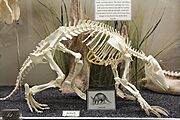
Skeleton
-
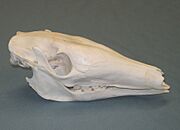
Skull
-
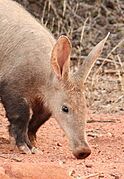
Front feet
-
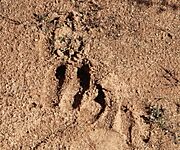
Footprint
-
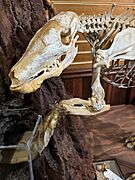
Strong forelimb


.jpg)

Aardvark's Amazing Head
The aardvark has a long head on a short, thick neck. Its snout ends in a disc that holds its nostrils. This snout is very flexible and can move a lot.
One of the most special things about aardvarks is their teeth. Unlike most mammals, their teeth don't have an outer layer of enamel. Instead, each tooth is made of many thin, tube-like structures. These teeth wear down but keep growing throughout their lives. Baby aardvarks have front teeth, but adults only have peg-like cheek teeth at the back of their jaws.
The aardvark's nose is incredible. It has a very strong sense of smell, which helps it find food in the dark. Its long, thin, snake-like tongue can reach up to 30 centimeters (12 inches) long. This sticky tongue is perfect for catching ants and termites.
Their ears are also very long, about 20 to 25 centimeters (8 to 10 inches). They are excellent at hearing, which helps them detect predators. Their eyes are small and mostly help them see in low light.
Inside the Aardvark's Body
The aardvark's stomach has a strong, muscular area that grinds up its food. This means they don't need to chew their food much. They have large salivary glands around their neck that produce sticky saliva. This saliva makes their tongue sticky, helping them catch insects.
Female aardvarks have two pairs of teats for nursing their young. Aardvarks are considered "living fossils" because their genes are very similar to those of their ancient ancestors. This means their bodies haven't changed much over millions of years.
Where Aardvarks Live: Habitat and Range
Aardvarks live in sub-Saharan Africa, which is the part of Africa south of the Sahara Desert. They can be found in places like savannas, grasslands, and woodlands. These areas provide the right kind of soil for digging and plenty of ants and termites to eat.
They spend the hot daylight hours sleeping in their cool, dark burrows. Aardvarks avoid places with too much rock, as it makes digging difficult. They also stay away from swampy forests where the ground is too wet for deep burrows. They have been seen at high altitudes, like 3,200 meters (10,500 feet) in Ethiopia. You won't find them in Madagascar.
Aardvark Life: Ecology and Behaviour
Aardvarks can live for up to 23 years in zoos. Their excellent hearing helps them stay safe from predators. These include fierce animals like lions, leopards, cheetahs, African wild dogs, spotted hyenas, and large Southern African rock pythons. Some humans also hunt aardvarks for their meat.
If an aardvark feels threatened, it can dig very fast to escape. It can also run in a zig-zag pattern to confuse enemies. If cornered, it will use its sharp claws, tail, and shoulders to fight back. They can even flip onto their backs and kick with all four feet!
-
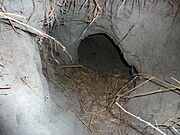
Entrance to a burrow
-
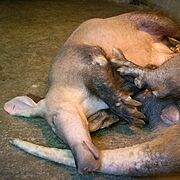
Resting
-
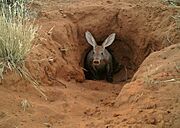
Emerging from a burrow


What Aardvarks Eat: Feeding Habits
Aardvarks are nocturnal, meaning they are active at night. They are solitary animals, living alone. Their diet consists almost entirely of ants and termites. In some areas, they prefer certain types of ants and termites. They usually avoid eating aggressive driver ants and red ants. Because they rely on such specific food, they need a large area to find enough to eat.
The only fruit aardvarks eat is the aardvark cucumber. This is a special relationship! The aardvark eats the fruit, then spreads the seeds near its burrows. The loose soil and rich nutrients in these areas help the cucumber plants grow quickly. The fruit also gives the aardvark much-needed moisture.
An aardvark leaves its burrow in the late afternoon or after sunset. It then searches for food over a large area, sometimes covering 10 to 30 kilometers (6 to 19 miles). As it hunts, it keeps its nose to the ground and ears forward, using its amazing sense of smell and hearing. They often zig-zag as they forage and usually wait several days before visiting the same termite nest again. This gives the insects time to recover.
When an aardvark finds a group of ants or termites, it digs into the nest with its powerful front legs. It keeps its long ears upright to listen for any danger. Then, it uses its long, sticky tongue to lick up an incredible number of insects—sometimes as many as 50,000 in one night! Its tough skin protects it from bites and stings. After an aardvark has visited a termite mound, other animals often come to eat the leftovers.
Aardvarks are most active during the first few hours of the night, usually between 8:00 p.m. and midnight. If the weather is bad or they are disturbed, they will quickly retreat to their burrows.
Aardvark Sounds: Vocalisation
Aardvarks are generally quiet animals. They make soft grunting sounds while looking for food. If they are heading into their burrow, they might make louder grunts. If an aardvark gets scared, it makes a bleating sound. When threatened, it will quickly try to reach a burrow. If no burrow is nearby, it can dig a new, short one very fast.
How Aardvarks Move and Live in Burrows
Aardvarks are good swimmers and can handle strong currents. They can dig a meter (yard) of tunnel in about five minutes! However, they usually move quite slowly. When leaving their burrow at night, they pause at the entrance for about ten minutes, sniffing and listening for danger. After this careful check, they dash out a short distance, then pause again to listen before starting to forage.
Besides digging for food, aardvarks also dig burrows to live in. These burrows can be temporary shelters or permanent homes. Temporary burrows are used as quick hiding spots. Main burrows are deeper and more extensive, with several entrances, and can be as long as 13 meters (43 feet). These large burrows are also used for raising young.
Aardvarks regularly change their main burrow's layout or move to a new one. Their old, empty burrows are very important for other African wildlife. Many animals, like African wild dogs, warthogs, hares, mongooses, hyenas, owls, pythons, and lizards, use these abandoned burrows for shelter. Without these safe spots, many animals would struggle, especially during wildfires.
Only mothers and their young share burrows. If an aardvark is attacked inside its tunnel, it might dig a new escape route, putting fresh soil between itself and the predator. Or, it might roll onto its back and fight with its claws. Aardvarks have even been known to sleep in recently dug ant nests for extra protection.
Aardvark Life Cycle and Reproduction
Aardvarks usually find a partner only during the breeding season. During this time, male and female aardvarks come together. Males do not help raise the young.
After about seven months, a single cub is born, usually between May and July. The cub weighs around 1.7 to 1.9 kilograms (3.7 to 4.2 pounds) at birth. Newborns have soft, wrinkled skin and floppy ears.
After two weeks, their skin smooths out, and their ears can stand upright after three weeks. Body hair starts to grow when they are about 5 to 6 weeks old. Aardvark cubs can leave the burrow with their mother after only two weeks. They start eating termites at nine weeks and are fully weaned (stop drinking milk) between three and four months old. By six months, they can dig their own burrows, but they often stay with their mother until the next breeding season. Aardvarks become adults and can have their own young at about two years of age.
Protecting Aardvarks: Conservation Efforts
For a while, people thought aardvark numbers were decreasing. However, this might be because they are hard to spot since they are nocturnal and secretive. There aren't exact counts, but their overall numbers seem stable. They are not common everywhere in Africa, but their wide range helps them maintain enough numbers. There might be a slight decrease in some parts of eastern, northern, and western Africa, but numbers in Southern Africa are not declining.
The IUCN (International Union for Conservation of Nature) lists the aardvark as a species of "least concern." This means they are not currently in great danger. However, they depend heavily on ants and termites for food. If there's a problem with the number of these insects, the aardvark population could be seriously affected.
Recent studies suggest that aardvarks might be sensitive to changes in temperature caused by climate change. Droughts, for example, reduce the amount of termites and ants available. If there isn't enough food, nocturnal animals might become more active during the day to save energy, but this exposes them to high daytime temperatures. A study in the Kalahari Desert showed that many aardvarks died after a drought.
Aardvarks can adapt well to living in zoos. The first aardvark in a zoo was at the London Zoo in 1869.
See also
 In Spanish: Cerdo hormiguero para niños
