
Pillars of Creation facts for kids

.jpg)
The Pillars of Creation is one of the most famous photographs ever taken in astronomy. Captured on April 1, 1995, by the Hubble Space Telescope, it shows massive towers of interstellar gas and cosmic dust. These structures sit inside the Eagle Nebula, also cataloged as Messier 16, in the constellation of Serpens. This cosmic nursery is located around 6,500–7,000 light-years (2,000–2,100 pc) away from Earth.
The photograph became an instant global sensation. It appeared on posters, t-shirts, album covers, and postage stamps. Astronomers Jeff Hester and Paul Scowen from Arizona State University assembled the original view. They used light filters tuned to the chemical glow of hydrogen, sulfur, and oxygen. These towering columns are real astronomical features known as elephant trunks. They act as cosmic incubators where brand-new stars are born from cold gas clouds.
Contents
The Meaning Behind the Name Pillars of Creation
Where Did the Title Come From?
The name Pillars of Creation refers directly to what happens inside the clouds. Deep within these dusty structures, new baby stars are condensing and lighting up for the first time. The phrase also borrows from historical literature. In 1857, a well-known London speaker named Charles Spurgeon used the phrase to describe the physical foundation of the natural world.
When NASA scientists revealed the 1995 photograph, they chose this poetic name to match its grand appearance. The columns resemble majestic stone pillars found in ancient ruins. Yet, unlike stone monuments, these pillars are active engines of cosmic construction.
Why Are the Pillars So Culturally Famous?
Before Hubble took this picture, most people thought of deep space as flat and empty. The Pillars of Creation showed the universe as a dramatic, three-dimensional landscape. It gave the public a clear look at how solar systems begin.
- The image reached classrooms all around the globe.
- Major magazines like National Geographic celebrated its anniversaries.
- Websites like Space.com consistently rank it among the greatest achievements of the Hubble Space Telescope.
Cosmic Architecture and Physical Structure

How Large Are the Gas Columns?
The scale of the Pillars of Creation is gigantic compared to our own solar neighborhood. The tallest column on the left stands roughly four to five light-years tall from base to tip. That single pillar is longer than the distance between our Sun and Alpha Centauri, the closest star system to us.
The tiny bumps, ridges, and finger-like shapes at the edges of the pillars are also massive. Many of these small shapes are actually wider than our entire Solar System. Even our Sun and all eight planets could easily fit inside one of those small protrusions.
What Are the Pillars Made Of?
The pillars are composed primarily of cold molecular hydrogen gas mixed with microscopic specks of rocky dust. This dark dust acts like a blanket, blocking the visible light from stars behind it.
- Cold molecular hydrogen gas forms the main bulk of the cloud.
- Microscopic silicate and carbon dust grains make the clouds opaque and dark.
- Trace amounts of helium, carbon, nitrogen, and oxygen are scattered throughout.
- The internal temperature inside the dense pockets is extremely cold, often dropping below -200 degrees Celsius.
How Do Star Incubators (EGGs) Form Stars?
At the edges of the columns, astronomers noticed dense, compact blobs of gas. Scientists call these structures evaporating gaseous globules, or EGGs.
EGGs act like protective cocoons. When gravity pulls enough cold gas together inside an EGG, the core becomes dense and hot. Eventually, nuclear fusion begins, and a new star is born.
Once a new star ignites, its intense light burns away the remaining gas cocoon. The newborn star then emerges into open space.
The Tug-of-War: Creation Versus Destruction
What Is Photoevaporation?
While the pillars are creating stars, they are also being destroyed. Nearby, in the center of the Eagle Nebula, sits a cluster of huge, hot, newborn O-type and B-type stars. These young giants blast out extreme amounts of ultraviolet (UV) radiation.
This powerful UV radiation heats the outer edges of the gas pillars. When the gas gets hot, it boils away into the vacuum of space in a process called photoevaporation. In Hubble images, this effect looks like a bright haze or ghostly steam rising from the tops of the pillars.
How Long Will the Pillars Survive?
Because of stellar winds and photoevaporation, the pillars lose mass every year. Astronomers estimate that the entire structure will erode away in roughly 100,000 to 3 million years.
This creates a race against time:
- Gravity tries to pull the cold gas inward to create more stars.
- Stellar winds and UV light push the gas outward and blow it away.
- Only the densest gas knots survive long enough to build solar systems.
The Supernova Shockwave Debate
In 2007, data from the Spitzer Space Telescope showed a warm cloud of dust near the pillars. Some scientists suggested this warm dust was a shock wave from an exploded star, known as a supernova.
If a supernova had exploded nearby 6,000 years ago, its blast wave might have already shattered the real pillars. Because the pillars are 7,000 light-years away, light takes 7,000 years to reach Earth. Under that theory, we would not see the destruction for another 1,000 years.
However, newer observations from other telescopes, including the Chandra X-ray Observatory, showed that winds from massive stars likely heated the dust instead. Most astronomers now believe the pillars are facing a slower, gradual erosion rather than a sudden destruction from a supernova.
Telescopes and Imaging Technologies
How the 1995 Hubble Image Was Created
The 1995 image was not taken with a standard color camera. It was assembled using 32 separate exposures from four detectors on the Wide Field and Planetary Camera 2 (WFPC2).
To show the chemistry of the nebula, astronomers assigned specific colors to narrow wavelengths of light:
- Green represents light emitted by hydrogen atoms.
- Red represents light emitted by singly-ionized sulfur ions.
- Blue represents light emitted by double-ionized oxygen atoms.
This color mapping is now known throughout science as the Hubble Palette.
Why Did the Original Photo Have a Stair-Step Shape?
Many people wonder why the top-right corner of the 1995 photograph looks like a notch or staircase.
WFPC2 used four separate camera sensors arranged in a grid. Three of the cameras provided wide views of space, while the fourth camera had high magnification to see tiny details. When scientists shrank the magnified image to fit next to the other three, it left an empty black space in that corner.
The 2014 Hubble High-Definition Remake
In 2014, astronomers pointed Hubble back at the Eagle Nebula to celebrate the telescope's upcoming 25th anniversary. They used a modern instrument installed by astronauts in 2009 called the Wide Field Camera 3 (WFC3).
The 2014 photograph showed:
- Much higher image sharpness and color contrast.
- A wider field of view showing the base of the columns.
- A companion image captured in infrared light, revealing hidden stars inside the clouds.
The old WFPC2 camera was returned to Earth during Space Shuttle mission STS-125. It is now preserved at the National Air and Space Museum in Washington, D.C.
The James Webb Space Telescope Views (2022)
In October 2022, the James Webb Space Telescope (JWST) turned its advanced infrared instruments toward the Pillars of Creation. Infrared light can pass straight through thick cosmic dust, allowing JWST to peer directly inside the pillars.
JWST captured two major perspectives:
- NIRCam (Near-Infrared Camera): Showed thousands of brand-new stars glowing like bright red rubies. These red dots show baby stars with active jets blasting into space.
- MIRI (Mid-Infrared Instrument): Highlighted the cool, dusty structures themselves, showing where dust is thickest and where future stars might form.
In June 2024, NASA released a detailed 3D visualization using combined data from both Hubble and JWST. This model allowed students and scientists to take a virtual flight through the towering columns.
-
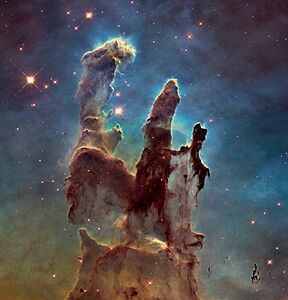
A higher-resolution Hubble Space Telescope image of the Pillars of Creation, taken in 2014 as a tribute to the original photograph.
-
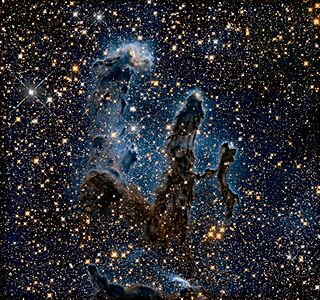
Infrared image taken by the Hubble Space Telescope in 2014, showing stars through the dust.
-
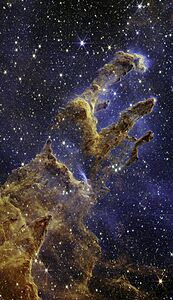
Near-infrared image taken by the James Webb Space Telescope in 2022.
-
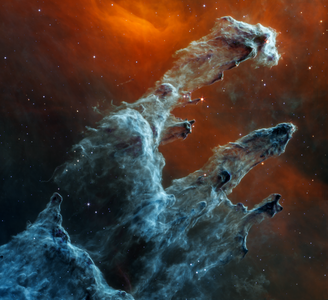
JWST mid-infrared view of the Pillars of Creation, highlighting the cooler dust layers.


.jpg)

Summary of Scientific Discoveries
The ongoing study of the Pillars of Creation has taught scientists valuable lessons about our universe:
- Astronomers learned how cold gas collapses under gravity to ignite new stars.
- Scientists observed how intense ultraviolet light shapes and destroys nebulas over millions of years.
- By combining visible, X-ray, and infrared images, researchers can see every stage of stellar birth.
- Studying these columns helps us understand how our own Sun and planets formed inside a similar dusty nebula about 4.6 billion years ago.
See Also
- Eagle Nebula
- Hubble Space Telescope
- James Webb Space Telescope
- Nebula
- Star formation
- List of photographs considered the most important
