
Red Range, New South Wales facts for kids
Quick facts for kids Red RangeNew South Wales |
|
|---|---|

Red Range, NSW
|
|

 Red Range
Location in New South Wales
|
|
| Population | 187 (2016 census) |
| Established | 1854 |
| Postcode(s) | 2370 |
| Elevation | 1,160 m (3,806 ft) |
| Location | 23 km (14 mi) SE of Glen Innes |
| LGA(s) | Glen Innes Severn |
| Region | Northern Tablelands |
| County | Gough County |
Red Range is a small village in the Northern Tablelands area of New South Wales, Australia. It's part of the Glen Innes Severn Shire.
A Look Back: Red Range's Story
How Red Range Began
Red Range started in 1854. A few years earlier, George Kempton and his wife Harriet came to Australia from England. In 1854, George chose land he called "Rocky Valley" near the Mann River. Later, he picked another spot called "Splitters Home," which became the village of Red Range.
Soon, the village grew. It had a church, some houses, a general store, and a school. The area was surrounded by peppermint bushes. A small building next to the shop, once a barn, was built around this time. It was made of vertical wooden slabs, typical for buildings back then.
Early Schools in Red Range
The first school in Red Range opened in 1879. A new wooden school building was built in 1886. The school building used today opened around 1996. The old building was moved and turned into a house. Water tanks from the old school are still used at the local store.
Mining History in Red Range
In the late 1800s, the Kingsgate Mines started operating nearby. There were over 60 different mining spots. These mines first dug for bismuth. Around 1900, they became Australia's main source of molybdenum. During World War 2, the mines also provided small amounts of quartz for making radios.
The First General Store
Opening the First Shop
In 1897, Miss Rainbow opened the first general store in Red Range. It was in a part of the building that is now the main shop. The shop, built in the early 1900s, is an extension of the original house. Inside, the walls are covered with special pressed steel in a fleur-de-lis pattern.
The original shop had dark wooden shelves. The counter was covered with linoleum. Old newspapers found under the counter showed it was re-covered in 1926. Coins from 1921 were also found. People used to travel far to shop here because of the great variety of goods. They even said, "If you can buy it in Australia, you can buy it in Red Range!"
Re-opening the Store
In 1992, the store re-opened as a second-hand shop. This was done by Dr. Lionel D. C. Hartley. He also started restoring a nearby cottage called "The Mews." This cottage then became a temporary Red Range Store, selling general goods and groceries.
In 1993, work began to restore the old shop-front. They used descriptions from local people to make it look like it used to. The shop originally had a narrow iron verandah. This was replaced around 1918 with a bull-nosed front. The restoration brought back the earlier design.
The wood used for the restoration was all from Red Range. The weather-boards came from a house next door. The verandah posts were from the original store. The roof timbers were old rafters from the Red Range Butter Factory. The restoration was finished in 1994. In 2004, The Red Range Store was sold, but it still trades online today.
Village Improvements
Electricity and Telephones
Around 1910, the shop switched from kerosene lamps to gas lights. Electricity came to the village in the mid-1950s. There was a big "Switching-on" party on April Fool's Day, 1955. Two of the oldest residents, Mrs Ryall and Mr George Morley, turned on the power.
Soon, the village had power poles and wires for electricity and telephone. However, in 1995, underground cables and an automatic telephone exchange were installed. This meant most of the old telephone poles were removed.
The School of Arts
The School of Arts building next to the store was made bigger in the 1920s. This was to show new magic lantern and movie shows. It had a reading room, a library, and a kitchen. The kitchen was a popular spot for children during events.
The School of Arts also had a post-office in one corner. This room is now a public library. Before that, the Post Office was in a building further down Victoria Street. Today, postal services come from Glen Innes.
Carl Tronier, a Danish cartwright, was the caretaker of the School of Arts. He had a shed where he fixed sulkies and buggies. He also upholstered and painted vehicles.
Sports and Recreation
Sports have always been important in Red Range. A popular event is the annual Red Range Carriage Riding Event. The recreation ground hosts an annual sports day and a camp draft.
Older residents remember facilities for cricket, tennis, rugby union football, horse sports, racing, and even a rifle range. Cricket teams played against nearby towns. The annual School Picnic was held on Empire Day (May 24th), which was Queen Victoria's birthday.
The Red Range market ground, behind the store, was approved in 1994. The first market was held there on October 10th that year. Two years before, the first council-approved carols-by-candlelight event took place there on Christmas Eve, 1992.
The Butter Factory and Bakery
Near the market ground are the remains of the Red Range butter factory. This factory used to export butter to Britain. It got milk from almost 100 local dairies when it was busy.
In 1919, Mr William (Bill) Whan built the first bakery in Red Range. A baker named Mr Wyld worked there. Bill Whan delivered bread to the village and surrounding areas using a horse cart. He delivered to the bismuth and molybdenite mines at Kingsgate and the tin mines at Skeleton Creek. The bakery closed in the late 1970s.
The Village Church
The old village church was one of the first buildings in Red Range. Residents remember it had beautiful cedar pews made locally by Mr Waimsley. The church was used by Anglican, Methodist, and Presbyterian ministers. In the early days, they often arrived by sulky or on horseback. Parts of the old church are now at the Retreat House at the Kingsgate Mines.
Images for kids
-
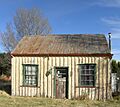
Cottage, Red Range, NSW
-
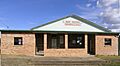
Red Range Memorial Hall
.JPG)
.JPG)
