
Sport facts for kids


Sport is a fun activity that involves physical movement and often friendly competition. It helps you stay fit and improve your skills. Whether you play alone or with a big team, sports can be very enjoyable for those who play and those who watch. From running races to team games like football, sports bring people together.
Sports competitions can be for individuals or teams. Some are open to everyone, while others are for specific groups. Sometimes games end in a tie, but often there are rules to find a single winner. Many sports have tournaments or leagues that crown a champion each year after a season of games.
Most people think of sports as activities that use your body, like running or swimming. But some organizations, like the International Olympic Committee, also recognize "mind sports" such as chess. These activities focus on mental skill rather than physical strength. All sports have rules to make sure everyone competes fairly. Winning can be simple, like scoring the most points, or it can involve judges who score your performance, like in gymnastics.
Records are often kept for sports, and big achievements are shared in sports news. Sports are also a huge source of entertainment. Many people love to watch games live or on TV. This makes sports a big industry around the world. In 2013, the global sports industry was worth about $620 billion. Running is one of the easiest sports to do, and association football (soccer) is the most watched sport worldwide.
Contents
- Understanding Sport: What It Means
- A Look Back: The History of Sport
- Playing Fair: Sportsmanship and Rules
- Who Plays Sports? Everyone!
- Amateur vs. Professional Sports
- How Technology Helps in Sports
- Sports and Learning
- Sports and Politics
- Sports and Religion
- What Kinds of Sports Are There?
- Related Topics
- Images for kids
- See also
Understanding Sport: What It Means
Where the Word "Sport" Comes From
The word "sport" comes from an old French word, desport, which meant "leisure" or "amusement." Around the year 1300, it was first used in English to describe anything people found fun or entertaining.
How We Define Sport Today


It can be tricky to decide exactly what counts as a sport. The Global Association of International Sports Federations (GAISF) helps set some guidelines. They say a sport should:
- Involve some kind of competition.
- Not harm any living creature.
- Not depend on special equipment from only one company.
- Not rely too much on pure luck.
GAISF also recognizes that sports can be physical (like rugby or track and field), mental (like chess or Go), motorized (like Formula 1 racing), or involve coordination (like snooker). Some sports even involve animals, like horse riding.
The Role of Competition in Sports

Most professional sports involve competition, where players or teams try to win. Organizations like the International Olympic Committee usually require competition for an activity to be recognized as a sport.
However, some people believe that any physical activity done for fun or fitness should be called a sport. For example, the Council of Europe says sport includes all physical activities that help you stay fit, feel good, make friends, or compete. This means even just exercising for fun can be seen as sport.
In competitive events, participants are often grouped by things like age, weight, or gender to make it fair. Winners can be decided by clear measurements, like how fast someone runs. Or, judges might score performances based on skill and artistry, like in gymnastics.
A Look Back: The History of Sport
.jpg)
.jpg)
People have enjoyed sports for thousands of years! In ancient China, around 2000 BC, gymnastics was popular. Ancient Egyptians enjoyed swimming, fishing, javelin throwing, and wrestling. In ancient Persia, sports like polo and jousting were connected to military skills. Traditional Indian games like Kho kho and Kabbadi have also been played for a very long time.

The Ancient Greeks loved sports, and their military culture influenced how sports developed. They even created the Olympic Games, held every four years in a village called Olympia.
Over time, sports became more organized with clear rules. With new inventions like cars and more free time, people started watching and playing sports even more. Mass media like TV and the internet made sports popular worldwide. Many athletes became professionals, earning money for playing, which made sports even more exciting for fans.
Playing Fair: Sportsmanship and Rules
What is Sportsmanship?
Sportsmanship is all about playing fairly and showing respect. It means being polite to your teammates and opponents, acting with honesty, and being graceful whether you win or lose.
Good sportsmanship reminds us that the fun of playing is often more important than just winning. As the Olympic founder Pierre de Coubertin said, "The most important thing in the Olympic Games is not to win but to take part."
Why Cheating is Not Okay
A key idea in sports is that everyone should have an equal chance to win. Rules are made to ensure fair play. However, sometimes players try to break these rules to get an unfair advantage.
Cheating goes against the spirit of sport. It can happen when someone tries to win dishonestly. Sports organizations work hard to prevent cheating and keep competitions fair for everyone.
Who Plays Sports? Everyone!
Girls and Women in Sports
_and_the_other_Runners_-_ISTAF_2006_-_Berlin,_3_September.jpg)
More and more girls and women are participating in sports. This is great because sports help with child development and physical fitness. At the Olympic Games, women made up 49% of athletes at Tokyo 2020 and reached full 50% equality at Paris 2024. However, worldwide, fewer women than men participate in sports regularly.
Some sports, like Baseball5, are mixed-sex, meaning men and women play on the same team.
Kids and Teenagers in Sports

Sports offer many benefits for young people. They provide opportunities for fun, making friends, staying fit, and even earning athletic scholarships for college. Playing sports can also help kids learn important life skills.
While sports are great, it's important to be aware of risks like injuries, including concussions. Popular youth sports like running, basketball, and football have these risks. Youth sports in the US is a big industry, worth about $15 billion, covering everything from equipment to coaching.
Sports for People with Disabilities
Disabled sports, also called adaptive sports, are played by people with physical or intellectual disabilities. Many of these sports are based on existing ones but are changed to fit the needs of the players. For example, wheelchair basketball is an adapted sport. Some sports, like goalball and boccia, were created especially for people with disabilities. The Paralympic Games are a major international event for disabled athletes.
Sports for Older Adults

Masters sport or senior sport is for athletes aged 35 and older. These sports can be regular activities or adapted ones, with or without competitions.
Some major events for older athletes include:
- World Masters Games, held every four years since 1985.
- European Masters Games, held every four years since 2008.
- Senior Olympics (Senior Games) in the US.
Watching Sports: Spectator Involvement

Many people love to watch sports! Both amateur and professional games attract huge audiences. People watch in person at stadiums or at home through TV and online streaming. Sometimes you need to buy tickets or subscriptions to watch.
Big sports events draw massive crowds and generate a lot of money from broadcasting rights. For example, the 2006 FIFA World Cup final had over 700 million viewers worldwide. The Super Bowl in the US is one of the most-watched TV broadcasts each year, with Super Bowl XLIX in 2015 averaging 114 million viewers.
Amateur vs. Professional Sports
.jpg)
Sport can be played for fun (amateur) or as a job (professional). Amateur sports, especially at local levels, are often called "grassroots sport."
Because so many people love watching sports, it has become a huge business. This has led to a culture of professional sport, where top athletes can earn millions of dollars.
The Olympic Games originally only allowed amateur athletes. However, since 1986, most professional athletes have been allowed to compete in the Olympics, with a few exceptions like boxing for a time.
How Technology Helps in Sports

Technology is a big part of modern sports. For some sports, like motorsport, it's essential. In others, it helps athletes perform better or helps officials make fair decisions.
Sports science uses technology to improve athlete performance, like analyzing video to perfect a technique. Sports engineering focuses on better equipment, such as advanced running shoes or swimwear. To keep things fair, sports organizations often have rules about what technology can be used. For example, in 2010, certain full-body swimsuits were banned in swimming because they gave swimmers an unfair advantage.
Technology also helps officials make decisions. In many sports, officials can review plays using instant replays. In association football, goal-line technology helps decide if a ball has crossed the goal line. In American football, coaches can challenge calls, and a referee reviews the play. Cricket and tennis also use systems like Hawk-Eye to help umpires make accurate decisions.
Sports and Learning
Sports can help young people connect with positive adult role models and offer great opportunities for growth. They also teach important life skills. In recent years, sports have been used to help reduce crime and give participants a sense of purpose and belonging.
Sports science is a recognized academic discipline where you can study how sports work. In the UK, for example, you can get qualifications like a BTEC National Diploma in Sports Coaching and Development.
Sports and Politics
Sometimes, sports and politics mix. Some leaders in the past, like Benito Mussolini and Adolf Hitler, used major sports events to promote their political ideas. They wanted to show off their countries and their beliefs to the world.
During a time when apartheid (unfair separation of people) was law in South Africa, many athletes refused to compete there. They did this to protest the unfair rules and help bring about change.
In Ireland, Gaelic sports like Gaelic football and hurling have a strong link to national identity. For a long time, there were rules about which sports could be played at certain venues, reflecting cultural pride.
Sometimes, strong feelings about sports can lead to disagreements. For example, a football match once caused tension between two countries, El Salvador and Honduras. This shows how important sports can be to people, but also reminds us that sports should be about friendly competition.
When the British ruled Bengal, their sports became more popular than traditional Bengali games. This changed some local customs and activities.
Sports and Religion
In Ancient Greece, sports were often part of religious festivals. The ancient Olympic Games were held to honor the god Zeus, bringing people together for both worship and competition.
Some religious thinkers have different views on sports. Some believe that focusing too much on human achievements in sports can take away from religious devotion. Others believe that sports can be a positive activity, but should not overshadow faith or involve activities like gambling.
What Kinds of Sports Are There?
There are so many different sports to choose from! They can be grouped into different types based on how they are played.
Athletics

Athletics is a group of sports that includes running, jumping, and throwing. It's often divided into two main parts:
Track Events
These events happen on a running track:
- Sprints: Short, fast races.
- Middle distance races: A bit longer than sprints.
- Long distance races: Very long races, like the Marathon.
- Walking races: Races where athletes must always have one foot on the ground.
- Hurdle races: Running over obstacles.
- Relays: Teams of runners pass a baton.
- Steeplechase: Running over hurdles and water jumps.
- Cross-country races: Running over natural terrain.
Field Events
These events involve jumping or throwing:
- Triple jump: Jumping three times in a row.
- Pole vault: Using a long pole to jump over a high bar.
- High jump: Jumping over a high bar without a pole.
- Hammer throw: Throwing a heavy metal ball attached to a wire.
- Discus throw: Throwing a heavy disc.
- Javelin throw: Throwing a long spear.
- Shot put: Pushing a heavy metal ball as far as possible.
Team Sports
In team sports, groups of players work together to win. Some popular examples include:
- Association football (also known as soccer)
- Baseball
- Softball
- Basketball
- Badminton
- Cricket
- American football
- Australian Football
- Canadian football
- Gaelic football
- Rugby league football
- Rugby union football
- Flag football
- Polo
- Volleyball
Individual Sports
These sports are usually played by one person competing against others or against themselves to achieve a goal.
- Golf
- Rowing
- Sailing (sport)
- Surfing
- Swimming
- Skiing (like Freestyle skiing or Ski jumping)
- Figure skating
- Diving
- Shooting
Combat Sports

Combat sports involve two people fighting each other, often with specific rules and safety measures.
Other Sports and Activities
Many other activities are also considered sports, focusing on strength, skill, or performance.
- Acrobatics
- Bodybuilding
- Gymnastics (including Rhythmic gymnastics)
- Motor sports (like Auto racing)
- Bobsled
- Dance
- Colorguard
- Marching band
- Esports: These are video game competitions, which are now recognized as a type of sport.
Related Topics
- Exercise: Staying active and fit.
- Healthy lifestyle: Living in a way that keeps you well.
- List of water sports: Sports played in or on water.
- Physical fitness: How strong and healthy your body is.
- Sports commentator: People who describe sports events on TV or radio.
- Strength training: Exercises to build muscle.
Images for kids
-

Sport in childhood. Association football, shown above, is a team sport which also provides opportunities to nurture physical fitness and social interaction skills.
-
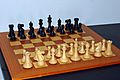
The International Olympic Committee recognises some board games as sports including chess.
-

Show jumping, an equestrian sport
-

Motorised sports have appeared since the advent of the modern age.
-

Swimmers perform squats as warm-up exercise prior to entering the pool in a U.S. military base, 2011
-

International level female athletes at ISTAF Berlin, 2006
-

A runner gives a friendly tap on the shoulder to a wheelchair racer during the Marathon International de Paris (Paris Marathon) in 2014.
-

Spectators at the 1906 unofficial Olympic Games
-

These lights at the Melbourne Cricket Ground indicate the decision the third umpire makes following a review.
See also
 In Spanish: Deporte para niños
