
The Nutcracker and the Mouse King facts for kids

"The Nutcracker and the Mouse King" (German: Nussknacker und Mausekönig) is a famous literary fairy tale written in 1816 by the German author E. T. A. Hoffmann. It tells the magical story of a young girl named Marie. Her favorite Christmas toy, a Nutcracker, comes to life. After a brave battle where he defeats the evil Mouse King, the Nutcracker takes Marie to a wonderful kingdom filled with dolls. The story was first published in Berlin in German. Later, in 1892, the Russian composer Pyotr Ilyich Tchaikovsky and choreographers Marius Petipa and Lev Ivanov used a version of the story by Alexandre Dumas to create the beloved ballet The Nutcracker.
Contents
The Magical Story of the Nutcracker
On Christmas Eve, at the Stahlbaum family home, Marie and her siblings receive many gifts. Their godfather, Drosselmeier, who is a clever clockmaker and inventor, gives them a clockwork castle. It has tiny mechanical people moving inside. But the children soon get bored with it. Marie then sees a special nutcracker and asks about him. Her father says he belongs to everyone, but Marie can be his special caretaker because she likes him so much.
The children use the nutcracker to crack nuts. Marie's brother, Fritz, tries to crack a nut that is too big. The nutcracker's jaw breaks. Marie is very sad and bandages him with a ribbon from her dress.
When it is bedtime, the children put their Christmas gifts away. Marie asks to stay with the nutcracker a little longer, and her parents agree. She tells the nutcracker that Drosselmeier will fix his jaw. At that moment, the nutcracker's face seems to frown, and his eyes flash. Marie feels a bit scared but thinks it was just her imagination.
The grandfather clock starts to chime. Marie believes she sees Drosselmeier sitting on top of it. Then, mice begin to appear from under the floorboards. Among them is the seven-headed Mouse King. The dolls in the toy cabinet suddenly come alive! The nutcracker takes charge, wearing Marie's ribbon, and leads them into battle against the mice. The mice are too strong. Marie sees the nutcracker about to be captured. She quickly throws her slipper at the Mouse King. After this, she faints and hurts her arm on the toy cabinet's glass door.
_(14778830311).jpg)
Marie wakes up in her bed the next morning. Her arm is bandaged. She tries to tell her parents what happened, but they do not believe her. A few days later, Drosselmeier arrives with the nutcracker, whose jaw is now fixed. He tells Marie a story about Princess Pirlipat and Madam Mouserinks, the Queen of the Mice. This story explains why nutcrackers look the way they do.
The Story of Princess Pirlipat
Madam Mouserinks once tricked Princess Pirlipat's mother. She and her children ate all the lard meant for the King's dinner sausage. The King was furious with Madam Mouserinks for ruining his meal. He asked his inventor, Drosselmeier, to create traps for the Mouse Queen and her children.
Madam Mouserinks was very angry about her children's deaths. She swore to get revenge on Princess Pirlipat. Pirlipat's mother surrounded her with cats to protect her. But the nurses who were supposed to keep the cats awake fell asleep. Madam Mouserinks used magic to make Pirlipat ugly. She gave the princess a huge head, a wide grinning mouth, and a cottony beard, just like a nutcracker.
The King blamed Drosselmeier. He gave him four weeks to find a cure. Drosselmeier went to his friend, the court astrologer. They read Pirlipat's horoscope. They told the King that the only way to cure her was for her to eat the nut called Crackatook. A special man had to crack it and give it to her. This man must never have shaved or worn boots since birth. He also had to hand her the nut kernel without opening his eyes and then take seven steps backward without stumbling. The King sent Drosselmeier and the astrologer to find both the nut and the man.
The two men searched for years without success. They returned home to Nuremberg. There, they found the special nut with Drosselmeier's cousin, a puppet-maker. His son turned out to be the young man needed to crack the Crackatook. The King promised Princess Pirlipat's hand in marriage to whoever could crack the nut. Many men tried and broke their teeth. Finally, Drosselmeier's nephew cracked it easily. He gave it to Pirlipat, who swallowed it and became beautiful again.
But as Drosselmeier's nephew took his seventh step backward, he stepped on Madam Mouserinks and stumbled. The curse then fell upon him, turning him into a nutcracker. Princess Pirlipat, seeing how ugly he had become, refused to marry him. She banished him from the castle.

Marie's Continued Adventures
While Marie recovers from her hurt arm, she hears the Mouse King whispering at night. He is the son of the now-gone Madam Mouserinks. He demands her sweets and dolls. She gives them up, but he keeps wanting more. Finally, the nutcracker tells Marie that if she gets him a sword, he will defeat the Mouse King. Fritz gives her a sword from his toy hussars.
The next night, the nutcracker visits Marie's room. He brings the Mouse King's seven crowns. He then takes her to the magical doll kingdom. They travel through the sleeve of her father's coat. Marie sees many wonderful things there. She feels like she is floating higher and higher. Suddenly, she falls and finds herself back in her bed. She tries to tell her mother what happened, but again, no one believes her. Even when she shows them the seven crowns, her parents forbid her from talking about her "dreams."
One day, Marie sits in front of the cabinet while Drosselmeier fixes one of her father's clocks. She promises the Nutcracker that if he were ever truly real, she would never act like Princess Pirlipat. She would love him no matter what he looked like. Then, there is a loud bang, and she faints, falling from her chair. Her mother comes in to announce that Drosselmeier's nephew has arrived from Nuremberg. By promising to love him despite his appearance, Marie broke the curse. The nutcracker became human again! He asks her to marry him. She accepts. A year and a day later, he takes her away to the doll kingdom, where she is crowned queen.
How the Story Was Published

The story first appeared in 1816 in a German collection called Kinder-Märchen (Children's Stories). It had 14 chapters, perhaps meant to be read over the 14 days between Christmas and a holiday called Epiphany. The title page even had a drawing of the Mouse King by Hoffmann himself. The part where Godfather Drosselmeier tells Marie the story of the Hard Nut is a "story within a story." This part is often left out of the ballet versions.
The story was later republished in Hoffmann's collection The Serapion Brethren. This collection included discussions among fictional characters about the stories. Hoffmann wanted to create a new kind of fairy tale for smart, imaginative children. He believed children could understand deeper meanings than adults sometimes thought.

In 1833, a part of the story, "The Fairytale of the Hard Nut," was published in English in a British newspaper. The first full children's version in Britain was by Ascott R. Hope in 1892. Later, in 1916, a British adaptation removed all German references due to World War I. The original author, Hoffmann, was not even mentioned.
The story was fully published in the U.S. in 1853. In 1930, an edition by Whitman and Company changed Hoffmann's ending. In this version, Marie's love did not restore the Nutcracker to human form, and they did not return to the doll kingdom. This change might have been to match the "sweetened" story often seen in the ballet.
Storytelling Secrets: Literary Devices
Hoffmann used many clever ways to tell his story. These ideas have become important in children's fantasy books.
Portal Fantasy
This is when characters enter a magical world through a special doorway. In Nutcracker, Marie and Drosselmeier's nephew enter the Kingdom of the Dolls through the sleeve of her father's fur coat. This is similar to Lucy entering Narnia through a wardrobe in C.S. Lewis's books. It also reminds us of Alice falling down the rabbit hole in Alice in Wonderland or the children going to Hogwarts through Platform 9¾ in the Harry Potter books.
.png)
Marie becomes small enough to enter the coat sleeve without needing any magic potions. Her young age also doesn't stop her from marrying the Nutcracker (now a king) and becoming queen. The story simply accepts these magical changes.
Eye Candy and Sweet Worlds
As Marie explores the Kingdom of the Dolls, she is amazed by sugar-coated fruits, houses made of sweets, and rivers of lemonade. These delightful sights were meant to thrill young readers. Similar sweet worlds appear in books like Roald Dahl's Charlie and the Chocolate Factory, where Charlie visits a magical chocolate factory.
Nonsense and Magic
At the start of the "Hard Nut" story, Godfather Drosselmeier recites a long series of strange clock sounds and odd phrases. This almost hypnotic chant helps signal a shift from the ordinary world to a fantastical one. Famous authors like Lewis Carroll (Through the Looking Glass) and George MacDonald (The Princess and the Goblin) also used nonsense in their stories to create a sense of magic and wonder.
Inviting the Reader to Imagine
The narrator in Nutcracker directly speaks to the audience, asking them to imagine the Christmas scene. This invites readers to use their own minds to help create the story's magic. It encourages them to see the "most splendid and wondrous things" with their own "eyes to see them."
A New Life in a Magical World
In many children's fantasy stories, like The Wizard of Oz, the main characters eventually return home. Marie does return to her bed after her first visit to the doll kingdom. However, after the Nutcracker (now the king) takes her there as queen, she stays. This suggests a permanent, wonderful new life in the magical world.
The Dumas Version and the Ballet

Alexandre Dumas, père, a French author, admired Hoffmann's story. He adapted it for a French audience, calling it Histoire d'un casse-noisette (The Tale of the Nutcracker). This version was published around 1844 or 1845. Dumas likely used an earlier French translation to help him. His adaptation included many illustrations by Bertall, which made the story even more appealing.
Dumas made it clear that Hoffmann was the original author. He often used a storytelling style where he told the tale to a group of children. This made his version very popular with young readers.
Dumas's adaptation is often described as a "sweeter" or "simpler" version of Hoffmann's original. This is especially true for the famous 1892 The Nutcracker ballet, which was based on Dumas's story. For example, the ballet added a scene where children emerge from under Mother Ginger's large skirt to dance.

However, Dumas also added vivid details to his story. For instance, he described Drosselmeier (whom he called Drosselmayer) as having lost an eye. In the battle with the Mouse King, Dumas included descriptions of mice being harmed by a toy cook and one doll being broken. He also added more emotional moments, like Marie crying out her love for the Nutcracker when he was in danger.
One small difference is that in Hoffmann's story, Princess Pirlipat's rescuer must never have worn boots. In Dumas's version, this was reversed, and the rescuer must always have worn boots. This detail might represent the idea of growing into manhood.
Dumas's version was important because it made the story more accessible to children and became the foundation for the world-famous Nutcracker ballet.
Other Inspirations
_(14780398774).jpg)
Hoffmann's story drew from older European folk tales. For example, the name Drosselmeier might come from "King Thrushbeard" ("König Drosselbart"), a story where a princess learns to love a king despite his looks. This is similar to Marie falling in love with the Nutcracker even when he looks like a toy.
The number seven appears many times in the story. The Mouse King has seven crowns, and the Mouse Queen had seven children. Drosselmeier's nephew had to take seven steps backward. Marie herself is seven years old in the story. This number often has special meaning in fairy tales.
Hoffmann also used ideas from common hero stories, like "The Dragon Slayer." In these tales, a hero is wounded while saving a princess, defeats a monster, and then marries her. In Nutcracker, the Nutcracker is the hero, Marie helps him in battle, and both are hurt.
Unlike many children's stories of his time, Hoffmann's Nutcracker did not try to teach strict lessons or scare children into behaving. Instead, it celebrated friendship, loyalty, and cleverness. This gentler approach might have been inspired by thinkers like Jean-Jacques Rousseau, who believed in more understanding ways of raising children.
Adaptations of the Nutcracker Story
The story of The Nutcracker and the Mouse King has inspired many different works:
- Composer Carl Reinecke created eight musical pieces based on the story as early as 1855. These pieces were performed with narration.
- The Nutcracker (Histoire d'un casse-noisette, 1844 or 1845) by Alexandre Dumas, père, is a retelling that became the basis for the 1892 Tchaikovsky ballet. In most ballet versions, Marie's name is changed to Clara.
- The Enchanted Nutcracker (1961) was a made-for-TV musical starring Robert Goulet and Carol Lawrence.
- The Nutcracker (Polish: Dziadek do orzechów) is a Polish film from 1967.
- The story was adapted into the 1979 stop motion film Nutcracker Fantasy, the traditional animation films Schelkunchik (Russia, 1973), and The Nutcracker Prince (Canada, 1990).
- In 1988, Care Bears Nutcracker Suite was based on the story.
- A BBC Radio adaptation by Brian Sibley was broadcast in 1991, featuring Tony Robinson as "The Nutcracker."
- The Nutcracker Prince is a Canadian 1990 animated film with Kiefer Sutherland as the Nutcracker/Hans and Megan Follows as Clara.
- In Mickey Mouse Works, the Mickey Mouse Nutcracker (1999) featured Minnie Mouse as Marie and Mickey as the Nutcracker.
- In 2001, a CGI-animated movie, Barbie in the Nutcracker, starred Barbie as Clara/Sugarplum Princess.
- A German animated direct-to-video version, The Nutcracker and the Mouse King, was released in 2004, with Leslie Nielsen as The Mouse King.
- Tom and Jerry: A Nutcracker Tale is a 2007 animated film.
- In 2010, The Nutcracker in 3D – a live-action film – was released.
- In 2012, Big Fish Games published a computer game Christmas Stories: The Nutcracker.
- Puella Magi Madoka Magica the movie: Rebellion (2013) uses themes and imagery from the story, including "The Nutcracker Witch."
- In November 2014, The House Theatre of Chicago adapted the story for the stage.
- On December 25, 2015, German television aired a new live-action adaptation as part of the 6 auf einen Streich series.
- In 2016, the Hallmark Channel presented A Nutcracker Christmas film.
- Disney's 2018 live-action film The Nutcracker and the Four Realms is a retelling of the story.
- In 2021 and 2022, PBS broadcast The Nutcracker And The Mouse King, John Mauceri's reimagining of the story, narrated by Alan Cumming.
- In 2023, Erika Johansen's novel The Kingdom of Sweets offered a new version of the story with twin sisters.
- In 2005, the painting "The Nutcracker – Christmas Eve Is Here At Last" by Elena Vladimir Baranoff was inspired by Hoffmann's tale and Tchaikovsky's music.
Images for kids
-
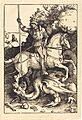
Saint George Killing the Dragon, woodcut by Albrecht Dürer (1501)

See also
 In Spanish: El cascanueces y el rey de los ratones para niños
