
Arctic ringed seal facts for kids
Quick facts for kids Arctic ringed seal |
|
|---|---|
 |
|
| Conservation status | |
Scientific classification  |
|
| Kingdom: | Animalia |
| Phylum: | Chordata |
| Class: | Mammalia |
| Order: | Carnivora |
| Clade: | Pinnipedia |
| Family: | Phocidae |
| Genus: | Pusa |
| Species: | |
| Subspecies: |
P. h. hispida
|
| Trinomial name | |
| Pusa hispida hispida (Schreber, 1775)
|
|
The Arctic ringed seal (Pusa hispida hispida) is a type of ringed seal. These seals live in the Arctic Ocean. They are the most common and widespread seals in the Northern Hemisphere.
Ringed seals are the smallest true seals. They get their name from the light rings on their dark grey fur. Polar bears, Arctic foxes, and killer whales often hunt them. Arctic ringed seals usually live for 15 to 28 years. People living in the Arctic have hunted these seals for food for a very long time.
Since 2012, Arctic ringed seals have been listed as threatened. This means their numbers are decreasing. They are losing their homes because of melting ice and snow.
Contents
About Arctic Ringed Seals
The Arctic ringed seal looks a lot like other ringed seals. It has a small head and a snout like a cat. Its body is plump and oval-shaped.
Its fur is dark with a silver belly. It has silver rings on its back and sides. This is why it's called a 'ringed seal'. They have strong claws on their front flippers. They use these claws to make breathing holes in the ice.
Adult seals can be 100 to 175 cm (39.5 to 69 inches) long. They weigh from 30 to 140 kg (70 to 310 lb). On average, they are about 1.5 meters (5 feet) long. They are the smallest seals in the true seal family.
Where Ringed Seals Live
Arctic ringed seals live all around the Northern Hemisphere. They are found in most seas that have ice during parts of the year. This subspecies is the most common of all ringed seals.
Their homes are divided into five main areas:
- The Greenland Sea and Baffin Bay
- Hudson Bay
- The Beaufort Sea
- The Chukchi Sea
- The White, Barents, and Kara Seas
It is hard to count all the seals. This is because their homes are far away. Also, they spend a lot of time under the ice. Scientists think there are about 1 million seals in the Beaufort and Chukchi Seas.
Life on the Ice
Arctic ringed seals are special because they can live on ice. The amount of ice affects their lives a lot. It changes where they move, what they eat, and how they raise their young. It also affects how safe they are from predators.
When water freezes in late fall, seals breathe in open water. When the ice gets too thick, they use their claws to make breathing holes. They can keep these holes open even in ice that is 2 meters (6.5 feet) thick.
They build snow caves called "subnivean lairs" over these holes. They use these lairs mainly to give birth and nurse their pups. The snow caves protect the pups from cold and from predators. Seals often return to the same breeding spots each year.
As it gets warmer, seals lie on the ice near their breathing holes. More seals appear on the ice surface as the snow melts in spring. Ringed seals are usually alone. But they might gather in groups around breathing holes when they shed their fur in spring.

Seal Life and Habits
Raising Young Seals
Male ringed seals can start having pups as early as 3 years old, but sometimes as late as 7. Females can start as early as 3, but sometimes as late as 9. Ringed seals have one pup each year. Pups are usually born in late March or April in the Arctic.
Mating happens while females are still nursing their pups. It is thought to happen near the birth lairs. Males might protect their areas during breeding season. They make a strong smell to mark their breathing holes and lairs.
After about 9 months, the female seal gives birth to one pup. Pups are about 60-65 cm (23-25 inches) long and weigh 4.5-5.0 kg (10-11 lb) at birth. They are born with a white coat of fur called "lanugo". This fur keeps them warm until they shed it after 4-6 weeks.
Pups nurse for up to 2 months in stable ice. In moving ice, they nurse for 3-6 weeks. During nursing, pups spend half their time in the water. They practice diving deep. Pups are usually weaned before the spring ice breaks up. They are four times their birth weight when they stop nursing. Ringed seals live for about 25-30 years. They are mostly solitary, meaning they live alone.

What Seals Eat
Ringed seals eat many different small animals. Scientists don't fully agree on their exact diet. What they eat depends on where they are, the season, their age, and their sex.
Arctic cod is often their main food. They also eat Herring, redfish, snailfish, sand lance, and Atlantic salmon. In spring, when they are mating and shedding fur, shrimp and other small sea creatures become more important.
In summer and fall, they eat fish like sand lance. This helps them build up fat for winter. In late fall through spring, cod family fish make up more of their diet. If females don't get enough fat, they might not have a pup that year. This makes sure they have enough energy for reproduction.
Seals usually hunt alone. They can dive 35 to 150 feet deep. They can stay underwater for up to 39 minutes. Some studies say seals swallow small fish whole. Others suggest they filter food with their teeth.
Who Hunts Seals

Polar bears are the main predators of ringed seals. Seal pups are easy targets for polar bears. Studies show that ringed seals are the main food for polar bears.
Snow lairs offer some protection. But Arctic foxes are also a threat. Foxes can enter the lairs and eat the pups. They also eat seal remains left by polar bears. Greenland sharks and sometimes Atlantic walruses might also hunt seals in the water.
Pups have special ways to avoid being eaten. They practice diving. They use breathing holes. Their white fur (lanugo) helps them hide. And they can hide in snow caves.
Protecting Arctic Ringed Seals
Main Dangers
The biggest danger to ringed seals is losing their home. This is happening because of climate change. Ringed seals need floating sea ice to have their pups. So, they are very sensitive to warming ocean temperatures.
The Arctic is warming faster than other places. This is because of the albedo effect. When snow and ice melt, less sunlight is reflected. More sunlight is absorbed by the water, making it even warmer.
Scientists predict big drops in sea ice after 2050. It would take many years for the ice to grow back. Losing ice for many years makes it unlikely the Arctic will return to how it was. This would be very bad for seals' reproduction and hunting.
Ringed seals have only one pup each year. This makes them very sensitive to environmental changes. They need enough snow and stable ice to build their birth lairs. Warming temperatures affect this habitat. This can shorten the time pups have to grow safely. By 2100, scientists think there won't be enough snow in April for lairs. This could lead to more pups and adult seals dying.
Another issue is ocean acidification. This means the ocean water is becoming more acidic. The Arctic waters are very sensitive to this. Ocean acidification could harm the small creatures seals eat. This would then affect the seals' food supply.
Seals and Humans
,_%27Ring-Seal%27.jpg)
Humans have hunted ringed seals for thousands of years. For indigenous people in the Arctic, seals have always been an important food source. Old sites in Arctic Canada show that people hunted ringed seals as far back as 300-3500 BC. They are still important for many northern communities. People hunt them for food in a way that does not harm their numbers.
However, there are other human-related threats. These include:
- Commercial fishing
- Ship traffic
- Oil drilling
- Pollution
- Human-caused global warming
Ringed seals are also in danger from oil spills. Oil drilling in their habitat threatens their health and safety.
What is Being Done to Help
In the United States, Arctic ringed seals have been listed as threatened since 2012. This is under the Endangered Species Act. They are also protected by the Marine Mammal Protection Act. Only Alaskan Natives are allowed to hunt them for food.
In Russia, the Franz Josef State Nature Reserve protects large areas where seals live. This reserve covers parts of the White and Kara seas. These areas are home to many ringed seals. Also, there have been hunting limits and licenses for decades.
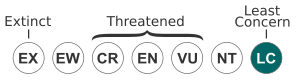
The IUCN Red List says ringed seals are a species of "Least Concern". This means they are not currently in great danger. However, the Red List suggests checking their status again within ten years. This is because of the impact of climate change on them.
Future Conservation Actions
Experts recommend actions to protect ringed seals, their land, and water. It is important to manage and protect their habitats. Getting "critical habitat" status under the Endangered Species Act would help their numbers recover. More research is needed on how many seals there are and where they live. This will help create better conservation plans.
Images for kids
-
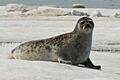
An Arctic ringed seal on the ice.
See Also
